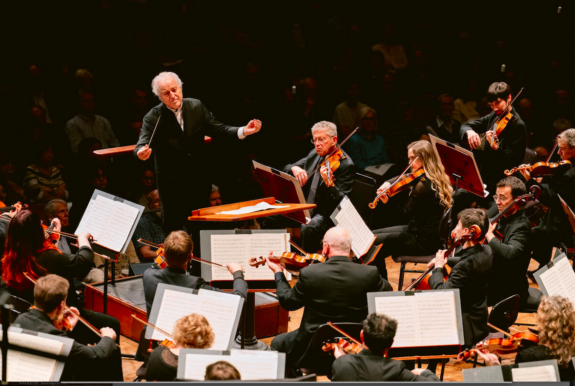
 United States Beethoven, Haydn, Mozart: Ying Fang (soprano), Sasha Cooke (mezzo-soprano), David Portillo (tenor), Stephano Park (bass), Adrian Roberts (narrator), San Francisco Symphony Chorus (director: Jenny Wong), St. Dominic’s Schola Cantorum (director: Simon Berry), San Francisco Symphony / Manfred Honeck (conductor). Davies Symphony Hall, San Francisco, 1.3.2026. (HS)
Beethoven – Coriolan Overture
Haydn – Symphony No.93 in D major
Mozart – Requiem in D minor
Most of us know Mozart’s Requiem in the version completed (and mostly orchestrated) by Franz Xaver Süssmayr, once the composer’s student and sometime copyist. The Requiem was left unfinished when Mozart died in 1791, and two other would-be composers gave up on the task before Süssmayr took over.
Sharp ears have little trouble distinguishing between the material Mozart did orchestrate – the ‘Introitis’ and opening ‘Kyrie’ – and the parts either orchestrated or completed from sketches by Süssmayr. A Mozart he was not, but the patched-together piece has earned its place as one of the most-performed requiems in classical music.
Conductor Manfred Honeck, music director of the Pittsburgh Symphony, came up with a fascinating reimagining of this work. He limited the requiem material to the parts we know Mozart either drafted or sketched, omitting the ‘Sanctus’, ‘Benedictus’, ‘Agnus Dei’ and ‘Communio’. Then he expanded the presentation with several sacramental works by Mozart, Gregorian chants sung by an unseen chorus and a few recited texts.
This version debuted three years ago in Pittsburgh and was recorded for an album entitled Mozart’s Death in Words and Music. The San Francisco Symphony debut this past weekend made for a fascinating and oddly soothing meditation on death.
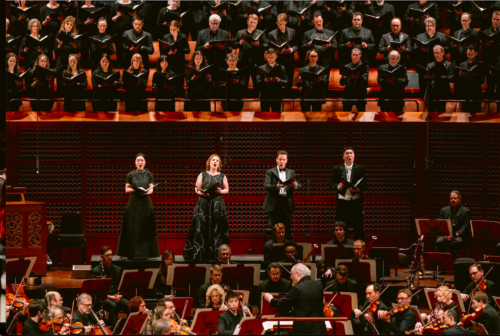
For ‘Imagining Mozart’s Funeral’, as the program called it, the Davies Symphony Hall stage was framed with flickering (electric) candles to set the scene for the hour-long production. The vocal casting didn’t hurt either, with the silvery gleam of Ying Fang’s soprano and Sasha Cooke’s expressive mezzo-soprano leading the way against the rock-solid foundation of bass Stephano Park. David Portillo’s lean, ringing tenor completed the quartet.
In the last of three performances, San Francisco Symphony Chorus delivered with its usual clarity and unforced expression and the orchestra, limited to Mozart dimensions, responded to Honeck’s stately tempos and careful phrasings. It all served to polish the ebbs and flows of the varied music and make it fit together in a dramatic arc.
The section preceding the actual Requiem music began quietly with three well-spaced chimes on middle D, executed by timpanist Edward Stephan to make them sound far away. St. Dominic’s Schola Cantorum intoned a Latin ‘Requiem aeternam’ to introduce an extract from a letter written by Mozart to his father expressing a feeling of peace about death. Actor Adrian Roberts, a regular with Oregon Shakespeare Festival and Berkeley Rep, did all the readings with grace.
The orchestra finally entered with Mozart’s ‘Masonic Funeral Music’, lending the somber piece a welcome richness. Gregorian chants, sung with reverence by San Francisco’s St. Dominic’s Schola Cantorum, preceded and followed a gorgeous ‘Laudate Dominum’ from Mozart’s Vesperae solennes de Confessore, a piece that often appears in concert, here sung with haunting beauty by Fang. Readings of ‘Who Knows Where the Stars Stand’ and ‘When in the Late Spring’ by Holocaust survivor Nelly Sachs led to the actual Requiem. Honeck sneaked into it with a quiet statement of the opening measures of the ‘Introitis’ before it blossomed into its majestic theme. He then found energetic definition in the fugue at the center of the ‘Kyrie’.
A reading from the Book of Revelation, the one about the pale horse and Death, led into the ‘Sequentia’ of six prayers. Most expressive were the ‘Dies Irae’, the ‘Tuba mirum’ and the lovely ”Lacrimosa which the chorus shaped with gentle warmth.
A final Gregorian chant (‘Christus factus est’) and another reading from Revelation 21, the one that describes ‘a new heaven and a new earth’, led to the ‘Offertorium’. That concluded with a reprise of the first eight bars of the ‘Lacrimosa’, which is all Mozart wrote of it before he died. As the music faded away, Honeck held a silence for long seconds before finishing with the chorus singing a cappella ‘Ave verum corpus’ the sublime motet written shortly before Mozart’s death.
The stage lights faded on the same three chime strokes that began the performance, and the audience’s response was strong.
Before the Requiem, concertmaster Alexander Barantschik delivered a short but heartfelt dedication of this performance to Joshua Robison, who died earlier that week. Robison, the husband of former music director Michael Tilson Thomas, was a fixture in the orchestra’s family and often involved in major projects such as semi-staged operas.
The first half of the program began with a heroic performance of Beethoven’s Coriolan Overture which begins with three loud chords, a nice foreshadowing of the three chimes in this Requiem presentation. Haydn’s joyful Symphony No.93, written in the same year as Mozart’s death and also in D major, made a suitable contrast to the profundity of the Requiem.
Harvey Steiman
Featured Image: Conductor Manfred Honeck and the San Francisco Symphony in Mozart’s Requiem © Kristen Loken