 United Kingdom Gilbert & Sullivan, The Gondoliers: Soloists, Chorus and Orchestra of English Touring Opera / Jack Ridley (conductor). Hackney Empire, London, 11.4.2026. (JR)
By the late 1880s W.S. Gilbert and Arthur Sullivan had already achieved great success with HMS Pinafore and The Mikado; but their relationship began to deteriorate (in particular over what became known as the ‘carpet quarrel’, a dispute over expenses at the Savoy Theatre). Luckily Gilbert and Sullivan got together again to create The Gondoliers, which was their last real success (After that they went on to write Utopia Limited and The Grand Duke, neither achieving lasting popularity).
The plot is daft, as so often the case in opera, not only in G&S: two Venetian gondoliers, Giuseppe and Marco, discover that one of them is the rightful king of a distant (fictional) land, Barataria, but nobody seems to know which one. Until the truth is sorted out, they try to run the kingdom on egalitarian principles where everyone is equal. One of them, however, appears to have been married off as an infant to the daughter of a scheming duke, who sees her future as a queen. In the end identities are untangled, the true king is revealed and all the romantic mix-ups are happily resolved. (The whole thing could today be settled by a DNA test, but a bit of spit does not an opera plot make).
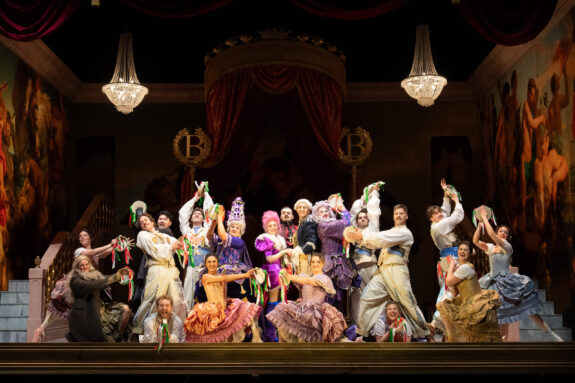
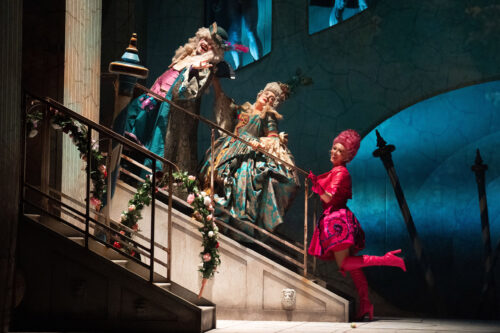
Act I is set in Venice, complete with a moving gondola, a blue and white striped bricola (stake), a backdrop of naked male statues and a set of stairs which turn out to be very versatile, particularly when transformed into a ship on which the gondoliers sail off at the end of the act to Barataria. Act II is set inside the Royal Palace in Barataria: a sumptuous backdrop of frescoes and regal props. The torture chamber is wheeled on towards the end of the opera and is a real coup de théâtre; it had the whole audience in hysterics – nobody expects the Spanish Inquisition. The set design and props could be the envy of many a distinguished major opera house, so full marks to English Touring Opera for transforming The Hackney Empire.
The Hackney Empire, in East London, opened in 1901 with the aim that art and culture should be available to everybody. Until 1956 it was run as a theatre and music hall; it then became a television studio, then from 1963 to 1984 as a bingo hall. Nearly demolished in the 1980s to become a car park, after a public fund-raising campaign, it reopened in 1986 as a permanent performance space. It closed in 2001 for over three years for renovation, and is now a Grade II* Listed Building. English Touring Opera has used the Hackney Empire as its regular London base for over 30 years. It is a real gem.
The predominantly young and mainly British singers were all of very sound quality, so much so that I hesitate to highlight any of them. However, Isabelle Atkinson shone from the outset as Fiametta and her movement down the steps showed her balletic skills. Lauren Young’s Duchess was a firm mezzo-soprano, and her almost final high top note, a B-flat, in ‘On the day when I was wedded’ was spot on. Phil Wilcox as the Duke impressed with his thespian and comedic skills. I liked George Robart’s light baritone, but pick of the bunch, for me, was tenor Robin Bailey as Marco, a firm and mellow voice: I was not surprised to read he was a founding member of VOCES8. Matthew Siveter’s rich baritone and clear diction also impressed. They were supported by a small and enthusiastic chorus; whilst it was helpful to have surtitles for the text of all the songs.
The whirling choreography and stage movement, particularly in the cachucha, was spectacular throughout, a real highlight. Full marks to director Liam Steel for bringing a dance-operetta approach and intricate comic timing to this work.
The small orchestra (of around 24) fizzed through the overture at the hands of Jack Ridley, who proved full of energy. They were sensitively amplified; balance and ensemble were never in doubt.
English Touring Opera is vital to bring opera to parts of the country which other opera companies do not reach. It has a stable, if not huge, Arts Council annual grant.
This production opened in Sheffield at the Lyceum Theatre last month, ETO’s newest venue. It then went to Cheltenham before reaching London. The production (along with Pagliacci) will now tour to Buxton, Norwich, Chester, Canterbury, Cambridge, Truro and Durham. Don’t miss this joyous entertainment – I guarantee you will have a smile on your face from start to finish.
John Rhodes
Featured Image: English Touring Opera’s The Gondoliers © Richard Hubert Smith
Cast:
Duke of Plaza-Toro – Phil Wilcox
Duchess of Plaza-Toro – Lauren Young
Luiz – George Robarts
Casilda – Kelli-Ann Masterson
Don Alhambra del Bolero – Matthew Siveter
Marco – Robin Bailey
Giuseppe – Samuel Pantcheff
Gianetta – Natasha Agarwal
Tessa – Beth Moxon
Fiametta – Isabelle Atkinson
Giulia – Phoebe Smith
Vittoria – Sarah Winn
Inez – Judy Louie Brown
Annibale – Jonah Halton
Francesco – Harry Grigg
Antonio – John Ieuan Jones
Georgio – Wonsick Oh
Production:
Director – Liam Steel
Set designer – Michael Pavelka
Costume designer – Laura Jane Stanfield
Lighting designer – Zeynep Kepekli
Would love to see you over the water in Northern Ireland. Pleeeease!