 Germany Staatsballet Berlin’s Nureyev: Vocalconsort Berlin, Orchestra of the Deutsche Oper Berlin / Dominic Limburg (conductor). Filmed at the Deutsche Oper Berlin (directed by Miriam Hoyer) on 21.3.2026 and available on ARTE Concert until 30.3.2031. (JPr)

2026 has no particular anniversary significance to Rudolf Nureyev but (apparently) in front of an audience full of the world’s ballet elite Yuri Possokhov and Kirill Serebrennikov’s Nureyev has arrived in the ‘West’ courtesy of Staatsballet Berlin. As ever when there is any opportunity to remember him it will make balletomanes of the current generation more keenly aware of how important Nureyev was to those – now of advancing age – who actually saw him dance at anything near his prime. It is 88 years since his birth and 33 years since his premature death. I am confident we will never see his like again.
One part of Nureyev’s legacy is how he always gave male dancers – himself first and foremost – as much to do as possible in any new version of the classics. He may not have always got the balance perfectly right; but what he did was often thought-provoking and spectacular, as witnessed by his stagings of Sleeping Beauty (1975) and Romeo and Juliet (1977) for London Festival Ballet (as English National Ballet was then) and both of those I saw time and again. In fact, next season ENB will be reviving his Romeo and Juliet. There were several other evenings at the regular London Nureyev Festival seasons during the 1970s and 80s, as well as at Covent Garden. I also saw Nureyev dance in his wonderful Vienna Swan Lake which he created in 1964 and remains in their repertory to this day (review click here). It was one of my most memorable evenings ever at the ballet.
The provocative and innovative Kirill Serebrennikov is a name familiar to readers of opera reviews on Seen and Heard (indeed his recent Das Rheingold is reviewed here). In 2017, his Gogol Centre in Moscow was commissioned by the Bolshoi to create a full-length work about Nureyev’s life. Mere days before its proposed premiere it was cancelled but the reaction to a film of its general rehearsal caused the Bolshoi to change its mind and the premiere went ahead on 9 December 2017. However, Serebrennikov was not there as he was under house arrest charged with embezzling state funds. Controversially he was convicted in 2020 and got a suspended sentence, with a travel ban lifted, he left Russia for Berlin when Russia invaded Ukraine. Performances of Nureyev continued at the Bolshoi until 2023 when it was banned once more because it was deemed to promote ‘non-traditional values’ i.e. homosexuality.
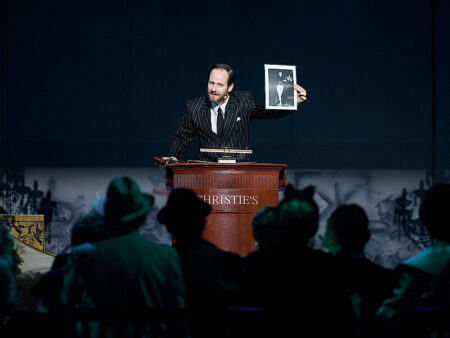
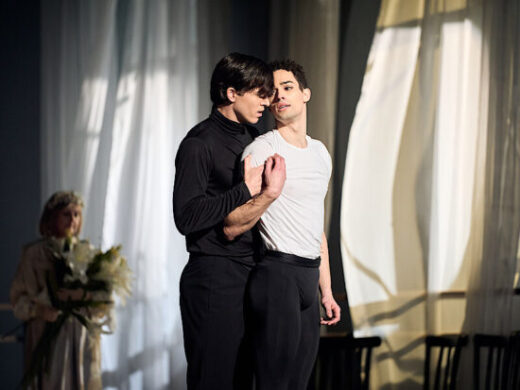
Nureyev begins with Christie’s auction in 1995 of items from the dancer’s homes in Paris, New York and elsewhere including his opulent furnishings, costumes, paintings and photographs. It provides the ballet’s framing device with Odin Lund Biron’s urbane Narrator (in the guise of the auctioneer speaking in English and French) announcing Lot 45, a set of 12 Josef Urban chairs, followed by Lot 17 (five rolls of wallpaper!) and ending poignantly with Lot 1272, the baton Nureyev used in the latter years. (However, the suggestion he conducted the Vienna Symphony Orchestra in London in 1991 is pure fiction.) Each passing lot allows us to witness a vignette from Nureyev’s colourful life as distilled by Possokhov and Serebrennikov’s imagination. From the way they move the auction is populated by some elderly ex-dancers and there is a tiaraed dowager figure in white cradling some lilies who drifts in and out of Nureyev’s story as we experience it. Who she is we, we never really know. I believe, she could be someone from Nureyev’s past, maybe his own mother, if not her, then possibly ‘Mother Russia’.
The Narrator is our guide through the high points of Nureyev’s life beginning with a ballet class at Leningrad’s Vaganova Academy in 1956 where a portrait of the Tsar is soon swopped for Lenin, then Stalin and finally Khruschev as the Soviet Union’s political landscape changes. We see Nureyev’s rise to prominence as well as his short fuse when a ballerina he partners does not meet his high standards. A Russian chorus singing a patriot song is the backdrop to Nureyev’s famous defection at Paris’s Le Bourget airport. As David Soares dances one of the (too?) many anguished and relatively earthbound solos we get, we hear the Narrator deliberately rush through a reading of the Soviet authorities’ official condemnation of the dancer they now considered a traitor. We see Nureyev embrace the more louche lifestyle Paris has to offer (emphasised by drag queens and a jazz band), before hearing some personal recollections by the dancers Charles Jude and Laurent Hilaire about Nureyev as Anthony Tette as The Student fluidly performs the despairing solo this time accompanied by Alexander Boldachev’s harp.
It is now October 1968 and we are in the New York City studio of foul-mouthed Richard Avedon for the infamous photo shoot where he demands ‘Not the legend, but the man’ and capturing that he did in all of the real Nureyev’s full-frontal photographic glory that was reflected more teasingly on the stage. Bringing the first act to a close was a tender love duet for Nureyev and Erik Bruhn (the languid Martin ten Kortenaar) to allusions – in Ilya Demutsky’s otherwise more Broadway-appropriate music – to Prokofiev’s Romeo and Juliet score. Poignantly we learn about Lot 875 and a letter Nureyev never sent to Erik with its ‘intimate and confidential’ contents.
Act II begins under chandeliers with the sale of stage costumes. As we hear the strains of Liszt’s music for their famous Marguerite and Armand ballet we recall, in their tenderly passionate duet, Nureyev’s famous partnership with Dame Margot Fonteyn (a fervid Iana Salenko). We are then whipped through – with too many costume changes for Soares’s Nureyev – an impression of his work as a choreographer including a display of his much-publicised volcanic temper as he disparages the dancers he is working with and shouts how the audience ‘come to see ME! Not you! Me in MY ballets!’ It was then the turn of Polina Semionova’s long-limbed fluency as The Diva to breathe life into the words of those ballerinas Nureyev partnered such as Natalia Makarova who Semionova clearly personified. (The music for this scene is based on Mahler’s Fifth Symphony Adagietto). Perhaps to showcase Nureyev opulent lifestyle in his Quai Voltaire Parisian apartment there is a Baroque fantasy replete with intoning countertenor; Nureyev is shown as the ‘Sun King’ and there are topless male dancers and a procession of male nude paintings.
An intriguing sequence brings Nureyev to its close with the desolation, loss of innocence and corruption of Pierrot Lunaire shown surrounded by more topless men in fetish-culture leather. This morphs into a reimagining of ‘The Kingdom of the Shades’ from La Bayadère but with both male and female dancers. As the background to this we hear not only Ludwig Minkus’s music but also a Tatarian lullaby being sung by mezzo-soprano Aleksandra Meteleva (Nureyev was of Tatar descent). It is at this point that Soares’s Nureyev takes the baton and goes down to the orchestra pit to ‘conduct’ some of the last ballet he worked on (review here). The music of Nureyev now drifts into a silence that is full of pathos.
Nureyev is a beautiful production, beautifully danced by the Staatsballet Berlin company – I understand – about half the size of that at the Bolshoi when they put it on. Even then the Deutsche Oper stage seemed crowded, and the eye often searched for Nureyev himself, especially in the scenes which implied Kirill Serebrennikov was more concerned in critiquing Russia’s authoritarian regime and its prejudices. The dancers had excellent support from all the solo singers, the Vocalconsort Berlin, musicians on the stage, and the Orchestra of the Deutsche Oper Berlin under conductor Dominic Limburg.
Since this ballet has the support of the Rudolf Nureyev Foundation a critical assessment of the outré life of the great dancer could not be expected. Indeed, through the slender David Soares’s performance we see something of (the more-muscular) Nureyev’s spirit while the tortured soul of the lonely, driven, work-obsessed and adulation-seeking artist is not fully explored. And Yuri Possokhov’s choreography for Nureyev himself concentrates more on the tricksy, intricate footwork he was known for rather than his ability to leap higher, spin faster and land softer than most other dancers of his generation.
Jim Pritchard
Featured Image: With the mysterious figure in the background, Martin ten Kortenaar (Erik Bruhn) and David Soares (Nureyev) © Carlos Quezada
Creatives:
Choreography – Yuri Possokhov
Libretto, Staging and Set design – Kirill Serebrennikov
Music – Ilya Demutsky
Stage design assistant – Olga Pavluk
Costumes – Elena Zaytseva
Video – Ilya Shagalov
Lighting design – Daniil Moskovich
Rehearsal (dance) – Dana Genshaft, Tiit Helimets, Yannick Sempey
Rehearsal (direction) – Evgeny Kulagin, Ivan Estegneev
Cast:
Narrator – Odin Lund Biron
Mezzo-soprano – Aleksandra Meteleva
Baritone – Navasard Hakobyan
Countertenor – Iwan Borodulin
Harp – Alexander Boldachev
Nureyev – David Soares
The Student – Anthony Tette
The Diva – Polina Semionova
The Ballerina – Marina Duarte
Erik – Martin ten Kortenaar
Margot – Iana Salenko
The Baroque fantasy you mention is actually related to real events. While director at the Paris Opera, he took a keen interest in the dancing at the court of Louis XIV after seeing a performance of a baroque opera at the Royal Opera of Versailles, with dances recreated by a former etoile of the Paris Opera. He was keen to try his hand at these dances and worked hard to learn them. He eventually worked them into a solo show with appropriate costumes which he toured. For more detail, see the following link: https://nureyev.org/rudolf-nureyev-choreographies/rudolf-nureyev-bach-suite-lancelot/.
JP for S&H: I suspect you may be partially correct of course, though doubt that what Nureyev devised as a solo to Bach had much to do with what was seen here with all the nudity.