
Soprano Eleonora Djodjoska-Mladenova talks with Gregor Tassie
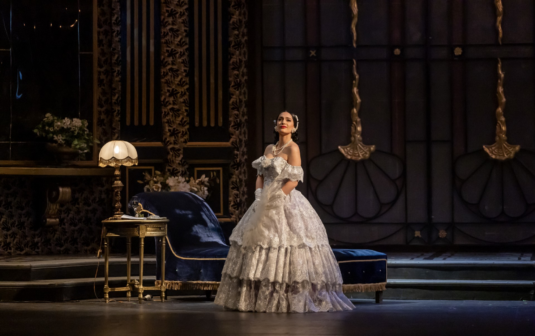
One highlight of the 2025 Wagner Festival in Sofia was the debut of young soprano Eleonora Djodjoska-Mladenova, who delivered a sensational Elisabeth in Plamen Kartaloff’s new Tannhäuser (review here). From first stepping on the stage, she seemed born for this role of an innocent girl falling in love. The singer from Northern Macedonia was acclaimed as an outstanding new star of the Sofia Opera. In 2026, reflecting Kartaloff’s trust, she was cast as the tragedienne Violetta Valéry — a role she triumphed in. Shortly after her La traviata debut (review here), I met with her to discuss her career to date.
Gregor Tassie: In 2024, you made your debut as Pamina in Die Zauberflöte, then last year, as Elisabeth in Wagner’s Tannhäuser, in which you made a great impression, and since then, you have gone on to be acclaimed as Violetta in La traviata. You were born in Northern Macedonia. Are you from a musical family, and what made you want to be a professional singer?
Eleonora Djodjoska-Mladenova: I was very fortunate to be chosen to sing the First Lady in the auditions for Die Zauberflöte and not even a year later to sing Pamina in the same production by Vera Petrova. I am the first professional musician in my family, even though some of the family members are very musical, but I guess they never saw music as a career opportunity. I started singing in local choirs and later when I was 13 years old I began training my voice professionally. I knew that being a singer was the thing I really wanted to pursue: in the beginning, not really knowing what I was getting myself into, but later on I realised I really did make the right decision. And my family was supportive every step of the way, even if it was new and strange to them too.
GT: You began studying at the Music Academy in Sofia with Ivanka Ninova. Was she a major influence on you?
EDM: In the Secondary School of Music in Bitola, North Macedonia, I started learning classical singing with Professor Maja Mitrovska, a student of Professor Ivanka Ninova, who has chosen to teach young singers exactly the way her professor did. So when the choice to continue my academic singing education was in front of me, it was only natural to come to Sofia and continue it with Professor Ninova, who, even though she didn’t know me as a person, it was as if she already knew my voice and how to further develop it. I chose to trust her completely, and in the five years of my academic education, she is the only person I have worked with besides her assistant Eva Perchemlieva. I continue to work and consult with them from time to time, because learning never stops.
I think it is very important to trust the person you are working with. Young singers often work with several people at the same time because of trust issues or maybe because of the feeling that in that way you will get to your goal faster. Sadly, it does not work that way, you can only get confused.
GT: You began singing in musicals by Alexander Vladigerov and other composers, but quickly went over to opera? Was this something you had already decided to do?
EDM: I always knew opera was my calling. Even when singing musicals or operetta, which was very fun to do, I knew that my focus is on opera and while experimenting with different genres I never let that change my focus.
GT: You started this phase of your career with operas by three quite different composers: Mozart, Wagner and Verdi. Do you think that these popular composers are your favourite, or do you want to sing in early baroque or in 20th-century opera, such as Richard Strauss, for instance?
EDM: As much as I love singing the pieces of the most popular composers, I would love to have the opportunity to sing something different from them, to challenge myself as a musician and test my limits, musically.
GT: The two roles of Elisabeth in Tannhäuser and Violetta in La traviata are quite different, both vocally and in character. Elisabeth is a young, innocent girl, while Violetta, despite her youth, is a courtesan. She is experienced in life, and has suffered from the society of men, but still believes in love, yet she can never fulfil her dream of a romantic future. How did you approach these two different roles? I have in mind the vocal aspect, from the light coloratura to the dramatic side of the voice, and the different characters of both women.
EDM: The role of Elisabeth in Tannhäuser is my first ‘close encounter’ with Wagner, and I fell in love with it from the very first notes. Of course, there was the doubt in everyone, including me in the beginning – am I too young to do it, will I manage to get over the musical obstacles and the psychological ones, so I decided to go one step at a time. Starting from just learning the music and then going deep into the text and the history of the piece and the characters, I had nearly 10 months to prepare for my performance. I worked on it with several people, and I took different bits and pieces from everybody. When we started the stage rehearsals, my husband Atanas Mladenov – who sang Wolfram – and I had so many discussions about the roles and their relationships, which helped me so much. About the musical part – I had to trust the process and be consistent in improving with every next rehearsal.
Violetta, on the other hand, is a role that I have dreamt of singing ever since I heard it for the first time, and it took my breath away. Up until the moment I had the opportunity to actually sing it I was scared of ‘touching’ it, but something in me said ‘you know you have it in you – just go for it’ and I did, knowing how hard the role is vocally and dramatically. It’s like it’s written for three different singers. I did not have as much time as for Elisabeth to prepare, but for the time I had, I was very focused on everything – from learning and memorising the role, to the endless musical and stage rehearsals and even the sleepless nights. The day of my debut was at the same time a very beautiful and scary experience. Right after the performance I didn’t waste any time and I made clear the points on which I should really work on for the next time that I have the opportunity to sing it. The work on the role continues and I wouldn’t want it any other way, even with the mistakes I make along the way.
I think that I have in me different parts of the different characters both women have, and that has helped me so much while working on them. And both Violetta and Elisabeth have some very important things in common: the strength to forgive, the spiritual purity and self-sacrifice.
And from these experiences, I have grown and learned that art really is for the brave ones, just like Maestro Kartaloff has told me many times while trusting me with these roles.
GT: Are there any models that you are guided by and did you listen to their recordings in helping you study these roles?
EDM: I really like listening to old recordings of singers, but I try to listen to them after I have learnt the role, even though I don’t always manage to keep myself from listening. For La traviata, for example, I really liked two different recordings – the first one a 1977 recording with Ileana Cotrubas and Plácido Domingo and the other a 1991 recording with Cheryl Studer and Luciano Pavarotti.
For Tannhäuser, I loved listening to a 1989 recording with Plácido Domingo and Cheryl Studer. Of course, I also like to listen to singers that are performing now.
GT: The baritone Atanas Mladenov who you are married to is one of Sofia Opera’s most distinguished singers, does he give you any special career?
EDM: He really is a distinguished singer! I really admire his professionalism and dedication to every single detail in everything he does. And besides being a great husband, he is a great colleague too. I feel like he is a singer that everyone feels comfortable singing with as a great partner, and that is because he is like that as a person, too. And he never tries to enforce his advice and opinions; he gives them if I am the one asking or when he really sees that I am struggling. And I always do ask, because not only does he sing beautifully, but he also has a good listening ear and can give great advice; either technical or vocal or just with a way to improve the piece I am trying to sing at the moment. He has more experience than I do, and I really appreciate his support, which he gives me unfailingly. He also is the first person that tells me when to stop, because I tend to overthink and overwork and he’ll cheer me up when I feel like I have fallen in a black hole and am struggling to find the right way when singing something. He’ll suggests something, I will try it and it usually works and he tells me to calm down because everything will work out. I really value and treasure that.
GT: What roles do you want to perform in the next seasons here? In any case, you have the guidance of other singers here and the director Maestro Kartaloff. How do you value the support of the Sofia Opera in launching your career?
EDM: I would really love to sing Liù in Turandot, Micaëla in Carmen, Nedda in Pagliacci and every different role that I could sing and that would be a plus for my growing vocally and as an artist. The support I have from my colleagues and Maestro Kartaloff is immense, and I really cherish that, especially being the youngest soloist in Sofia Opera. The trust he has in me and the support gives me the drive to work really hard and give the best version I have of myself for every role I do. And I am really grateful and appreciative of that because not many young singers have the opportunity I have. It really is important to have someone who trusts you and sees in you the things you are capable of doing and Maestro Kartaloff saw that in me, which I am really thankful for. That kind of support is everything a young singer could wish for but it is also very important to work hard to earn it and never stop working on yourself. Be the artist you are so that the support continues and the success grows!
GT: Thank you for your time and good wishes for the future.
Beautiful writing.