 Bulgaria Verdi, La traviata: Soloists, Ballet, Chorus and Orchestra of Sofia Opera and Ballet Theatre / Zhorzh Dimitrov (conductor). Sofia Opera Theatre, 8.4.2026. (GT)
Verdi’s eighteenth opera, La traviata, is the most popular of all his stage works since its premiere in 1853. It was first staged in Bulgaria in 1910 by the Sofia Opera Society, in a production by Mihaylov-Stoyan and conducted by Haydziev. This acclaimed revival of Plamen Kartalov’s 1996 production of La traviata is still a jewel in the company’s repertoire.
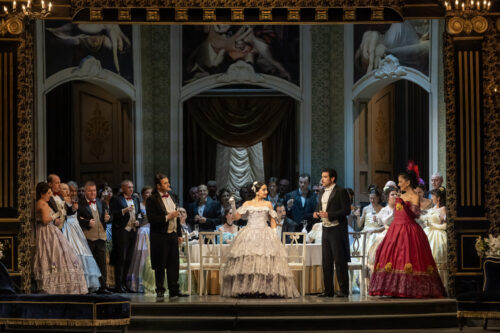
The underlying theme of the original play by Alexander Dumas, the younger’s La Dame aux camélias, as the composer noted to a friend, is ‘a scandal for our age.’ The decaying grandeur of 19th-century Paris, characterised by decadence in dark reds and blues, contrasts with the gloomy rooms of Violetta’s country home in Ivan Savov’s sets. The clash between the dreariness of this country home and the bright colours of the Act II ball was palpable, and superbly enacted by the lighting design of Andrej Hajdinjak and was pivotal to the underlying plot, invoking the sensuality of Violetta’s love and Alfredo’s lust for her, counter to the vileness of Parisian society.
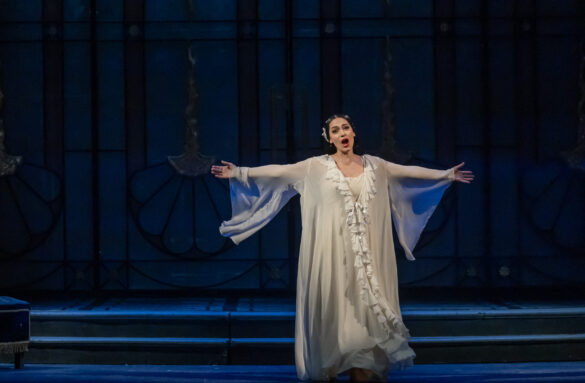
In the opening scene, Violetta is lying as if dead. Letters drop down upon her. She seizes one and reads it. The importance of letters for Violetta’s fate was poignantly shown, and this was reprised at the end. The second-act ball scene was superbly executed with magnificent dancing. It was evocative of the societal degradation of the era as it transformed to sexual intimacy — a brutally orgiastic display in an appearance of societal scandal. The tragedy of Violetta’s fate and her illness are palpable from the opening scene. Violetta’s exploitation by men can never bring her happiness, but only a lonely death. An innovative change by Plamen Kartalov to the usual close was that rather than dying in Alfredo’s arms, she retreats, arms aloft, approaching the great window as the closing bars bring the tragedy to a close.
The star, both vocally and dramatically, was in the magnificent portrayal of Violetta by Eleonora Djodjoska-Mladenova. This was tangible from her first aria, ‘Libiamo ne lieti calici’ The impression gained was as if she had been singing this role for years; this was most notable also in her show-stopping ‘Ah, for’se lui che l’anima’. Throughout, Djodjoska-Mladenova was sublime in the most testing and difficult arias – almost as if this role was made for her.
The other outstanding performance was the Germont of Ventseslav Atanasov with his remarkably noble and beautifully toned baritone; he was in complete identity with his rather hesitant role as the dutiful and honourable father of Alfredo. ‘Pura siccome un angelo’ in his appeal for Violetta to give up his son. His ‘Di Provenza il mar.’ was quite remarkable in sensitivity. There were no false gestures; everything was expressed vocally and in the emotion of his face and eyes. The Alfredo of the Venezuelan tenor Reinaldo Droz started brilliantly in the duet with Violetta, ‘Un di, felice, eterea’ and got even better throughout in a spell of deeply expressive and beautiful singing, notably in the cabaletta, ‘Sempre libera’ with Violetta. At first, he seemed a little reserved, yet he soon cast off any nerves to give an outstanding performance, often matching Djodjoska-Mladenova.
The cast included several impressive performances. Among them, Petar Buchkov’s Baron Douphol stood out as Violetta’s lover; once again, Buchkov was in magnificent voice, reminiscent of his Hagen in last year’s Götterdämmerung. Similarly, Blagovesta Mekki-Tsvetkova’s Annina was vocally excellent, particularly in the Act III duet ‘Parigi, o cara’. Tsveta Sarambelieva’s Flora was also outstanding, distinguished by her rich mezzo-soprano and characterisation. In addition, Angel Hristov’s Doctor Grenvil was in fine voice and performed with great tact.
Zhorzh Dimitrov’s masterly direction of the orchestra was excellent, bringing out every nuance of Verdi’s score with colour and verve and evincing the tragic drama unfolding on the stage. It was remarkable this is the first Bulgarian I have seen conducting here. The chorus was impressive once more as they were in Macbeth in February (review here). Prepared by Violeta Dimitrova, they were magnificent, bringing out all the splendour of Verdi’s choral writing; often sensational in the Spanish dances, and wittingly sarcastic of the social plight of Violetta. The costumes by Savov were in character for 19th-century Paris, colourful and proper for the decadent bourgeoisie of Parisian society. The Spanish dancers were stunning in their brief spell, spectacularly choreographed by Riolina Topalova, breaking up the debauchery of the scenes, and a stunning, evocative highlight of the evening.
Yet this evening belonged to Eleonora Djodjoska-Mladenova. Last year, on a memorable evening in Sofia’s new production of Tannhäuser, her portrayal of the young, innocent and pure Elisabeth (review here) was performed with astonishing assurance and mastery during the Wagner Festival. In her new role of Violetta, she affirmed that Sofia Opera has a young soprano who is already a star of extraordinary talent.
Gregor Tassie
Featured Image: Eleonora Djodjoska-Mladenova as Violetta Valéry © Svetoslav Nikolov
Production:
Director – Plamen Kartalov
Revival director – Vera Petrova
Set and Costume design – Ivan Savov
Choreography – Riolina Topalova
Lighting – Andrej Hajdinjak
Chorus master – Violeta Dimitrova
Cast:
Violetta Valéry – Eleonora Djodjoska-Mladenova
Flora Bervoix – Tsveta Sarambelieva
Annina – Blagovesta Mekki-Tsvetkova
Alfredo Germont – Reinaldo Droz
Giorgio Germont – Ventseslav Anastasov
Gaston de Letorieres – Hrisimir Damyanov
Baron Douphol – Petar Buchkov
Marches D’Obigny – Nikolay Voynov
Doctor Grenvil – Angel Hristov
Giuseppe – Slavi Manov
Commissioner – Anton Andreev