
 Germany Dresden Music Festival 2026 [1] – Various, ‘Countertenor meets Saxophone Quartet’: Xavier Sabata (countertenor), Kebyart (saxophone quartet – Pere Méndez [soprano sax], Víctor Serra [alto sax)], Robert Seara [tenor sax] and Daniel Miguel [baritone sax]). Palais im Grossen Garten, Dresden, 22.5.2026. (MC)
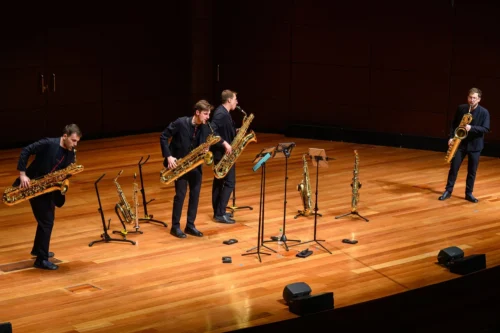
My first concert at the Dresden Music Festival 2026 was held in the visually picturesque Palais im Grossen Garten. Sustaining severe bomb damage in 1945 this historic building, situated in the great gardens, has been restored to hold concerts, exhibitions and public events. The festival often uses the Palais im Grossen Garten as one of its concert venues and it is one I have been pleased to attend on numerous occasions.
This international festival contains many varied concert programmes including this performance an all-Spanish affair. We heard an unusual combination of works sung by Spanish countertenor Xavier Sabata, Romantic and Impressionist music eras accompanied by the Spanish saxophone quartet Kebyart. Titled ‘I am an unusual thing – A songbook’ the programme included a mix of works spanning almost 350 years from Purcell to Widmann. I have reported on Sabata in concert most notably in 2019 in a programme of Vivaldi and Handel with soprano Sabina Puértolas from the Dresden Frauenkirche.
Due to the uncommon range of instruments my main concern was the saxophone sound being too weighty for accompanying a countertenor. I needn’t have worried as overall the balance was satisfying. Formed in 2014 saxophone quartet Kebyart was first on the stage. Chosen to open the concert was a work by Italian baroque composer Locatelli the first of his Sei Introduttioni Teatrali (Six Theatrical Introductions) Op.4. A delightful instrumental piece with the main melody played by Pere Méndez on his straight necked soprano saxophone.
It was the second work when Xavier Sabata appeared on stage, walking slowly, text in hand and began singing. The bald-headed, bearded Sabata was dressed in dark trousers together with a conspicuous silver dress shirt that shimmered in the summer sunlight that beamed through the windows.
Great Italian composer Vivaldi was represented by his celebrated aria Sovente il sole (Often in the Sun) from the serenata-pasticcio Andromeda Liberata based on Greek mythology. Perseus’s much-loved aria was sung by Sabata with a melancholic beauty. A highlight was Sabata’s performance of Der Lindenbaume (The Linden Tree) from Schubert’s masterwork Winterreise. It did surprise how well the countertenor voice so expressive and convincing suited this Romantic Lieder. In addition, a mélodie by French Late-Romantic and Impressionist composer Deodat de Severac Paysages tristes – Soleils couchants (Sad landscapes – Settings Suns) to verse by Verlaine was a success with Sabata radiating genuine feeling that I found eminently moving. Throughout the concert Sabata’s effortless artistry was palpable.
Of course, the countertenor voice is fundamentally connected with baroque music so in the second half it was interesting to hear Sabata take on 20th-century music notably Gershwin, Weill and Sondheim it was enjoyable but not my favourite part of the programme. It is worth singling out the terrific performance given to the first of Sabata’s encores the aria Let the Bright Seraphim from Handel’s oratorio Samson (1743).
I admit to being bowled over by the sound that Kebyart was able to create from the saxophones with such impressive unison and tone colour. From French baroque composer Rameau’s E minor Suite from his Second Book for harpsicord the two pieces Le rappel des oiseaux and Tambourin, arranged by Mathias Riise, demonstrated Kebyart’s excellence with music of the baroque. More striking playing of distinction was the sixteen-year-old Mozart’s Andante from his Divertimento, KV 138 with the puckish interplay of the saxophones so noticeable. Captivating were the three contrasting contemporary pieces Noises, Keys and Corale II from Widemann’s 7 Caprices written especially for the saxophone quartet. I have made a point to check out the complete set of Caprices.
This was an interesting and enjoyable concert by diligent countertenor Xavier Sabata accompanied by the equally hard-working saxophone quartet Kebyart. Not everything was to my particular taste although the Dresden audience seemed thoroughly entertained and applauded loudly.
Michael Cookson
Featured Image: Xavier Sabata © Michal Novak
‘I Am An Unusual Thing – A Songbook’
Locatelli – No.1 from Sei Introduttioni Teatrali (Six Theatrical Introductions) Op.4
Vivaldi – Sovente il sole (Often in the Sun) from pasticcio-serenata Andromeda Liberata, Anh. 117 (1726)
Rameau – Le rappel des oiseaux & Tambourin from E minor Suite from 2nd Book for Harpsichord (1724, rev.1731, arranged by Mathias Riise)
Purcell – O Solitude, my sweetest choice, Z 406 (c.1684, arranged by Mathias Riise)
Jorg Widmann – Noises, Keys & Corale II for saxophone quartet from 7 Caprices (2022)
Schubert – Der Lindenbaume (The Linden Tree) from Winterreise, D911
Deodat de Severac – Paysages tristes – Soleils couchants (c.1899)
Mozart – Andante aus Divertimento, KV 138 (1772)
Michael Nyman – I am an Unusual Thing
George Gershwin – The Man I Love
Stephen Sondheim – Losing my Mind from the musical Follies
Kurt Weill – Je ne t’aime pas (I don’t love you)
Plus encores