 Germany R. Schumann, Bartók, Zemlinsky: Soloists, Hamburg Philharmonic State Orchestra / Karina Canellakis (conductor). Hamburg State Opera, 20.5.2026. (DM-D)
Production:
Director – Tobias Kratzer
Revival director – Ludivine Petit
Sets and Costumes – Rainer Sellmaier
Video – Manuel Braun
Lighting – Michael Bauer
Dramaturgy – Henriette von Schnakenkurg
Casts:
Robert Schumann, Frauenliebe und -Leben
Soloist – Vera-Lotte Boecker
Piano – Joseph Middleton
Béla Bartók, Bluebeard’s Castle
Bluebeard – Johan Reuter
Judith – Annika Schlicht
Alexander Zemlinsky, A Florentine Tragedy
Simone – Johan Reuter
Bianca – Ambur Braid
Guido – Thomas Blondelle
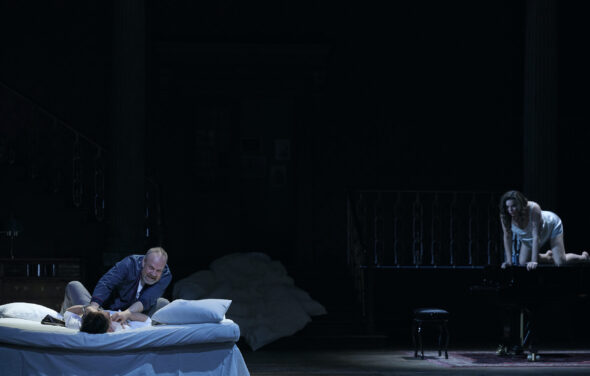
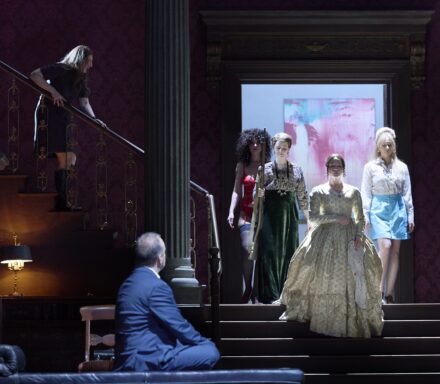
This production was first seen at Den Norske Opera in Oslo in 2024 and was now revived in Hamburg with a different cast. The title for the entire evening, Frauenliebe und – Sterben (A Woman’s Love and Dying) was inspired by the first of three works that made up the programme, Robert Schumann’s song cycle Op.42, Frauenliebe und -Leben (A Woman’s Love and Life). It was performed by pianist and soprano, with different performers across the season of eight performances: two each with Kate Lindsay and Éric Le Sage, Annette Dasch and Wolfram Rieger, Marlis Petersen and Stephan Matthias Lademann, and Vera-Lotte Boecker and Joseph Middleton. The song cycle charts the feelings of a young woman from falling in love, via marriage and children, until the death of her husband. Rainer Sellmaier created an indicative domestic context of stage, with plush sofa, and his costumes reflected financial independence and affluence, all located in the past around the time of the creation of the song cycle in 1840. Piano and pianist were part of that design: the event was a domestic concert, with some extras also dressed in period costumes embellishing the scene as servants or visitors. The space opened up for Bartók’s Duke Bluebeard’s Castle, and Johan Reuter, who was on the stage in the silent role as the admired and pivotal husband in the Schumann song cycle, turned into Bluebeard. In the third piece, Zemlinsky’s Eine Florentinische Tragödie (A Florentine Tragedy), Reuter was cast as Simone, a Florentine cloth merchant returning home early from an unsuccessful business trip only to catch his wife Bianca in the act of betrayal with Prince Guido. He pretends not to realise or care and seeks to sell some of his wares to Guido. In the process, Simone manages to provoke Guido to a duel. In the end, Simone strangles Guido. Bianca admires Simone’s strength and husband and wife reconcile. For this one-act opera, a large double bed was the central element on the stage around which the plot developed.
The design was thus indicative throughout, rather than naturalistic. Although of course different in terms of different contexts and contents, a personal style emerged that was familiar from Sellmaier’s designs for Das Paradies und die Peri (review here) and Monster’s Paradise (review here). It worked just as well here as it did with those other two productions directed by Tobias Kratzer. As with those, Kratzer’s attention to detail and carefully developed Personenregie enabled him to tell a cogently and faithfully thought-out, mature story.
Vera-Lotte Boecker was very moving as the loving girl turning wife turning mother turning widow, capturing all stages of this whirlwind tour of all of life’s deepest emotions with genuine openness and honesty, never in doubt about anything that was happening to her, not realising her passivity, her lack of agency.
For the two one-act operas, Karina Canellakis made her debut conducting opera in Germany. In 2025, she recorded Duke Bluebeard’s Castle on CD, and in the same year she conducted a concert performance of A Florentine Tragedy in Amsterdam. As with her concert hall conducting that I have seen and heard (starting with London, BBC Proms, 2017, and Nottingham, Hallé Orchestra, 2018), her approach to Bartók and Zemlinsky was lively and energetic, passionate and with much attention to detail. Under her baton, the orchestra’s sections played in particularly well-articulated unison. She also demonstrated a very strong musical rapport with the singers.
Annika Schlicht sang Judith in Duke Bluebeard’s Castle with the full power of a mezzo-soprano, characterised by an admirably supple, rich, velvety lower register. She was not afraid of and very secure with the vocal range that has made the role almost equally attractive to a soprano. In A Florentine Tragedy, the central female character, Bianca, represented yet another kind of woman. In comparison with Schumann’s innocent heroine and Bartók’s courageous near-victim, Bianca was presented as a woman living out her instincts and carnal desires, the femme fatale, dominant in relationships, volatile, seething, and prone to changing her mind in an instant. Zemlinsky’s opera was based on a short story by Oscar Wilde, and indeed Bianca shares many features with Salome, the heroine of Wilde’s one-act play, and the basis of the opera by Richard Strauss. Ambur Braid’s vocal versatility has been praised very highly indeed for her Salome (since 2020), and she was excellent as Bianca, flowing with and floating above Zemlinsky’s post-romantic orchestral feast. Thomas Blondelle overcame a shaky start to develop a clear vocal line for Guido, using his pleasant tenor to best effect. Johan Reuter was able to differentiate efficiently between the two characters, Bluebeard and Simone, with an overall lean voice, giving Bluebeard’s evil nature a further dimension of depth (which a merely massive voice would not have been able to achieve).
Daniel Meyer-Dinkgräfe
Featured Image: From A Florentine Tragedy: Thomas Blondelle, Johan Reuter and Ambur Braid © Matthias Baus