
 United States Various: Yuan-Qing Yu (violin), Chicago Symphony Orchestra / James Gaffigan (conductor). Orchestra Hall, Chicago, 21.5.2026. (ZC)
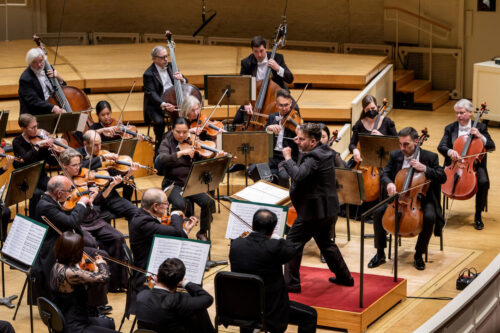
Grieg – Holberg Suite
Kreisler – Violin Concerto in C major, ‘In the Style of Vivaldi’
Anna Clyne – Sound and Fury
Haydn – Symphony No.101 in D major, ‘The Clock’
Thursday’s program for the Chicago Symphony Orchestra was originally meant to spotlight the conductor and violinist Pekka Kuusisto, whose curiosity and range have made him a rare figure on international stages. His program would have traced a neat line between old music and the new works inspired by it. Kreisler’s Violin Concerto in C major, a pastiche of Vivaldi, would have sat beside Grieg’s Holberg Suite and Einojuhani Rautavaara’s The Fiddlers, both rooted in antique forms. The second half would have paired Haydn’s Symphony No.64, the ‘Tempora mutantur’, with Anna Clyne’s Haydn‑inflected Sound and Fury – a work for chamber orchestra and tape.
Then Kuusisto withdrew. Earlier this year, he announced that he would stop performing in the United States for the foreseeable future, citing the country’s political climate. His absence left a hole in the season and was a genuine loss for Chicago audiences.
The CSO moved ahead. James Gaffigan stepped in on the podium, and Yuan‑Qing Yu, the orchestra’s assistant concertmaster, took over the concerto. Rautavaara’s piece was removed, and Haydn’s Symphony No.101, ‘The Clock’, replaced the originally planned No.64.
Programs like this one have become rare in major American orchestras. Audiences have been conditioned to expect large, high‑impact works, and smaller ones can seem slight by comparison. Yet chamber‑sized concerts have their own benefits. They allow delicate interplay among sections and highlight colors that get swallowed by bigger scores. Humor – one of Haydn’s most durable tools – registers cleanly. And if anyone assumed that a Haydn-inspired work by a contemporary composer would be underpowered, Clyne’s Sound and Fury offered a persuasive counterexample.
Gaffigan, a conductor comfortable across a wide range of styles, proved an adaptable substitute. I first heard him in Santa Fe leading Kaija Saariaho’s Semafor, and he brought a firm sense of shape to her shifting textures. Here he conducted with a full‑bodied physicality, using broad gestures and switching between baton and hands. The orchestra responded with playing that was vivid if not always as sharp as it could be. But the overall impression was one of energy and commitment. Luckily, Gaffigan will return to Chicago in a few weeks for a program of American music that includes Bernstein’s Age of Anxiety.
Kreisler’s concerto is a curious work, and his own history hovered over the performance. For years he wrote pieces in the style of Baroque composers and presented them as rediscovered manuscripts. His motives were practical: Kreisler wanted new repertoire to perform but found little that suited him. The ruse succeeded, at least for a time, because few performers or critics back then had a firm grasp of Baroque style – its works were being rediscovered and performed for the first time in centuries. The early‑music movement was in its infancy and had not yet reshaped the field.
To modern ears, formed in a time where great Baroque works shimmer from concert stages to jewelry commercials, Kreisler’s imitation comes across more as an affectionate homage or academic exercise and not a serious deception. It has the surface sparkle of Vivaldi but little of his innovation. Yu handled the flourishes with ease, supported by her colleagues in the strings. It is always refreshing to see section leaders step forward as soloists, and orchestras should make space for that more often.
The second half of the program, pairing Haydn with Clyne, was the evening’s strongest stretch. Sound and Fury borrows Haydn’s directness. It rarely lingers, moving in quick bursts and shifting colors and textures. Clyne threads in brief musical quotations – some from Haydn, some from Bartók – that flicker by without calling attention to themselves. Her use of a prerecorded version of Macbeth’s ‘Tomorrow and tomorrow and tomorrow’ soliloquy – and the origin of the work’s title – could have felt heavy‑handed, but it lands with surprising restraint. When the words enter, the piece tilts toward incidental music, as if offering a frame for Shakespeare’s meditation on time and futility.
Haydn’s ‘Clock’ Symphony made a fitting companion. The famous ticking motif is only one of its pleasures. Heard after Clyne’s piece, the symphony felt less like a historical artifact and more like a living reference point, and a reminder that clarity, proportion and imagination can still carry a program, even when our ears favor spectacle.
Zach Carstensen
Featured Image: Violinist Yuan-Qing Yu and conductor James Gaffigan in Kreisler’s Violin Concerto in C major © Todd Rosenberg