
 Germany Dresden Music Festival 2026 [3] – Elgar: Nicola Benedetti (violin), London Philharmonic Orchestra / Edward Gardner. Kulturpalast Dresden, 25.5.2026. (MC)
Elgar – Violin Concerto in B minor, Op.61 (1910); Symphony No. 1 in A♭ major, Op.55 (1908)
Titled ‘British Orchestra Sensations 1’ this orchestral concert was given by the visiting London Philharmonic Orchestra under its principal conductor Edward Gardner. The concert featured two major Elgar works written just two years apart the Symphony No.1 and the Violin Concerto. Both are widely recognised as quintessential contributions to the English late and post-romantic periods. Elgar was a self-taught composer, and these celebrated scores have become staples of the standard orchestral repertoire. An acutely sensitive person Elgar drew musical inspiration from his English heritage and tradition, its captivating landscapes especially his beloved Malvern Hills, his religion and his romantic loves and infatuations.
Elgar enjoyed puzzles, cyphers, and codes, and likely saw the value of adding an intriguing musical mystery to a composition. His 1899 breakthrough work Enigma Variations successfully included musical sketches of friends he did not identify but gave clues. A decade or so after the Enigma Variations Elgar wrote a cryptic inscription in Spanish on the manuscript score of his Violin Concerto that read ‘Aquí está encerrada el alma de …..’ (Herein is enshrined the soul of …..). Taken from a prefatory note to the Lesage’s novel Gil Blas the Spanish citation with the five dots being a clue to the name of a friend. The mystery of the friend’s identity secretly embedded within has never been satisfyingly solved. Elgar’s wife Alice is a five-letter name put forward, as is family friend Alice Stuart-Wortley, known as Windflower. It is thought that Windflower as his muse was the inspiration behind the enigmatic inscription.
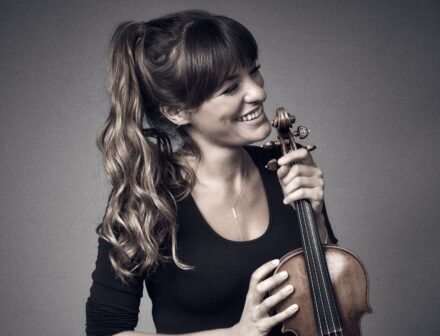
Scottish born Nicola Benedetti stepped on the stage dressed in all black. Such a perceptive performer she played Elgar’s challenging Violin Concerto so magnificently. It felt that Benedetti understood how this passionate score was a glimpse into Elgar’s private life, and I strongly sensed the anguished yearning of love. Her unforced virtuosity was captivating and as I often say about the best soloists everything felt completely natural. Following the windswept opening of the first movement Allegro Benedetti’s focus, keen concentration and control was evident producing playing of passion and grace. The highpoint of the performance was the melting beauty Benedetti produced in the glorious Andante movement which was so alluring, making the hair stand up on the back of the neck. Marked Allegro molto the mercurial finale was bursting with remarkable energy and new ideas. Entirely engaged Benedetti’s playing was outstanding especially in the cadenza accompanied by pizzicato tremolando thrummed on muted strings and the unaccompanied solo passage close to the conclusion. Knowing this music so well the performance of the LPO under Edward Gardner was top-drawer. Benedetti deserved and was given a rapturous ovation by the audience.
It is well known that for some years Elgar had considered writing a symphony inspired by the life of General Gordon, yet the score didn’t come to fruition. After his fiftieth birthday Elgar began his Symphony No.1 a work partly written during time spent in Rome in 1908. In four movements and scored for large orchestra, it was premiered by the Hallé Orchestra under Hans Richter in 1908 at the Free Trade Hall, Manchester. It was a triumph being performed over one hundred times in its first year. Richter stated that the First Symphony was ‘The greatest symphony of modern times’ and the journal, The Musical Times, described the work as ‘An immediate and phenomenal success.’
Overall, Edward Gardner conducted an expansive performance with accomplished control of phrasing, weight and tempo. In the breezy opening movement Andante. Nobilmente e Semplice Gardiner’s choice of tempi and dynamics felt judicious. Next the Scherzo-like second movement that had an uneasy recklessness about it and Elgar’s writing rarely let the tension drop. In many quarters Elgar’s expressive music has become associated with imagery especially of the Monarchy of Edwardian England. Under Gardner here I was able to visualise the pageantry of a ceremonial event in Whitehall. In the welcome central section, there is glorious music of introspection, where I could imagine nature perhaps in a forest at night. Gardner and his players clearly relished the Adagio with its heartbreaking theme which contains such intensely passionate music, some of the most beautiful ever written. The outstanding level of performance was truly captivating and towards the conclusion of the movement I felt Elgar was depicting the sorrow of lovers parting, perhaps for a long ocean voyage. Marked Lento – Allegro the finale contained many challenges of changing tempi, rhythm, dynamic and disposition which Gardner and his players surmounted unerringly. In this music of grandeur as the nobilmente theme returned I easily imagined an important State occasion in say Horse Guards Parade.
The Kulturpalast audience loved the playing of Nicola Benedetti and with two of Elgar’s greatest works, the London Philharmonic Orchestra under Edward Gardner did themselves proud.
Michael Cookson