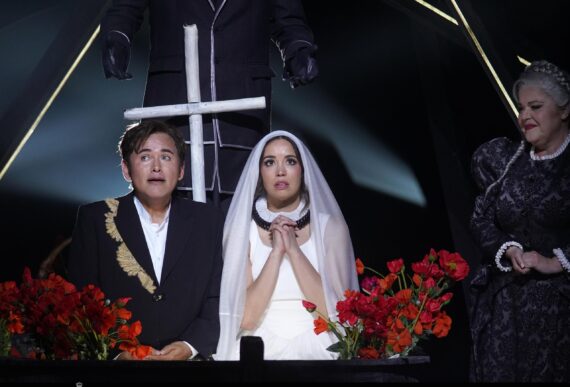
 Spain Gounod, Roméo et Juliette: Soloists, Dancers, Teatro Real Chorus, Teatro Real Orchestra / Carlo Rizzi (conductor). Teatro Real, Madrid, 9 and 10.6.2026. (JMI)
I begin my comments on these performances by mentioning the difficulties that had to be overcome. I usually organize my traveling well in advance and plan to cover several dates and theaters, and I hoped on this occasion to attend Roméo et Juliette at Teatro Real, Turandot in Valencia and Le nozze di Figaro in Barcelona. However, I had not taken into account that my chosen dates coincided with the Pope’s visit to Madrid and Barcelona, and I had to adjust the trip. Problems with tickets and trains meant I could only be at these Madrid performances on later dates than I intended.
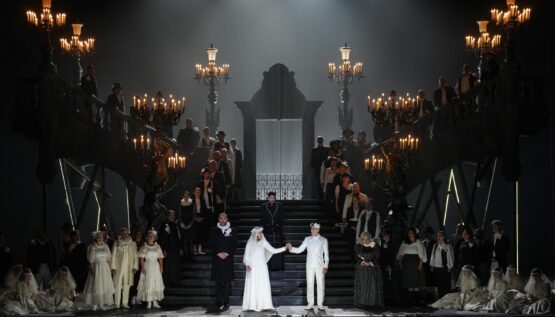
This is a new co-production by Teatro Real and the Opéra National de Paris. The direction is by Thomas Jolly, and I found his work unconvincing. The sets, which rotate throughout the opera, feature a grand staircase that seems to be a copy of the staircase of the Palais Garnier in Paris. As it rotates, a balcony appears which serves as Juliette’s terrace. Up to this point, the set design works well, but a problem arises in Act III with the wedding of the protagonists where the set seems inappropriate for such an intimate ceremony. Thomas Jolly resolved this by using a boat as a set, and it then reappears as Juliette’s tomb.
There is an excess of ballet dancing (choreography by Josépha Madoki) all over the stage, and music and scenes are included that are not normally seen in this opera. They might have some interest but would best be deleted, particularly the ballet scene at the front of the stage after Juliette drinks the concoction given to her by Frère Laurent (Friar Laurence).
The musical direction was entrusted to Carlo Rizzi, whose interpretation was rather routine. A Roméo et Juliette that lacks emotion is due to the musical direction. Rizzi’s conducting in the first part of the opera was particularly boring but it improved in the second part. Perhaps he had something to do with the added music, and especially the ballet, and I reiterate that it is uninteresting and unnecessarily lengthens the opera. Suffice it to say that on the occasions I have seen the opera in the past, the length hasn’t reached 2 hours and 30 minutes, a limit clearly exceeded here where it lasted for 2 hours and 43 minutes. The performances of the Teatro Real Chorus and Orchestra were fine.
The real star and undisputed triumph of the performance was soprano Nadine Sierra who effortlessly overcame all the difficulties of the score. She reached her peak in the scene where she drinks the potion, singing magnificently and delivering an unsurpassed performance. Sierra is a great artist, and the audience recognized this. In the second cast, arias received applause that lasted no more than 10 seconds, but Sierra was met with long ovations and bravos.
In the second cast, we had the debut of soprano Julia Muzychenko as Juliette. Her performance was generally good although there were some notable flaws in her voice: her lower notes were weak and at times inaudible, and the high notes occasionally bordered on shouting.
Roméo in the first cast was sung by tenor Javier Camarena who gave a good performance but was, undoubtedly, overshadowed by his exceptional stage partner. Camarena did nicely but he wasn’t the Roméo one might dream of. In the second cast, tenor Ismael Jordi as Roméo gave a good performance but his voice is rather lacking in beauty.
The remaining characters are secondary, beginning with Frère Laurent who was sung by Roberto Tagliavini in the first cast; his presence in a minor role is somewhat unusual. Jean Teitgen in the second cast was also good. Baritone Benjamin Appl has an attractive voice and gave a fine performance as Mercutio, as did Carles Pachon. Héloïse Mas covered the part of Stéphano adequately, and so did Carmen Artaza. Veteran Laurent Naouri was Capulet, and the passage of time is noticeable in his voice. In the second cast we had Jean-Fernand Setti, a powerful bass but with tuning problems. Tybalt was sung by tenor Maciej Kwasnikowski whose voice was well-suited for the role; David Alegret’s voice was too light for the part.
José M. Irurzun
Featured Image: Javier Camarena (Roméo) and Nadine Sierra (Juliette) © J. del Real
Production:
Director – Thomas Jolly
Sets – Bruno de Lavanère
Costumes – Sylvette Dequest
Lighting –Antoine Travert
Choreography –Josépha Madoki
Chorus conductor – José Luis Basso
Casts:
Roméo – Javier Camarena / Ismael Jordi
Juliette – Nadine Sierra / Julia Muzychenko
Frère Laurent – Roberto Tagliavini / Jean Teitgen
Mercutio– Benjamin Appl / Carles Pachon
Stéphano – Héloïse Mas / Carmen Artaza
Capulet – Laurent Naouri / Jean Fernand Setti
Tybalt – Maciej Kwasnikowski / David Alegret
Gertrude – Sonia Ganassi
Paris – Tomeu Bibiloni