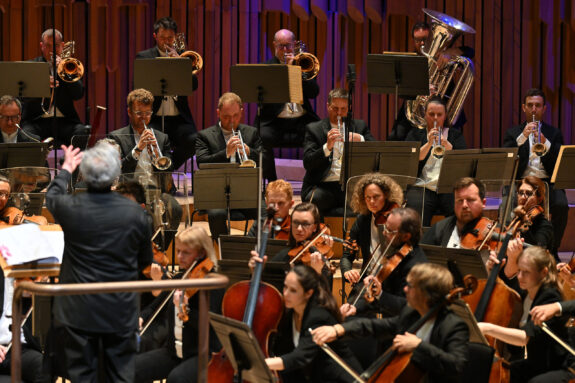
 United Kingdom Elgar, Mahler: London Symphony Orchestra / Sir Antonio Pappano (conductor). Barbican Hall, London, 11.6.2026. (AV-E)
Elgar – Variations on an Original Theme, ‘Enigma’, Op.36
Mahler – Symphony No.5 in C minor (1901-1902)
This London Symphony Orchestra concert, performed in memory of Michael Tilson Thomas (1944–2026), carried an added layer of historical reflection. First conducting the LSO in 1970 when stepping in at the last minute for Gennady Rozhdestvensky, Tilson Thomas quickly became a regular guest. Seventeen years later, in 1987, appointment as LSO Principal Conductor followed, succeeding Claudio Abbado in September 1988. Dame Kathryn McDowell, Managing Director of the London Symphony Orchestra, described Michael Tilson Thomas as ‘ahead of his time’, emphasising a career defined by curiosity, innovation, and advocacy for new ideas, as well as a deep commitment to musicians and institutions, and a long-standing association with the LSO spanning almost sixty years.
Sir Antonio Pappano gave a short tribute before the performance: ‘MTT was the kind of musician I always aspired to be. With his astonishingly omnivorous musical appetite, he achieved a knowledge and wisdom not only about the mechanics of how music works but how to communicate its message and spirit to orchestral musicians, students and audiences alike. His never-ending energy, bags of talent and American can-do approach went hand in hand with a fierce intelligence that underpinned everything he was involved with. I am immensely proud that Michael was a crucial part of the LSO family. A beacon in every way.’
The opening of Elgar’s Enigma Variations unfolded in an atmosphere of gentle, intimate fragility, the theme emerging with understated poise before branching into a sequence of sharply characterised variations. The orchestral palette was finely balanced throughout, with particular warmth, depth, and expressive richness in the cello tone, which lent several variations an understated emotional core.
Variation VII (Troyte) was very well paced, but the timpani playing was thumpy and brutish, lacking incisive crispness, the sonority becoming excessively reverberant in the Barbican Hall acoustic and dominated by a harsh impact. In Variation XI (G.R.S.), Allegro di molto, the timpani again dominated, the final strokes landing with blunt, heavy impact rather than rhythmic definition, the acoustic further exaggerating weight at the expense of clarity and balance. Nimrod navigated into a more inward, tensile stillness, its harmonic pacing poised and searching rather than broadly climactic, the music suspended in a fragile emotional equilibrium.
In the finale, Elgar’s closing variations returned earlier material in a more integrated, cumulative form, the Nimrod-derived contours and broader thematic fragments interlocking within a final build-up of controlled intensity. The brazen brass carried the principal weight of the climactic ascent, its chords firmly projected and precisely balanced against the string texture, allowing the final peroration to register as structured culmination rather than rhetorical expansion.
I could tell that Mahler’s Fifth had been marinating in the mind of Maestro Pappano for some time, because this was a perfectly prepared main course. The opening Trauermarsch emerged with solid, structurally incisive intent, steady concentration and strong architectural control, the pulse remaining firm and focused even under considerable sonic pressure.
The Stürmisch bewegt, mit grösster Vehemenz second movement was conducted with great gusto and panache, its volatile architecture driven forward in jagged surges of sound, opening with blazing horn calls and searing orchestral outbursts before repeatedly collapsing into momentary pockets of uneasy lyricism. The timpani and brass writing was played with uncompromising force; though in the Barbican acoustic this frequently had a harsh, brutal sonority, the climactic peaks registering less as expressive intensity than sheer physical impact, at times painfully loud on the ears.
The Scherzo offered greater clarity and poise, though beneath its surface ease lay a more unsettled, continually shifting character. Pappano shaped the movement with a buoyant lilting grace, allowing its rhythmic contours to breathe naturally while maintaining an underlying sense of structural control. The horn writing, at times recalling a distorted Ländler idiom, was delivered with expressive flexibility and poise, the lines unfolding with an ease which suggested rustic dance forms refracted through a more modern, unsettled lens. Strings and woodwind interjections disrupted the apparent poise with sudden rhythmic displacements and flickers of irony, while the brass contributed a firmer, more grounded weight beneath the surface buoyancy.
There was a sense of music well-rehearsed, with details clearly internalised and textures finely shaped, allowing Pappano to draw out both its dance-like surface and its underlying instability. What initially appeared as structural lightness and dance-like ease gradually gave way to a more unsettled and fragmented character, as the apparent poise of the Ländler-derived material began to fracture through displaced accents, destabilising orchestral interjections and a persistent undercurrent of tension.
In the often sentimentalised Adagietto, frequently prone to incontinent indulgence, Pappano’s refreshing reading unfolded with calm clarity, a seamless stream of serene sensations without recourse to emotional excess. After hearing how Pappano austerely conducted the Adagietto, I have revised my previous criticisms of it. In my recent review of Mahler’s Fifth under Vasily Petrenko with the Royal Philharmonic Orchestra (review here), I described the Adagietto as ‘mawkishly kitsch’ and an ‘intermission interlude’. That is no longer the case.
What emerged felt radically reimagined, as if heard anew. For here, for the first time, I heard the Adagietto conducted out of time, suspended from time, with no sensation of time passing. A timeless soundworld of luminous incandescence where the serene strings breathed with quiet inevitability, their lingering lines allowed to alight, unfurl and hover without saccharine schmaltz, creating the séance-sensation of sedated stillness. Equally striking was the seamless integration of the harp into the string texture, an instrument too often isolated and spotlighted from the surrounding sonority. Here the harp was woven effortlessly into the orchestral fabric, contributing to a single, glowing continuum of sound. This definitely was well-marinated Mahler.
In the Rondo-Finale, Pappano maintained a forward-thrusting sense of monumental momentum, drawing together the disparate strands of the work into a coherent and compelling whole. Rhythmic energy remained buoyant throughout, the contrapuntal writing articulated with impressive clarity and purpose.
What had begun in darkness and uncertainty now unfolded with confidence and affirmation, the orchestra responding with playing of remarkable discipline, brilliance and conviction. Yet again, aided and abetted by the ‘in-your-face’ Barbican Hall acoustics, the timpani were far too loud and coarse rather than intense and muscular. The concluding bars, whilst majestically powerful, were a pain to the ears in their sheer loudness. The audience, however, rightly erupted in ecstatic applause for a well-seasoned feast of the Mahler Fifth.
Alexander Verney-Elliott
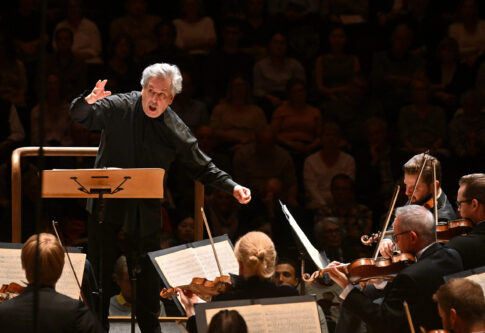
Featured Image: Sir Antonio Pappano conducts the London Symphony Orchestra © Mark Allan/LSO