 United Kingdom Garsington Opera 2026 [2] – Verdi, La traviata: Soloists, Garsington Opera Chorus, Philharmonia Orchestra / Douglas Boyd (conductor). Garsington Opera at Wormsley, 31.5.2026. (CR)

As is well known, Verdi’s La traviata met with a cool reception at its premiere in 1853, partly on account of its lacking the broad canvas of wider historical, public events which served as the backdrop to many of the politically conscious operas he composed before this one, during the first phase of the Risorgimento. Louisa Muller’s production implicitly addresses that supposed lack by neatly aligning the public and private aspects of Violetta’s charismatic personality at least, achieved through focusing both sides compactly within the same revolving set that does service for all scenes across the whole opera. That enables her, and other characters, to pass from one dimension to the other seamlessly. Furthermore, given the tight arrangement of the set’s various compartments, and that during the Prelude Violetta emerges from her deathbed and walks through the various scenes where the characters stand as tableaux vivants in episodes from the narrative, it is as though she is reviewing the sequence of her life just before her demise. The whole set and action effectively become the outward manifestation of her private mind and memory, and the opera’s narrative unfolds as her recalling of the past, just as Verdi suggests that looping back by starting the Prelude with the haunting chords which evoke her dying. Public and private are therefore played out both choreographically and dramaturgically.
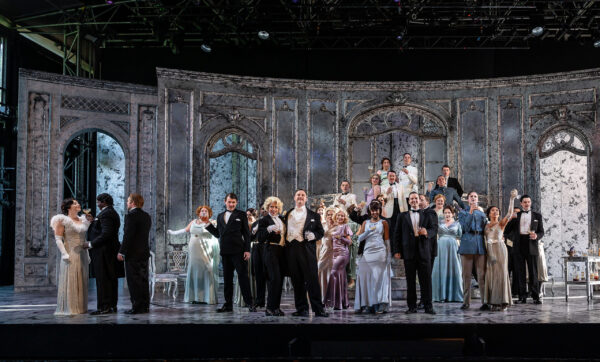
It was only on reading the programme note after the performance, however, that it became clear (to me at any rate) that the production is also in fact meant to address explicitly a wider, external historical background by setting the drama in 1939, i.e. right on the eve of World War Two when thoughts of death and destruction were prevalent. Certainly, Christopher Oram’s designs of the public scenes convey the salon or club atmosphere of the 1920s or ‘30s in general terms. But nothing I saw obviously alluded to the imminent outbreak of that or any worldwide catastrophe, except that Giorgio Germont is cast as an army officer. In any case, that interpretation can make sense entirely in terms of the interpersonal dynamics at work within the opera’s original scenario – and I thought effectively so – as explaining his propensity to a severe code of decorum and morality. It’s also explicable that France at any time in the 19th or 20th century would have a standing army, and there is no hint here of any enemy which a military force is preparing to fight. It would have been a weakness had this production simply aped the concept of Cabaret, but its concept of 1939 surely needs more drawing out. The tarnished silver set evidently represents a world in decay, though its underlying decorative style appears more Belle Époque than either Art Nouveau or Art Deco, and I read its symbolism of disintegration as a hangover of roughly the period of the opera’s composition into this production’s era of the 1920s/30s, rather than as portending the destruction of the 1940s to come.
Violetta’s charisma is exuded mostly through Madison Leonard’s superb singing. She has a demure presence on stage, which her vocal performance makes up for in radiating the allure with which her many admirers become besotted, and Baron Douphol and Alfredo in particular. Leonard skilfully and beautifully navigates the tricky modulation between the publicly confident courtesan and the mortally ill lover. Oleksiy Palchykov brings a natural ardour to the part of Alfredo with a touch of grainy strenuousness in his tone rather than more conventional lyricism. As his father, Roland Wood sounds as impressively resolved and formal as he appears in army uniform, even when he finally yields and accepts Violetta as his daughter – seemingly accepting her on his terms rather than exactly on hers. Henry Waddington offers more warmth as Doctor Grenvil, while Alfredo’s friend Gastone de Letorières and rival Baron Douphol are colourfully sung by Sam Harris and Chuma Sijeqa respectively.
Douglas Boyd and the Philharmonia Orchestra provide sensitive and dramatically engaged support, opening with a finely veiled account of the Prelude, which gives way to a full, vivid spectrum of sonorities for the public spectacles with an energetic pace. The Garsington Opera Chorus make especially resounding contributions in the music and in their alert choreography as the salon attendees and carnival-goers. In short, this production’s study in decay is a moving as well as a paradoxically rejuvenating realisation of this most ubiquitous opera’s internal world. But the attempted 1939 setting is perhaps something of a red herring which I am not sure would have added much to the scenario if it had been more decisively implemented.
Curtis Rogers
Featured Image: Garsington Opera’s La traviata © Clive Barda
Production:
Director – Louisa Muller
Set designer – Christopher Oram
Lighting designer – Marcus Doshi
Movement director – Matthew Steffens
Chorus master – Jonathon Cole-Swinard
Cast:
Violetta Valéry – Madison Leonard
Alfredo Germont – Oleksiy Palchykov
Giorgio Germont – Roland Wood
Gastone de Letorières – Sam Harris
Baron Douphol – Chuma Sijeqa
Doctor Grenvil – Henry Waddington
Annina – Mathilda Bryngelsson
Flora Bervoix – Alexandria Moon
Marchese d’Obigny – Sam Young
Giuseppe – Matthew Sotillo-Cooke
Messenger – Peter Lidbetter
Flora’s Servant – Sisa Mjekula