 Switzerland Wagner, Tannhäuser: Soloists, Zurich Opera Chorus and Orchestra / Tugan Sokhiev (conductor). Zurich Opera House, 21.6.2026. (AL-L)
The Wagnerian summer of 2026 has officially started. Even before the opening of the Bayreuth Festival and before the new Die Walküre at Bavarian State Opera, it was Zürich that fired the opening shot with this new Tannhäuser — and a very well-aimed shot it was.
Tugan Sokhiev, making his debut in Zurich, was a welcome surprise, since his reputation is built on the Russian and French repertoires, and his forthcoming appointment as chief conductor and artistic adviser of the Orchestre de la Suisse Romande, announced just days ago, only reinforces that image.
Yet here was a Wagner of startling idiomatic authority: long, arching lines, meticulous attention to architecture, and tempi that kept the music alive and forward moving without rushing. This was young Wagner — the Wagner of the early 1840s, long before the endless melodies and the metaphysics of Bayreuth — and Sokhiev caught that freshness, that almost Italianate urgency, with complete conviction.
Zürich, it is worth remembering, has its own Wagnerian resonance. In the park of the Villa Wesendonck, a stele with a lyre reminds us that Wagner lived there from April 1857 to August 1858 and worked on both Siegfried and Tristan und Isolde under the patronage of the Wesendoncks — the very house, now the Museum Rietberg, is located a few minutes from the opera house. That biographical thread gave the evening a particular charge.
The two principal debuts of the evening were outstanding. Eric Cutler, making his first appearance in the role and at this house in this production, was a revelation. His Act III Rome Narration of his pilgrimage was among the most compelling accounts of that brutal, exposed monologue one is likely to hear: the dramatic intensity was palpable, every word weighed, the line never broken even in the most testing moments. Christina Nilsson, likewise new to Zürich, brought a bright, clear timbre to Elisabeth — a sound that carries freely and without effort above the orchestra, most notably at the climax of the second-act ensemble — combined with a care for phrasing in her arias that is increasingly rare. Both singers were at pains to inhabit their characters rather than merely decorate them.
Christian Gerhaher’s Wolfram was a more equivocal pleasure. The diction was, as always, impeccable, the projection assured, the musical intelligence evident in every bar. Yet there was a degree of affectation, of too-deliberate intention, that worked against the character’s natural nobility. Where Wolfram’s poetry should flow, Gerhaher’s Wolfram was calculated. Rachael Wilson made a well-focused, melodious Venus, and the smaller roles — Christof Fischesser’s authoritative Hermann chief among them — were excellently cast throughout. The chorus sang well in the first and third acts, though some intonation slipped in the Act II tournament. One regretted that the returning pilgrims did not process visibly on and off stage in the third act, always one of the opera’s most quietly devastating moments.
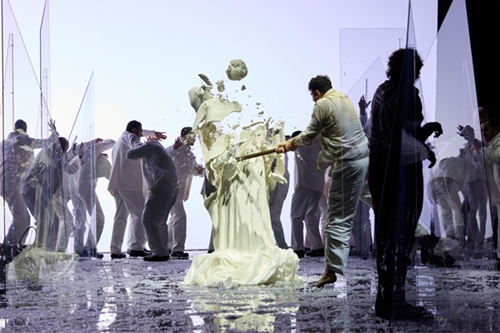
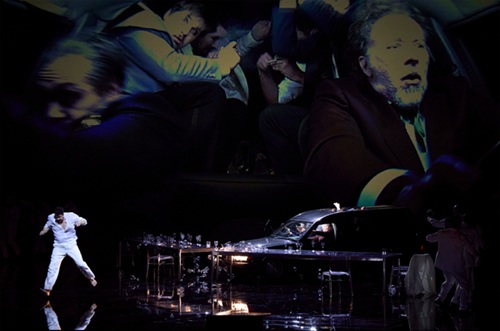
Director Thorleifur Örn Arnarsson frames the opera as a dream — or nightmare — unfolding inside Tannhäuser’s own mind. The concept produces some powerful images: the prelude staged with a multiplication of Tannhäuser doubles, the gradual petrification of Elisabeth in a striking coup de théâtre reminiscent of Jean-Pierre Ponnelle’s celebrated Salzburg Les contes d’Hoffmann, where the director similarly managed to make the soprano vanish before the audience’s eyes. Arnarsson also permits himself some genuinely comic touches: an entrance by car, driven by Wolfram and bearing Hermann, Biterolf and the assembled Minnesingers in various states of inebriation, raised knowing smiles in the audience, as did the near-farcical slow procession of the Wartburg notables impeding Hermann’s Act II address. The quality of the acting direction throughout was real, a reminder that Arnarsson’s background is in theatre. Some first-night roughness in the chorus notwithstanding, the level of singing was very high.
Zürich may in fact be close to an ideal space for Wagner. The opera house is neither as vast nor as acoustically peculiar as Bayreuth’s Festspielhaus and its intimacy allows the colours of the Zurich Opera Orchestra to register fully, the words to be heard with unusual clarity, and, paradoxically, the singers to project above the orchestra with a presence that is sometimes harder to achieve in Bayreuth. If this Tannhäuser is what a Wagnerian summer in Zurich looks like, one looks forward to what will follow.
Antoine Lévy-Leboyer
Featured Image: Zurich Opera’s Tannhäuser © Herwig Prammer
Cast:
Tannhäuser — Eric Cutler
Elisabeth — Christina Nilsson
Wolfram von Eschenbach — Christian Gerhaher
Venus — Rachael Wilson
Hermann, Landgraf von Thüringen — Christof Fischesser
Biterolf — Andrew Moore
Walther von der Vogelweide — Johan Krogius
Heinrich der Schreiber — Nathan Haller
Reinmar von Zweter — Brent Michael Smith
A Young Shepherd — Yewon Han
Production:
Director — Thorleifur Örn Arnarsson
Set design — Erna Mist
Costumes — Teresa Vergho
Lighting design — Martin Gebhardt
Choreography and Assistant Direction — Sebastian Zuber
Chorus master — Klaas-Jan de Groot
Dramaturgy — Jana Beckmann, Roman Reeger