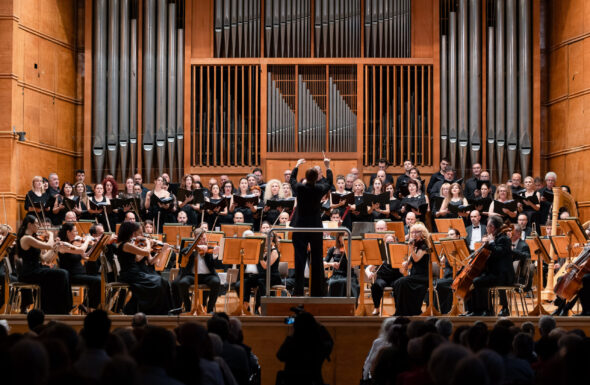
 Bulgaria Arutyunyan, Borodin, Smetana, Vladigerov: Tine Thing Helseth (trumpet), National Philharmonic Choir (choir director: Maria Valchanova), Sofia Philharmonic Orchestra / Viliana Valtcheva (conductor). Bulgaria Hall, Sofia, 28.5.2026. (GT)

Smetana – Vltava from Má Vlast
Alexander Aruntyunyan – Trumpet Concerto in A-flat major
Pancho Vladigerov – Jewish Poem, Op.48
Borodin – Polovtsian Dances from Prince Igor
During a break in the Wagner Festival in Sofia, this concert proved a fascinating evening of romantic music, led by an outstanding young Bulgarian conductor, Viliana Valtcheva. The Sofia Philharmonic Orchestra goes back to 1892, first as the Royal Orchestra, after Bulgaria gained sovereignty, and was led by the Czech kapellmeister Josef Hochola. It was renamed the National Philharmonic in 1945 and has been the leading symphony ensemble in Bulgaria, embracing symphonic, chamber, choral and educational work. Musicians who have worked with the orchestra include Bruno Walter, Igor Markevich, Hermann Abendroth, and Carlo Zecci, and the orchestra regularly works with the world’s finest musicians.
Since 2017, the music director has been Nayden Todorov, with other past Bulgarian conductors including Emil Tabakov and Dobrin Petkov. Its concert season invites the finest musicians from across the globe; this season includes Kirill Petrenko, Christoph Eschenbach, Ivo Pogorelich and Gideon Kremer.
The opening of Smetana’s Vltava quickly revealed the beautifully clear intonation of the woodwind and brass, and it was evident that the Sofia Philharmonic strings have a beautiful bloom, especially in the first violins led by Kalina Hristova, who would play several delightful solos throughout the evening. Initially I thought the tempo adopted by Valtcheva was somewhat hurried, as if there was a storm blowing on the river, yet this only added to the drama of the piece, and it was a good marker for the rest of the evening that the young Bulgarian conductor kept the score firmly in her grip. The brass group showed their prowess in the closing bars, and the piece was an excellent introduction to this evening of four quite different stylistic works.
The Armenian composer Alexander Arutiunian (1920-2012) is mostly known for his gorgeously colourful Trumpet Concerto from 1950. Generally, only first known from Soviet recordings, the piece gained a second life after decades of neglect in the West when the brilliant young Sergei Nakariakov played and recorded it, bringing it widespread popularity. The work embraces the rich melodic world of Arutunian’s compatriot Khachaturyan’s Violin and Piano Concertos, which won worldwide success for their folk harmonies and colourful romanticism.
The opening phrases displayed many qualities of what could be called ‘Soviet Romanticism’, in an upbeat display of incredible virtuosity by the Norwegian Tinge Thing Helseth, leading the speedy tempo which was decorated by often breathtaking contributions from the woodwind and brass groups. Arutunian’s score is remarkable in its flexibility to switch the themes across the orchestra and embrace the talents of the Helseth with his trumpet. The cadenza in the final section was magnificent in its prolonged, almost exhibitionist technique and never departed from the romantic colours of the score. Ultimately, the climax was colourfully infused with Armenian folk harmony and brilliant exotic colours. In response to the warm applause, Helseth played an encore of a folk piece by Holmboe.
Pancho Vladigerov (1899-1978) is generally regarded as Bulgaria’s greatest composer; he was born in Zurich, yet spent his childhood years in Bulgaria, was educated in Europe and achieved success in Europe and the US during the 1930s. Following the war, he settled permanently in Bulgaria. This is only the second time I have heard his music in the concert hall after a performance of his orchestral piece Vardar by the USSR State Symphony under Svetlanov at the 1988 Edinburgh International Festival. His music is colourful, superbly orchestrated, yet in my opinion, has always lacked a distinct style, as he embraces late romanticism, modernism and jazz mixed with folk influences. He was also an active pianist and conductor and lectured at the Music Academy now named in his honour. This piece is inspired by his Jewish mother and is regarded as his masterpiece, with Shostakovich describing it as follows: ‘A work like this is written only once in a hundred years’. Vladigerov uses the Kaddish prayer that he heard his grandfather reciting in his childhood, and it is heard throughout the work with other Jewish melodies and uniquely Vladigerov fuses Bulgarian folk themes with them. He called it on his finished score Meditation hebraique dedicated to Leonid Pasternak his grandfather, although it was renamed Jewish Poem. There is an elegiac sorrow that transforms at the climax into a beautifully expressed passionate outburst of glorious rich colour.
The final work in the programme proved an excellent choice with the National Philharmonic Choir joining the orchestra, and from the beginning, Valtcheva was firmly in control of the colourful opening evoking the Polovtsian camp. The Eastern exoticism and exciting rhythm emerged with great dynamic power with great contributions from the woodwind and beautifully enhanced by the strings. The entry of the mixed chorus gave a beautifully Slavic harmony against the richly orchestrated dances ranging from the barbarism of the central section to the lyricism of the maidens’ dances. The applause at the end became a standing ovation from the capacity audience.
The Bulgarian conductor Valtcheva, who masterminded this evening, is a new name for me, and I was very impressed by her expressive conducting. Her broad, expansive arm movements, together with her precise hand and finger movements, ensured she carefully managed the rhythm and tempo. Valtcheva has an attractive style which must assist her in her work with both opera, ballet and orchestral ensembles. She studied in Switzerland, and with Boulez, Haitink and Mehta and worked at Lucerne and Zurich Opera Theatres. Currently, she is working at two opera and ballet companies in Bulgaria, and it should not be long before more is seen of her in Europe.
Gregor Tassie
Featured Image: National Philharmonic Choir and the Sofia Philharmonic Orchestra conducted by Viliana Valtcheva.