 Spain Verdi, Il trovatore: Soloists, Teatro Real Chorus and Orchestra / François López Ferrer and Nicola Luisotti (conductors). Teatro Real, Madrid, 15, 16 & 17.7.2026. (JMI)
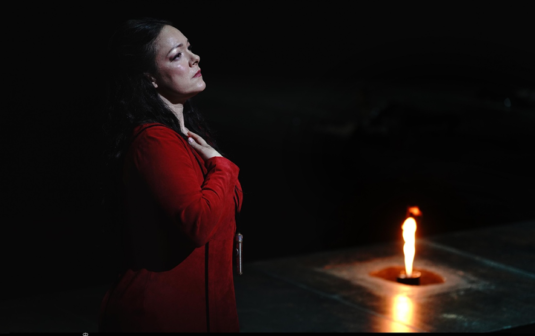
It may seem surprising that I am beginning my chronicle of Il trovatore 2026 so late, given that the final performance takes place on 20 July. My original plan was to attend the opening performances of the first two vocal casts which were to feature the great Anna Netrebko as Leonora, but a serious accident forced me to cancel. Unfortunately, Netrebko also had to cancel, but her replacement was more than remarkable.
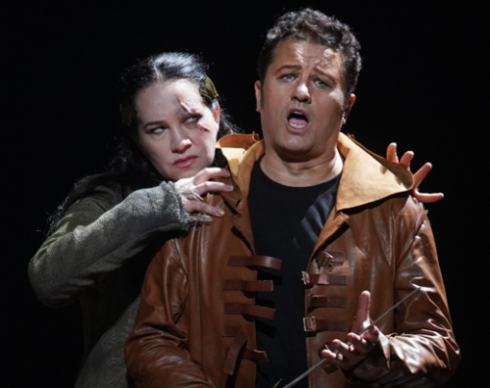
The Francisco Negrin staging is the one used here six years ago. It is a co-production of the Teatro Real, Monte Carlo and Copenhagen companies and premiered in 2017. Negrín makes the specters the protagonists of the opera and has, at many points, two extras on the stage representing Azucena’s mother and the child who died (who is none other than Manrico). Overall, the production is dark, unattractive and uninteresting.
Louis Désiré’s design offers a single stage for the entire opera, enclosing it with side walls; at the back are some openings where members of the chorus appear. There are only a few minor stage elements: whether in the Queen’s garden, the gypsy camp, the convent or the prison, nothing changes. The costumes, also by Désiré, are somewhat timeless and rather boring. Bruno Poet’s lighting does not take advantage of the production’s dark, nocturnal atmosphere, nor does the stage direction offer anything noteworthy.
On 15 July, the conductor was Nicola Luisotti’s assistant, François López Ferrer, and I did not find his leadership convincing. He overused orchestral volume in the tutti passages to the point of annoying the audience. On the following days the musical direction was in the hands of Teatro Real’s Principal Guest Conductor, Nicola Luisotti. His conducting was as brilliant as one would expect from him: it is in Verdi operas that he seems to find his best. The Teatro Real Orchestra once again delivered an outstanding performance.
Manrico (Il trovatore) was sung by tenor Celso Albelo, whom we are accustomed to seeing in lighter roles. Undoubtedly, he has the high notes – his best asset – but Manrico is much more than high notes. A more robust voice is needed in the middle register and Albelo’s seems to me lighter than desirable. Yusif Eyvazov was the second Manrico, and his presence was due to the expected presence of his ex-wife, Anna Netrebko, as Leonora. His voice is suitable for the role though its quality leaves something to be desired. Though it was one of the best performances I can recall from him.
The third Manrico was Piotr Beczała, who can easily be considered the best interpreter today. His debut in the role took place in Zurich in December 2021, but he must not have been entirely satisfied since he did not sing it again until four years later in Vienna. Since then, he has been a regular and magnificent Manrico and his performance here was brilliant, with that velvety voice offering great beauty and evenness. He had no trouble making himself heard from anywhere on the stage. His always eagerly awaited ‘Di quella pira’ was as brilliant as one would expect, but his rendition of ‘Ah si ben mio’ was not as satisfying. In any case, Piotr Beczała is a great Manrico.
Saioa Hernández is a dramatic soprano while Leonora requires a lyric soprano or, at most, a lírico-spinto. She sings with intensity although she avoids the top notes on some occasions. Eleonora Buratto’s Leonora almost made me forget Anna Netrebko. She is a lyric soprano with a controlled voice and offers superb, sustained notes, although her high notes don’t have the same beauty as the rest of her voice. She received the longest standing ovation. The third Leonora was Marina Rebeka, whose lirico-spinto soprano is well-suited to the role although her singing lacks warmth and suffers from a touch of monotony. The high notes do not have the same quality as the middle register, and she occasionally avoids them.
Count Luna was sung by baritone Juan Jesús Rodríguez who gave the most convincing vocal performance. His voice retains its characteristic beauty and power – a true Verdi baritone. The biggest ovation of the evening was for him after his ‘Il balen del suo sorriso’. The new Count was sung by George Petean and the audience gave him a strong ovation, but I found his singing monotonous despite an attractive and suitable voice. What I liked least was his constant need to sing at the front of the stage: his voice has some difficulty reaching the audience properly and the upper register is strained.
The third Count was baritone Artur Ruciński whom I have heard on many occasions and enjoyed. I cannot say the same on this occasion – his voice has clearly lost volume even though he is only 50. The biggest problem is that he is perfectly aware of his vocal condition which makes him also seek the front of the stage. His ‘Il balen’, sung from a seat, received a big ovation. We are lucky that opera houses have an orchestra pit or we might have had him singing in the stalls.
Azucena was sung by mezzo-soprano Teresa Romano, whom I was seeing for the second time. The first time was in Parma in October 2010 when she sang the role of Leonora. In my previous comments, I noted then that her middle and lower registers were sumptuous, while her upper register was lacking, and this explains her change of vocal range and current status as a pure mezzo-soprano. Her performance was convincing in every respect, except for her opening aria, ‘Stride la vampa’, where she failed to elicit any applause. The second Azucena was sung by mezzo-soprano Clementine Margaine, who once again proved to be a reliable choice. Her voice is remarkably even throughout her range, and she possesses a resonant lower register, perfectly suited to the role of Azucena. The third Azucena was sung by Ksenia Dudnikova whose resonant voice offers a very sonorous lower register. In short, she is a remarkable Azucena.
Ferrando was nicely sung by bass Marco Mimica and, on the last day, by Krzysztof Bączyk who performed adequately. The supporting roles were well-covered by Rocío Faus (Inés), Fabián Lara (Ruiz) and a superb Moisés Marín (Messenger).
José M. Irurzun
Featured Image: Piotr Beczała (Manrico) and Ksenia Dudnikova (Azucena) © J. del Real
Production:
Director – Francesco Negrin
Sets & Costumes – Louis Désiré
Lighting – Bruno Poet
Chorus master – José Luis Basso
Casts (in chronological order):
Manrico – Celso Albelo / Yusif Eyvazov / Piotr Beczała
Leonora – Saioa Hernández / Eleonora Buratto / Marina Rebeka
Count Luna – Juan Jesús Rodríguez / George Petean / Artur Ruciński
Azucena – Teresa Romano / Clementine Margaine / Ksenia Dudnikova
Ferrando – Marco Mimica / Krzysztof Bączyk
Inés – Mar Morán / Rocío Faus
Ruiz – Fabián Lara
Messenger – Moisés Marín
Of late Leonora has been sung by lighter voices. Earlier and throughout the 20th Century many heavier voices sang the role from Emmy Destinn, Rosa Ponselle, Frida Leider, Gina Cigna, Zinka Milanov, Martina Arroyo and Sondra Radvanovsky and some big lyrics such as Gabriella Tucci and Leontyne Price. The only roles that seem to be immune from casting light are Azucena and Di Luna. Eleanora Buratto has been singing a heavier more spinto rep lately and after hearing her in Simon Boccanegra, I think Federica Lombardi would sing a glorious Leonora.