 United Kingdom Bampton Classical Opera Summer 2026 – Grétry, Zemira e Azor: Soloists, The Orchestra of Bampton Classical Opera / Andrew Griffiths (conductor). Cokethorpe School, Witney, Oxfordshire, 17.7.2026. (CP)
Bampton Classical Opera’s Director, Jeremy Gray searches every year for an opera not frequently heard. Once again, his selection is an excellent one with a geographical setting so very topical! Early 18th-century composers seeking oriental settings to show their colourful and expressive orchestrations discovered Persia and the waterway between the Persian Gulf and the Gulf of Oman – the Strait of Hormuz – appealing to contemporary tastes of the time. With a choice of 2000 folklore stories of the ‘morality lesson’ which is Zemira e Azor, Bampton’s 2026 selection is André Grétry’s 1771 composition, recomposed in Mannheim in 1776, with the Italian libretto by Mattia Verazi. An ingenious English translation by Gilly French and Jeremy Gray, with additional music by Niccoló Jomelli and Ignaz Holbauer, this opera in four acts builds the Bampton Classical Opera’s reputation for fresh and exciting developments. This classic fairy tale teaches the importance of empathy and kindness.
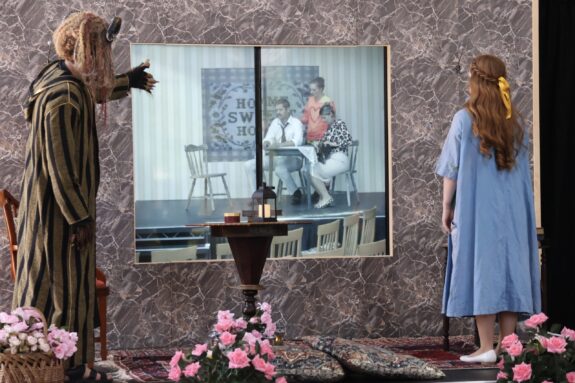
Sir Thomas Beecham, a keen supporter of Grétry’s music, praised him for his grace and melodic invention surpassed only by Mozart. In conductor Andrew Griffith’s hands this production is a musical treat, thanks in no small part to hand-picked musicians capably led by Caroline Balding. Creative offstage contributions by wind and brass players add to the enjoyment of the final act. So too, some extremely effective lighting designed by Ian Chandler and visuals created by David Hudd and Keith Farr. There are two stages, one, the home of Sandro (Samuel Pantcheff) the trader, the other, part of the palace belonging to ‘the beast’ Azor, the Prince of Kamir (Gwilym Bowen). Musicians slot in conveniently between the two stages. A vibrant overture begins the opera as Sandro, the trader loses his vessels in the Strait of Hormuz to the severe storms and lightning in these dangerous waters, depicted musically by excellent horn and bassoon playing. Seeking refuge in Azor’s palace, Sandro with his servant Ali (Andrew Irwin) are caught in the act of attempting to steal a rose as a gift for Zemira his youngest daughter (Ffion Edwards). Azor, the twin-horned ‘beast’ threatens death but relents when a deal is negotiated in which one of three daughters will take their father’s place as a sacrifice!
Baritone Samuel Pantcheff leads an extremely talented cast as the very caring trader father. Siân Dicker (Fatima) is outstanding as one of the spiteful and disgruntled sisters; she soon becomes the leader of the trio, her spinto soprano voice equipping her well for dramatic moments as the seriousness of the potential sacrifice of one of the girls dawns on the trio. The duet in the second act between Dicker (Fatima) and mezzo-soprano Rachel Roper (Lesbia) when they discuss the implications of the sacrifice was noteworthy. Zemira travels with Ali to meet Azor to fulfil her father’s deal.
Tenor Gwilym Bowen (‘the beast’ Azor) is a remarkable discovery by Bampton; his portrayal as ‘the beast’ from the balcony was most convincing as he despairs of his future. He patiently sits for Zemira as she paints his portrait, offers her a magic ring which will release her from his power and arranges for her to be part of the amazing ‘magic picture scene’ in which she sees her father and sisters at their home. Above all, he is charming and, as Zemira impresses him with her tenacity and resilience, Azor to, becomes charmed. The complications of staging the ‘magic picture scene’ are enormous; it worked without a hitch! As offstage wind and brass are conducted by Andrew Griffiths, his harpsichord player Alex Norton takes charge of the remaining string and wind players. The creative direction of Act III is remarkable with the lighting plot designed to remind the audience of the significance of that rose – which caused the controversy – with floods on the ceiling of coloured rose depictions.
This is an opera which merits many a revival. The production has a well-chosen cast always engaging and showing sympathy when required, notably in Act IV as a miserable Sandro (Pantcheff) needs the comfort of Fatima (Dicker) and Lesbia (Roper) who deliver another excellent duet before Zemira (Edwards) returns from the now charmed ‘beast’. Ffion Edwards was proficient as Zemira, Rachel Roper was adept as Lesbia, Siân Dicker was superb as Fatima; all three girls engage in a family row which ends abruptly when Zemira (Edwards) casts off her magic ring and disappears, soon to reappear alongside Azor at his palace. The happy end to the fairytale is in sight! Gone is ‘the beast’s’ ugly twin-horned costume; replaced by an elegant long coat as the count reflects on the success of the ‘magic picture scene’, with offstage flutes echoing the onstage strings. Andrew Irwin’s busy interpretation of Ali the servant, a role he has clearly enjoyed, culminates in a most humorous fourth-act appearance as an angel clasping a bunch of roses, soon to utter the immortal words ‘may you live happily ever after’ to Azor and Zemira! Fireworks appear on the screens of the ‘magic picture scene’ and the happy ending is complete.
Bampton Classical Opera has delivered another delightful achievement.
Clive Peacock
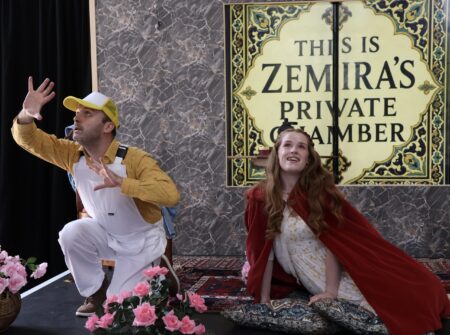
Featured Image: Gwilym Bowen (Azor) and Ffion Edwards (Zemira) © Bampton Classical Opera
Cast:
Sandro – Samuel Pantcheff
Ali – Andrew Irwin
Azor – Gwilym Bowen
Zemira – Ffion Edwards
Fatima – Siân Dicker
Lesbia – Rachel Roper
Production:
Director – Jeremy Gray
Associate Director – Harriet Cameron
Costumes – Pauline Smith, Anne Baldwin
Lighting – Ian Chandler
Visuals – David Hudd, Keith Farr
Répétiteur and Harpsichord – Alex Norton