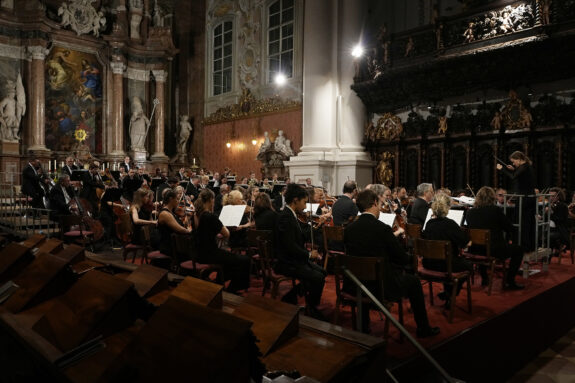
 Austria St Florianer Brucknertage 2026 – Beethoven (orch. Bruckner), Bruckner: Altomonte Orchestra / Katharina Wincor (conductor). Sankt Florian, 21 & 22.8.2026. (KW)
Beethoven (orch. Bruckner) – Piano Sonata No.8 Op.13 Pathétique – First movement introduction and exposition, from Bruckner’s Kitzler Study Book.
Bruckner – Symphony No.3 in D minor, Wagner Symphony, 2nd version, 1877.
The St Florianer Brucknertage – St Florian Bruckner Days – is a friendly, small scale festival which I would recommend anyone at all interested in Bruckner to attend. It feels like both an enormous pleasure and a privilege to be at this amazing baroque monastery in which Bruckner grew up and visited over fifty times thereafter. This year, after a week’s programme of chamber music, lieder, organ music and Bruckner-inspired jazz, there were two orchestral concerts. They opened with a performance of Bruckner’s orchestration of the opening of Beethoven’s Pathétique Piano Sonata, an exercise he wrote when studying orchestration with the Linz cellist and conductor, Otto Kitzler. It made an effective seven minute prelude, and something one is unlikely to hear anywhere else!
Bruckner’s Third Symphony opens with ‘an exquisitely written play of strings’ (Erwin Doernberg), described as ‘an eerie trance’ by Dermot Gault, ‘a mist of floating figurations’ by Robert Simpson. What the Altomonte Orchestra played was certainly exquisite, but neither eerie nor misty, but lively, rhythmic and full of expectation, the tread of the cellos and double basses purposeful rather than dogged, and the famous trumpet theme and woodwind responses sounded joyful, building with increasing excitement to the fortissimo unison. With this positive and direct opening, Maestra Katharina Wincor set her stamp on the performance to follow. Tempi were fairly brisk, but not excessively so, and although it was with this symphony that Bruckner’s ‘monumental’ style first seemed to find its feet, the Altomonte orchestra made sure that even in the extended D minor exposition it was never static: the music’s heart was beating throughout and its progress to its destination never in doubt.
There are many especially wonderful moments in the symphony and Wincor handled them all with authoritative expertise. Attending rehearsals it was impressive to see that she knew exactly what and where she wanted to improve, flicking speedily through the score pages, wasting no time on ‘exalted chatter’. There are several passages in this symphony where the blazing tumult from the full orchestra is suddenly cut off – it is as though a window has been abruptly closed, the noise from outside ceases and we are in a world of solitude, possibly even loneliness, rapt prayerful phrases – and then, equally suddenly, the window is thrown open again, the tumult briefly resumes before the window closes and we return to the quiet, the prayerful phrases now allowed to develop. These abrupt changes in dynamic were negotiated consummately by Wincor and her musicians, the whole sound enhanced rather than muddied by the extended reverberation in St Florian abbey. It seemed that the conductor’s combination of clear rhythmic marking of the beat with elegant gestures to mould the shape and dynamic of the phrases carried the music through all Bruckner’s dramatic extremes with never any danger of disrupting the formal cohesion of the work. It was very impressive.
Bruckner’s tempo marking for the slow movement – Andante. Bewegt, feierlich, quasi Adagio – (‘bewegt’ meaning something like ‘animated’, and ‘feierlich’ meaning solemn, ceremoniously) – is pretty inscrutable: neither one thing nor the other. Wincor chose to veer more to Andante and animated, rather than solemn and Adagio. It worked very well, making an effective structure of Bruckner’s abbreviation of the movement in this version, producing a strong climax, and it closed with the most beautiful E-flat major chord on the horns, held for six bars. During rehearsals Wincor was concerned to tune the orchestra, to ask groups players to assemble their chords note by note, and in the performance it paid off handsomely.
The thundering Scherzo was graced with a most beautifully articulated Trio, an absolute joy to listen to, and completed by the controversial coda. Bruckner had crossed it out in his manuscript and in the engraver’s copy, but it is 41 bars of Bruckner which it’s a great pleasure to be able to hear now and then!
As a listener – and probably as a performer! – it helps to know where you are in the formal structure of the Finale. You need a grip on what each of the three theme groups are, and a way of distinguishing what is development and not recapitulation, otherwise it can often seem loud and chaotic. Katherina Wincor seemed never in any doubt of where she was going and how to get there. There are two stormy sections of development based in the first theme, and then a wonderful iteration by the cellos of the chorale element of the chorale-plus-polka second theme. The cellos played this passage with heart-stopping beauty – it was a really magical moment. Another special passage is in the second theme recapitulation where the material seems to disintegrate in rather ghostly chromatic descent. The Altomonte Orchestra made this sound a really intriguing and mysterious farewell to the polka, to be heard no more in the symphony.
Finally, the strings begin their determined ascent crowned by a blazing trumpet fanfare, and everything resolves onto a triumphant statement of the opening trumpet theme. It was tremendous!
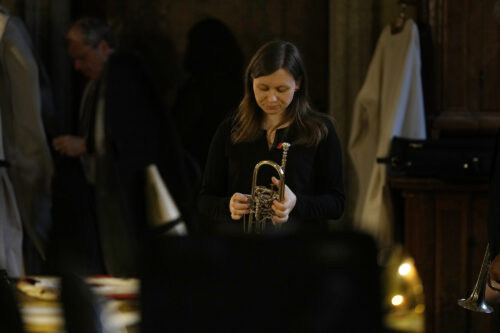
The symphony was performed twice, on the Friday and the Saturday, and maybe the second performance flowed even better than the first, perhaps played a little more confidently – though there wasn’t much to choose between them. The conductor was presented with a bottle of wine at the end of the Friday performance, upon which she immediately strode through her players to hand it to Bianca Oberleitner who played the first trumpet, introducing the motto theme that had set the whole symphony going. It seemed a very appropriate gesture, after all it was this symphony that gave rise to the Wagner’s epithet: ‘Bruckner the Trumpet’.
Ken Ward
Featured Image: Katharina Wincor conducts the Altomonte Orchestra at Sankt Florian © Reinhard Winkler
We were there and indeed an absolute joy to listen to it!
[edited]