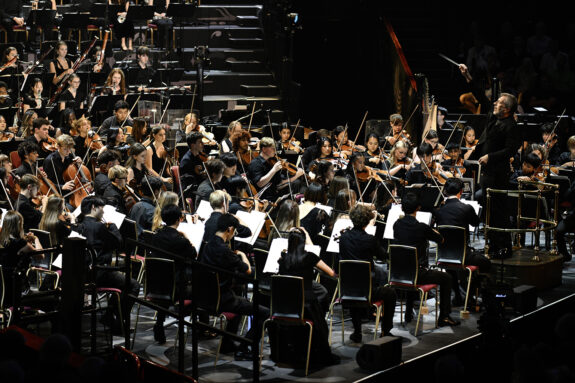
 United Kingdom BBC Proms 2026 [13] – Liszt, Adès, and Berlioz: National Youth Orchestra / Thomas Adès (conductor). Royal Albert Hall, London, 8.8.2026. (MB)
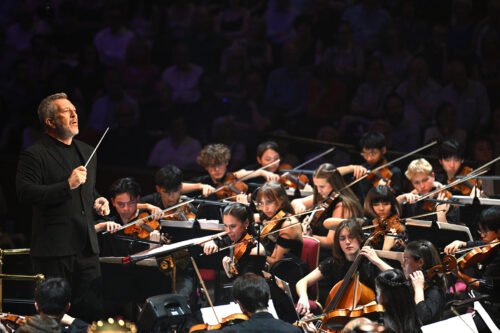
Liszt – Mephisto Waltz No.1, S.110/2
Adès – Dante: Part 2, ‘Purgatorio’
Berlioz – Symphonie fantastique, Op.14
To hear the National Youth Orchestra is always a treat. The enthusiasm of young musicians, not a cynical bone in their bodies, can hardly be gainsaid; but enthusiasm will only get one so far. These musicians have technical and musical capabilities beyond their years; many will have professional careers ahead of them. Just look at the NYO’s alumni. They will have many more rehearsals than a professional orchestra could ever hope for. (Eat your heart out, Celibidache!) There is also the sheer joy of hearing an orchestra of this size too; again, unaffordable on the professional scene for almost anything but Gurrelieder — and often not even then. Berlioz knew a true orchestral pianissimo required a far greater body of musicians than one was ever likely to hear, rendering his works either utopian or unperformable or, on some measure, inadequately performed in reality. What we hear today from ‘period’ and ‘modern’ orchestras alike, whatever the ideological claims of the latter, will almost always fall short of what he required. Such is life, at least under capitalism. We stretch our resources to breaking-point and beyond, and ultimately make do with less than perfection; otherwise, we should hear nothing at all. It was nonetheless a treat to hear the Symphonie fantastique played with musicians within the range of Berlioz’s expectation, if still towards the lower end (albeit with more powerful, modern instruments).
Before that, the first half of this concert conducted by Thomas Adès offered music by Liszt and Adès himself. The greatest musical avant-gardist of the 19th century, Liszt was stranger neither to ideas nor to practice in the realm of musical ‘progress’: neither on the piano nor the orchestra, inventing for the latter the new genre of the symphonic poem. So important were they to Wagner that he actually played down some of his own prior innovation, here strictly preceding that of Liszt, so as to incorporate Liszt’s poems into his musico-historical schema. The first Mephisto Waltz has a not dissimilar conception, reminding us that there were orchestral works before Liszt, as there have been many after, that may not strictly be classified in that way, but which at least come close. (Ask Berlioz, for one.) No one writes – plays, listens – in a vacuum. Coming to this music for the first time or the hundredth – the latter unlikely, for we hear it far less often than we might – no one would have failed to register the NYO’s musical, indeed human energy from the conductor’s first downbeat, indeed before that too. Unanimity of sound, but also of purpose, reached through collaboration rather than dictatorship, was apparent here and throughout the entire concert, whether in the opening phrase or the whirlwind that ensued, string crescendos a remarkable case in point (more difficult than they might sound). It was quite a ride for all of us. Handling the sudden change of tempo for the love music is a difficult task: how to ensure necessary contrast but also ‘symphonic’ continuity. If Adès proved stronger in the former than the latter, there was nonetheless much to admire and be thrilled by — especially in the return to full throttle. Moreover, all orchestral solos were taken exquisitely (again, very much the case throughout the concert).
Adès’s ballet Dante was written for the Royal Opera House and Opéra de Paris for the septcentenary of Dante’s birth. Here we heard the second of its three parts, ‘Purgatorio’. Its performance seemed once again to be outstanding, NYO musicians clearly relishing the opportunity to work with a composer on his music, in a performance it is difficult to imagine being surpassed. I felt decidedly ambivalent to it as music, though, a promising opening leading to outright bathos. The first six of its seven sections contains recorded material: baqashot chants, as revealed in Edward Venn’s useful note, connecting both with the composer’s family history and themes in Dante. They were fascinating to hear, as was, at the music’s best, their incitement to and/or emergence from orchestral material, be it for solo instruments, groups, or something approaching a full ensemble. I am not sure the writing always escapes orientalism, arguably all the more pronounced in frequent combination – almost as if we had not progressed from Saint-Saëns – of tonality and ‘fantastic’, ‘Oriental’ colouring. The microtones of the ‘real thing’ had considerably more intrinsic character. Despite the tendency towards film music, one could imagine it danced — and that was of course part of the point.
There were certainly thrills to be heard when we reached the final ‘Ascent’ in ten horns or five trombones standing together to play. When joined by bells, though, the score ended up sounding uncomfortably close to a television ‘Christmas special’. It made a noise, as did the orchestra, but beyond that? Wagner advised Liszt not to write a ‘Paradiso’ movement for his Dante Symphony, declaring depiction of paradise beyond the powers of music: advice Liszt wisely heeded, substituting a ‘Magnificat’. Given the nature of this musical approach, I think I shall similarly refrain as listener. Whatever my misgivings, a poorly-behaved audience – slurping ice cream, dropping things on the floor, taking phone calls, air conducting, and more – loved it.
And so, to Berlioz, gifts of conductor and orchestra united in a performance that threatened to raise the roof even of the Albert Hall, yet lacked nothing in subtle detail. The first movement received as fine a performance as I can recall for a long time, its introduction barely registering as such, but rather as one stage, full of potential yet equally absorbing on its own terms, in an ever-developing, shortish symphonic poem of its own. NYO energy could be experienced as coming direct not only from the players but their instruments: testimony to Adès’s wise stewardship in pursuit of Berlioz’s goals. I was especially intrigued by the darker corners, timbre, harmony, tempo, and more united in production of colour and motion. All manner of shades between them and the composer’s signature manic Romanticism made for another captivating journey, as did a graceful, yet at-times-menacing second-movement ball, here given with cornet solo. (Truth be told, I prefer it without, but in this context, it would have been idiocy not to give the soloist his moment to shine, as he certainly did.)
Once the ballroom had been brought to eyes and ears, the ‘Scène aux champs’ unfolded with every bit as keen a sense of musical narration. Excellent use was made of the Albert Hall; in veritable coups de théâtre, both oboe echo of cor anglais solo (excellent in both cases) and thunder-drums above in stereo with their siblings below made fine use of the gallery. Berlioz would have loved the spatial drama, as, I am sure, he would the Beethoven rarely more than a little below the surface, underpinning the movement’s structure. The darker timbres of the ‘March to the Scaffold’ echoed and extended the aforementioned corners in the first movement, lugubrious and extravert twin sides to the same fateful coin. If ever you had wanted to experience the sound of eight bassoons standing from within an orchestra, here was your opportunity. That was not in itself the point, but rather what was done with them — which proved to be of equal excellence.
A duly rollicking finale combined narrative and musical coherence to the extent that it would have been inconceivable to divide them. As black sabbath bells pealed from the gallery, witches and skeletons came to life and partied below. Coordination was no mean task in itself; bar one slightly precarious moment, quickly salvaged, there was no problem at all. The chase to the close, full of incident, imparted a properly Gothic thrill in this monstrous hall. If it were no surprise to be treated to an encore, the choice of music perhaps was, a darkly sensual John Barry ‘Space March’ from the score to You Only Live Twice. Now that is how you do film music.
Mark Berry
Featured Image: The National Youth Orchestra conducted by Thomas Adès © BBC/Chris Christodoulou
A brilliantly accurate if somewhat lengthy critique of Saturday’s NYO performance at the RAH… The early points regarding the huge scale of orchestral forces, (but even then being numerically well less than Berlioz wished for), got one thinking about earlier performances that one has either heard or taken part in. Listening to the Berlioz in the recorded sound (a different feed on Radio 3 to BBC TV?), I was constantly thinking that BBC sound engineers of yesteryear were trained to a much higher musical degree in their appreciation of a believable/acceptable orchestral balance. Do we honestly need to bring every wind/brass/percussion solo to the front of the texture so crudely?
Anyway, hats off to the NYO players (and coacheing staff) for a super performance Symphonie Fantastique, one which will live long in the memory
Good review. Slightly unfair on the Adès piece I thought. I was at the Birmingham concert and found it interesting. A second hearing live on R3 had me in tears at the end – very rare for me to have an emotional response to contemporary music, bar the odd, manipulated, stage musical! Agree that the Berlioz was a wonderful performance, truly Berliozian wild and energetic yet with the appropriate moments of stillness. One of the finest I’ve heard in ages, and sent me scurrying to my collection to play a few more! Personally I love the cornet solo which was prominent, along with the stereo harps in Birmingham, but barely audible in the radio relay and even more muted in the TV broadcast, sadly. Some oddly missing camera closeups of solo players too (the drummers at the end of the March to the Scaffold, and the triple cymbal players at the end), the more so since soloists stood for easy recognition! Yes, unnecessary to a knowledgeable audience, but a nice cue, I felt, for the many teens in the audience who might not otherwise know what is making the sound they are hearing.
The Liszt was well done, it is good to see Liszt’s orchestral music performed. There was some splendid playing throughout and Adès clearly knew the score thoroughly.
Adès’s own piece was a mixed bag of musical ideas, but it was listenable and certainly well played. I’m not sure how long it will stay in the repertoire, but it was good to hear it, even though we only had one of the three sections played.
I’m afraid I have to take issue with the performance of the Berlioz. The first movement was far, far too fast and facile. It did gain excitement at that speed, but at the cost of refinement and atmosphere. The speed put the players under too much pressure at times, and parts were a bit scrappy. The same applied to the speed in the second movement, the Ball. Refinement was sacrificed for surface excitement, and there was precious little sense of the dance at times. The third movement was again much too fast. Some criticise Berlioz for writing too long and wandering a pastoral scene, but it wasn’t helped, in my view, by playing it too fast again. The wind solos were rather lacking in character. Adès had many of the brass and woodwind soloists stand up for their solo passages, which struck me as somewhat theatrical and unnecessary. The March to the Scaffold set off at a good tempo, but the speed soon increased and the deadly menace lacked impact at this tempo. Again, surface excitement triumphed over the terror depicted in the music. I was left feeling that we were closer to Disney than to the French Revolution and the weirdness of Berlioz’s invention. The final movement was, once again, too fast for too much of the time. Yes, it was terribly exciting, but, no, it was nowhere near dark or menacing enough for a Witches’ Sabbath.
I am fully aware that my views are not shared by many other commentators of this particular performance, but I do know the score and have heard many dozens of performances and own many famous recordings.
The NYO are to be congratulated on the very high standards of their playing and ensemble. It is so good to see these young musicians so committed and skilful. Sadly, one wonders how many came from state schools, now that successive governments seem to give classical music such little importance, with the result that independent schools and specialist music academies are being relied upon to provide our musical future.