
 United Kingdom Day One of the Presteigne Festival 2026 [1]: St Andrew’s Church, Presteigne, 27.8.2026. (PC)
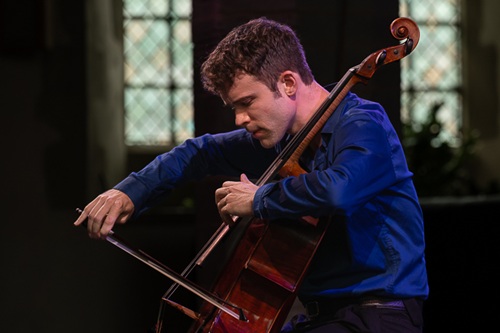
3pm – ‘The Fall of the Leaf’: Rainer Crosett (cello)
Sally Beamish – Gala Water
Natalie Roe – I need stillness (world premiere)
Imogen Holst – The Fall of the Leaf
J. S. Bach – Suite in D minor, BWV1008
Now in its 44th year, the Radnorshire-based Presteigne Festival is always a shining highlight of the UK classical music calendar. The opening day of the 2026 festival provided a perfect illustration of this annual event’s exceptional qualities of enterprising programming and top-flight musicianship in attractive surroundings.
Five days of diverse and eclectic music-making began with the relaxed intimacy of an afternoon solo cello recital in the beautiful setting of Presteigne’s St Andrew’s Church. Rainer Crosett’s programme offered a classic of the repertoire preceded by three fine works from the 20th and 21st centuries. The concert began with a considered and deeply felt interpretation of Sally Beamish’s Gala Water of 1994. A poignant and directly communicative response by the composer to the loss of her baby by miscarriage, the work takes the form of a set of diverse variants on a Scottish folk tune, part of which is stated simply at the close of the piece. This committed account captured the music’s broad range of expression, from wistful reflection to impassioned declamation, offering a compelling soliloquy that drew the audience in further with every shift in mood.
The festival has always presented an impressive array of contemporary works and this year’s first example took the form of the premiere performance of Natalie Roe’s I need stillness, which was commissioned as part of the Royal Philharmonic Society’s Composer Programme. The score concerns a fervent desire to retreat from the hustle and bustle of everyday life to embrace silence and repose. The music began calmly and spaciously with long-held notes, punctuated by a repeated, two-note ‘heartbeat’ motif. This recurring figure provided the basis of the energetic central episode, driven by emphatic arpeggiated and scalic passages. A slowing of tempo signalled the arrival of the thoughtful and serene final section, which included ear-catching moments where the cellist glided into playing firstly near the fingerboard and then near the bridge of the instrument before the ‘heartbeat’ motif faded to a final note of arrival. Rainer Crosett conveyed the composer’s colourful and engaging narrative with improvisatory flair.
Remembered best for her role as Benjamin Britten’s amanuensis, Imogen Holst (1907-1984) has yet to receive her due as a composer, so it was a particular pleasure to encounter her variations on a theme, The Fall of the Leaf (1963). The theme itself, which features a descending line followed by an obsessively repeated, sighing, two-note phrase, is stated at the outset and returns at the end of the piece. The three variants at the heart of the score are a decisive Vivace with constantly shifting dynamics, a tenderly lyrical Poco adagio, laced with decorative flourishes and a gossamer-light, toccata-like Presto. All the work’s various technical and expressive demands were met with elegance in this fresh and poetic performance.
An impassioned account of J. S. Bach’s Suite in D minor combined nobility with suppleness. It rounded off a recital of notable drive and refinement, a quintessence of this festival’s most treasurable attributes.
7.30pm – ‘The Soldier’s Tale’: Rowan Pierce (soprano), Imogen Whitehead (trumpet); Jonathan Gunthorpe (narrator), Alex Wilson (The Devil), Alexander Knox (The Soldier), Ruth Evans (director), Presteigne Festival Ensemble, George Vass (conductor)
Cecilia McDowall – The Night Trumpeter
Lillie Harris – The aspens talk of rain (world premiere)
Stravinsky – The Soldier’s Tale
St Andrew’s, Presteigne also provided the location for the opening day’s evening concert that featured two recent pieces for mixed chamber ensemble followed by a ground-breaking music theatre work by Stravinsky. All three items on the programme were conducted with precision and warmth by the festival’s artistic director, George Vass.
Cecilia McDowall’s The Night Trumpeter (2002) is scored for a sextet of trumpet, violin, cello, clarinet, bassoon and piano and consists of two movements, both of which were inspired by historical uses of the trumpet. Entitled ‘The power of dreams’, the opening movement takes its cue from a description in Rose Tremain’s novel, Music and Silence of the Duchess of Mecklenburg’s engagement of a night trumpeter to keep watch over her sleeping grandson, the future King of Denmark, Christian IV. The trumpeter had to sound the alarm if the baby awoke and play a lively melody to dispel nightmares. Lit with sparkling piano sonorities, the opening section was still and gentle. Presently, a lilting, berceuse-like passage led by a fond trumpet theme held sway before shadows fell over the score, followed by vigorous alarums. An uplifting trumpet melody sounded from afar before the movement’s initial, bright resonances returned reassuringly. The second movement, ‘Kircher’s Ear’, conjures up illicit Court conversations picked up by an early bugging device shaped like a huge trumpet, devised by Kircher, a German architect contemporary of Christian IV. At the start of the movement, the bell of the trumpet was directed into the piano to magnify harmonic resonances and after this, a succession of spirited and rhythmic exchanges ensued. The Presteigne Festival Ensemble musicians caught the opening movement’s dreamy, tender qualities and relished the furtive busyness of the second movement. Imogen Whitehead’s responsive and assured handling of the prominent trumpet lines was especially fine.
There followed a festival commission, The aspens talk of rain by Lillie Harris. This piece was written for solo soprano and an ensemble made up of clarinet, bassoon, violin, cello, double bass and piano. It consisted of four settings of poems, mainly by Edward Thomas, with an except by Emily Pfeiffer. Mindful of the text’s description of birds and leaves before and after the rain, the composer took poems that conjure up rural imagery and detail to create the musical equivalent of a quiet evening walk through the British countryside. The resulting movements, entitled ‘Scents’, ‘Feathers’, ‘Leaves’ and ‘Crystals’, were bathed in an idyllic, Arcadian glow, thanks to the wonderfully blended, mellifluous instrumental writing and flowing vocal lines, imaginatively characterised by Rowan Pierce. The four unbroken movements formed a single, evocative span, taking in moods ranging from relaxed, awestruck, playful, contemplative and energetic. Embracing depictions of sunshine and shadow, the music ended with a delicately fashioned illustration of a light shower on summer leaves, suffused with airy, staccato triplets that evaporated into silence. This fluent, vividly drawn piece was gracefully and warmly rendered by soloist, players and conductor in an appealing and assured concert debut that drew an enthusiastic response from the audience.
After the interval came a performance of Stravinsky’s The Soldier’s Tale (1918) that benefitted from the use of Michael Flanders and Kitty Black’s witty English translation of the text, subtle but atmospheric lighting effects and deft directorial touches such as the use of the venue’s pulpit to deliver a homily to the audience. Jonathan Gunthorpe’s suave, unflappable narrator, Alex Wilson’s flamboyant, insinuating Devil and Alexander Knox’s earnest, likeable Soldier all made their mark, bringing the narrative to life with considerable verve. The crowning glory was the superb playing of the Presteigne Festival Ensemble, virtuosic and stylish under the vigilant and supportive direction of George Vass. While the performers were receiving their applause, the conductor rightly singled out violinist Francesca Barritt, outstanding among a consummate group of musicians who inhabited and savoured Stravinsky’s punchy, riveting score.
Paul Conway