
 United States Ukrainian Freedom Orchestra 2026 Invincible Tour [2] – Frolyak, Verdi: Ailyn Pérez (soprano), Natalie Lewis (mezzo-soprano), René Barbera (tenor), Soloman Howard (bass), Met Chorus Artists (chorus director: Tilman Michael), Ukrainian Freedom Orchestra / Keri-Lynn Wilson (conductor). David Geffen Hall, New York. 26.8.2026. (RP)
Bohdana Frolyak – Gloria
Verdi – Requiem
Encore: Yuri Shevchenko – We Do Exist! (Ми є!)
Conductor Keri-Lynn Wilson and the Ukrainian Freedom Orchestra opened their second New York concert with Bohdana Frolyak’s vividly colored, spiritually charged Gloria. Commissioned by the Ukrainian Freedom Orchestra and given its world premiere in Warsaw on 16 August, the work is dedicated to Ukraine’s heroes. Despite its sober character, Frolyak envisions a time when the tears and horrors of war give way to peace and freedom.
In the program, Małgorzata Lisiecka compares Frolyak to the Greek tragic heroines Hecuba, Electra and Antigone. Frolyak’s music embodies their shared qualities – grief, resistance, remembrance – in the agitated chimes that begin the work, the death rattles of cymbals and timpani and crashing dissonances. Most poignant is the incorporation of Levko Lepky’s song ‘Чуєш, брате мій’ (‘Do You Hear, My Brother?’), with words by his brother, the poet Bohdan Lepky. The song has become an emblem of exile, loss and remembrance in Ukraine. Frolyak transforms its melody into a funeral march for her country’s fallen warrior heroes.
The somberness is repeatedly interrupted by tranquil passages, sparkling, transparent phrases pierced by sharp dissonances and sudden bursts of color in which the orchestral sound magically shimmers. The work ends with a calm, solemn progression of chords shot through by the harp. Frolyak has poured too much emotion into Gloria for it to be fully absorbed in a single hearing. The visceral impact is undeniable, however, as are its moments of striking beauty.
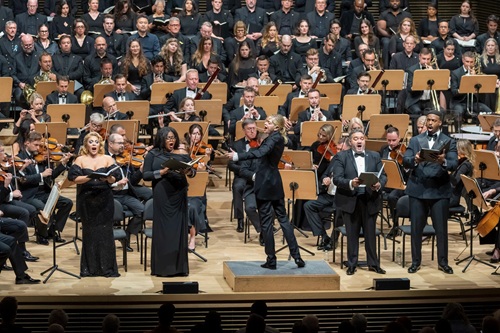
Conducting from memory, Wilson led a singularly powerful performance of the Verdi Requiem. Her approach was monumental in scale while never becoming operatic. Key to her interpretation was the sensitivity she brought to the piece’s more reflective passages and the blend she achieved from the soloists.
The chorus, billed as the Met Choral Artists, was drawn from the Metropolitan Opera Chorus and prepared by its director, Tilman Michael. It began with the singers whispering ‘Requiem aeternam’ and ended with soprano Ailyn Pérez and the chorus repeating ‘Libera me, Domine’ ever more softly, finally fading to a pianississimo. In between came moments of sheer terror as Wilson unleashed the full sound of chorus and orchestra in the Dies irae, punctuated by Dmytro Ilin’s demonic blows on the timpani.
Apart from demonstrating its ability to sing at the extremes of volume that Verdi demands, the Met Choral Artists impressed with their vivid expression of the text. Granted, the Dies irae was a pure sonic experience, with the overwhelming volume producing visceral impact at the expense of intelligibility. The Sanctus erupted in a blaze of contrapuntal brilliance, its two choirs answering one another with exhilarating rhythmic energy. The success was owing to Wilson’s judicious choice of tempo, resisting the temptation to drive it at breakneck speed.
Pérez could have paid tribute to Dolly Parton with her fantastic coif (a color seldom, if ever, found in nature) and a form-fitting, sparkling black gown. Like Parton, however, Pérez has an important voice and artistry to match. She displayed the creamy lushness of her voice in the work’s lyrical passages. The beautiful calm of her voice was heard for the final time in the ‘Requiem aeternam’, after she had instilled ‘Libera me, Domine, de morte aeterna’ with terror through the slice, thrust and urgency of her singing.
Mezzo-soprano Natalie Lewis has a voice of extraordinary clarity, depth and richness that commands attention, as does her artistry. In the Recordare, her warm voice blended perfectly with Pérez’s, and they achieved the same in the Agnus Dei, a model of purity of tone, impeccable intonation and controlled legato. In the Lacrymosa, Lewis displayed the dramatic weight and emotional intensity that come naturally to her.
René Barbera possesses a lyric tenor of refinement and beauty. At his most stentorian in the Ingemisco, Barbera lent passion and eloquence to the supplicant’s plea for mercy and forgiveness. He directed those same qualities inward in the ‘Hostias’, notable for the ease with which he sang its long, sustained phrases. Authority and power resonated from Soloman Howard in the bass’s dramatic entrance on the words ‘Mors stupebit’ in the Dies irae as they did in the low, more declamatory lines of the Tuba mirum. The quartet achieved a remarkable blend and the richness of Howard’s sepulchral bass provided its foundation.
As she had in the prior evening’s concert, Wilson led the orchestra in Yuri Shevchenko’s meditation on the Ukrainian national anthem for solo violin and string orchestra, We Do Exist! (Ми є!). Once again, concertmaster Marko Komonko played its poignant melody with profound feeling, his tone resonating equally with sweetness, tears and hope. After the ensuing silence came cries of ‘Slava Ukraini!’ (‘Glory to Ukraine!’) from throughout the hall, ringing out as triumphantly as the antiphonal trumpet calls that had resounded so powerfully in the ‘Tuba mirum’ of the Requiem.
Rick Perdian