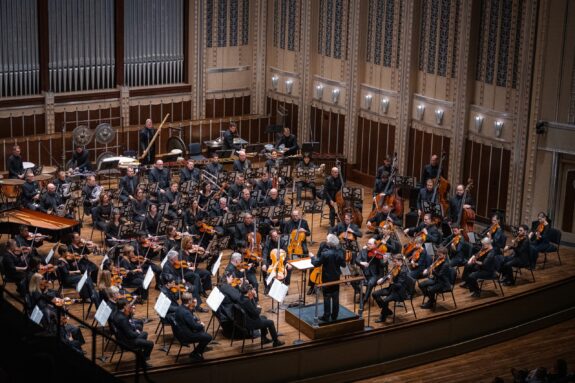
 United States Summers at Severance [4] – Various: Cleveland Orchestra / Franz Welser-Möst (conductor). Mandel Concert Hall at Severance Music Center, Cleveland, 27.8.2026. (MSJ)
Wagner – Prelude to Act I of Die Meistersinger von Nürnberg
Deutsch – Intensity
R. Strauss – Symphonia domestica, Op.53
Encore: R. Strauss – ‘Moonlight Music’ from Capriccio
Franz Welser-Möst made a welcome return to Cleveland this weekend to close off his last summertime appearances as music director and to rehearse the orchestra in repertoire that will figure in the ensemble’s upcoming European tour in October. The concert, while quite a workout for the orchestra, showed them in fine form while giving spotlights to Welser-Möst’s accomplishments as he enters the final year of his twenty-five in Cleveland.
Without question, the scene-stealer was Bernd Richard Deutsch’s Intensity, a work that Welser-Möst and the Cleveland Orchestra commissioned from the young German and premiered in 2022. Deutsch is one of several interesting composers who have filled the ensemble’s Daniel R. Lewis composing fellowship in the last two decades, including such names as Matthias Pintscher, Jörg Widmann and Alison Loggins-Hull. Deutsch’s discovery has to count as one of Welser-Möst’s most impressive accomplishments, for this composer wields an endlessly creative voice. Early in Deutsch’s fellowship, we heard his organ concerto Okeanos with Paul Jacobs as soloist, which was met with great warmth by the Cleveland audience who do not stand and cheer for a new piece unless they really mean it. And cheer they did. Intensity came later, and Welser-Möst’s choice to bring it back in his final season stands as testimony to his regard for it. Just last season, we had the opportunity to savor Deutsch’s new work, Urworte, also commissioned by the Cleveland Orchestra. He is a composer worth following.
Looking at the stage before the start of Intensity, one might be forgiven for raising a skeptical eyebrow at the battery of percussion instruments along the back of the stage. After all, untold numbers of modern pieces run through a checklist of obscure percussion sounds as composers take a desperate stab at sounding innovative. But one can rest assured with Deutsch that every instrument is there for a purpose that will justify its usage and Deutsch will make it highly expressive. This piece included a moment where tuned gongs were doubled a couple of octaves higher by harps, an ear-tickling texture unlike anything else I have heard, but – more importantly – a plangent, mysterious sound that evoked emotion. Another startling moment was when Deutsch took slide whistles, the silliest of instruments, and had the percussionists play them in slow glissandos that were positively unearthly. Other moments seemed to nod at other pieces of music: the gamelan-like mallet instruments of Messiaen’s Turangalîla in one place and the horns in another section sounding for a moment like the fragmented playout-groove at the end of The Beatles’ album Sgt. Pepper’s Lonely Hearts Club Band.
The composer’s sheer confidence is there in his title. Who would dare name a piece Intensity when he has everything to lose if it doesn’t sound intense enough? Bernd Richard Deutsch, that is who, and from its teeming opening to the uncanny quiet middle section and on to the frenzied ending the piece never let up on intensity. Tonal but expressively free-ranging, this is the kind of music that makes you want to hear it again and again, so kudos to Welser-Möst for bringing it back as well as scheduling it for the upcoming tour. In short, it’s a masterpiece, and this conductor and orchestra deploy it masterfully.
As the summer ends and the 2026/2027 Cleveland season begins, there will be ample opportunities to take stock of Welser-Möst’s years with the orchestra, and his programming will provide many ideal moments. One such instance was his concert-opening direction of the Prelude to the first act of Richard Wagner’s Die Meistersinger. This is a popular concert chestnut but it isn’t often performed this well: many conductors and orchestras get bogged down in the detailed counterpoint and/or let the textures bloat into a sort of generic grandeur. Welser-Möst would have none of that – he kept the tempo spritely and textures aerated and played with a light touch, a reminder that the opera is, after all, a comedy.
Likewise, his handling of Richard Strauss’s affectionate portrait of family life in Symphonia domestica avoided the potential longueurs and kept it flowing with elegance and buoyancy. One of the classic recordings of the work – the 1964 gem by George Szell and the Cleveland Orchestra – is still a formidable reference. But what is winning about Welser-Möst’s way with it is that he allows more elan and charm than Szell whose hand always seems to grip the steering wheel with white knuckles. In that sense, Welser-Möst is more in the manner of the recordings by Rudolf Kempe and Zubin Mehta, both of whom responded to the sense of fun Strauss surely intended for the work. Strauss is one of Welser-Möst’s lodestones, and the orchestra reflected the conductor’s elegant way with this music while making the composer’s considerable virtuosic challenges feel direct and natural. Particularly impressive were the extended solos by Robert Walters on English horn, Frank Rosenwein on oboe and concertmaster Joel Link on violin.
The Strauss was followed with more Strauss as an encore, a glowing performance of the ‘Moonlight Music’ from Capriccio. Cleveland Orchestra tour attendees will be in for a treat.
Mark Sebastian Jordan
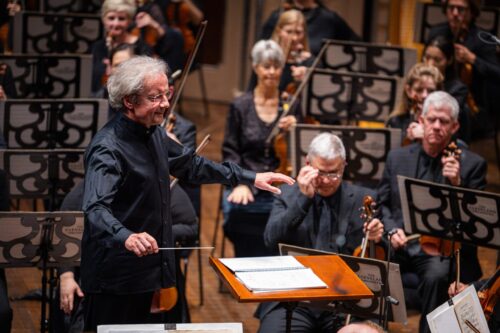
Featured Image: Franz Welser-Möst leads the Cleveland Orchestra in Deutsch’s Intensity © Aireonna McCall-Dubé/TCO