
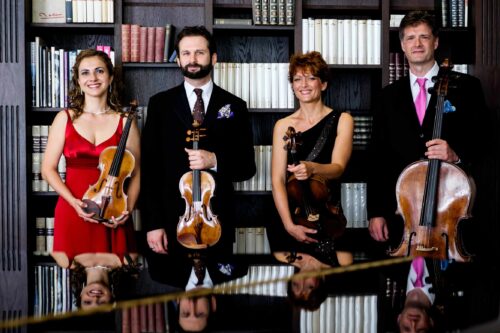
 United Kingdom Edinburgh International Festival 2026 [7] – Kurtág, Schubert: Gringolts Quartet (Ilya Gringolts, Anahit Kurtikyan [violins], Silvia Simionescu [viola], Claudius Hermann [cello]). Queen’s Hall, Edinburgh, 24.8.2026. (GT)
Kurtág – Officiúm breve, Op.28; (Hommage à Jacob Obrecht), Op.13; Twelve Microludes for String Quartet, Op.13 (Hommage à Mihály András)
Schubert – String Quartet No.15 in G major, D.887
Encore – Dvořák – Cypresses No.3
This morning’s recital was one of the most intriguing of the chamber music programme in this year’s festival; choosing Schubert’s final expression in the quartet genre and matching his musical ideas with the Hungarian composer György Kurtág (in his centenary year) was a masterstroke by the curators of the festival. The structure of the programme was innovative, with Kurtág’s music heard between the four movements of Schubert’s final string quartet, allowing the audience to hear the relationship between the composers.
Schubert was experimenting with harmony decades ahead of his time, especially here in his last quartet, as he suddenly changed major chords to minor chords rather than developing the opening major idea in the huge opening movement, Allegro molto moderato, something which was experimented with a century later by Bartók, Kurtág’s fellow countryman. The movement opens up the struggle between light and darkness; the idea being marvellously opened by violinist Ilya Gringolts and which is not resolved until the final notes. Each of Schubert’s movements contains expressive delights, such as the depths of despair in the second movement, Andante un poco moto, which reaches terrifying moments in loud shrieks of despair, yet concludes as it returns to a static, bland exchange between the violin and cello.
In the third movement, Scherzo. Allegro vivace – Trio. Allegretto, it is the Trio that takes us to a different world, lingering somewhat before reprising the bright, upbeat ideas of the Scherzo, yet attempting to change the novelty before the fourth movement, Allegro assai, which explores the aggressive tension absent from the previous movements, using only brief changes in rhythm and exploring irony and operatic references taking us to new boundaries in the quartet genre. The cheerfulness of the cello pizzicatos from Claudius Hermann transcends the excitement by closing on a radiant note. Composed in 1826, it was not heard until 1851, when music was already changing and somewhat heralding Bruckner in its cosmic grandeur.
Kurtág was influenced by Schubert, and his Játékok includes many quotations from Schubert in transcription form for double piano. In this performance, the Arioso interrotto from Kurtág’s Officium breve, dedicated to Andreae Szervánsky and alluding both to Webern and to the lyricism of Szervánsky, was played between the first and second movements of the Schubert 15th String Quartet. The piece is broken into fifteen brief parts, which are no more than fleeting episodes of brightness and sparks of life.
Kurtág’s Hommage à Jacob Obrecht opened the second part of the concert and, before the third movement of the Schubert quartet, proved a remarkable switch from Schubert’s music to the exploration of musical apparitions from 500 years ago. Kurtág’s composition offered pictures of darkness and light and was almost revelatory and magical for string quartet.
The third piece by Kurtág was between the third and fourth movements of the Schubert Quartet. Twelve Microludes for String Quartet, Op.13 (Hommage à Mihály András) are short dances on the chromatic scale that briefly allude to Webern and barely last more than a minute each.
The concert proved revelatory, combining a remarkable hearing of one of the greatest Schubert string quartets, mixed with the Hungarian composer’s masterly pieces that reflect on Schubert, Obrecht and the 20th-century modernism of Webern, Bartók, and Stravinsky. The curators of this concert deserve the highest praise for programming this surprisingly innovative concert, and especially for marking the birth centenary of the great Hungarian composer, teacher and pianist. The performance by this outstanding string quartet deserves the highest praise and is among the highlights of this year’s festival.
Gregor Tassie