
 United Kingdom Day Two of the Presteigne Festival 2026 [2]: St Andrew’s Church, Presteigne, 28.8.2026. (PC)
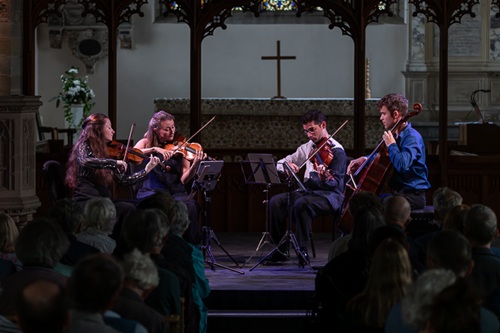
2pm: ‘Bosmans, Schumann and Fragments’: HearAndNow Collective, Amsterdam
Henriëtte Bosmans – String Quartet
Sally Beamish – Nine Fragments (String Quartet No.4)
Schumann – String Quartet in A minor, Op.41, No.1
The second day of the Presteigne Festival featured two memorable chamber concerts held in the village’s St Andrew’s Church. Both events highlighted the communicative strength of chamber music, in their subtlety, intimacy and immediacy.
The HearAndNow Collective, Amsterdam gave a memorable afternoon recital in repertoire spanning three centuries. Rarely encountered in British concert halls, the 1927 string quartet by Dutch composer Henriëtte Bosmans received a polished and persuasive account. From the outset, the players caught the ear with the opening movement’s evocative unison subject, and they were alert to every unexpected harmonic shift in the ensuing material. In the central Lento, an elegiac violin theme was rendered with simple dignity, and the more relaxed succeeding music was effectively contrasted. The exhilarating finale’s energetic rhythms brought the performance to a compelling close. This subtle and distinctive piece made an arresting concert-opener.
Sally Beamish’s Nine Fragments (String Quartet No.4) of 2018 comprises a series of brief, splintered movements that hold up a distorting mirror to various passages in Robert Schumann’s Quartet in A minor of 1842. The players brought a nervous intensity to these fleeting shards and their contorting perspectives. Yet they remained sensitive to the music’s broadly fluctuating moods, conveying joy as well as wistfulness and solemnity and allowing generous space for the hushed and spacious ‘Liebeslied’ fourth movement to unfold. Reflections on the considerable challenges of the Schumanns and Clara’s grief throughout her widowhood seemed to seep through the cracks in this intense, but always compassionate set of fractured, but revealing miniatures.
It was enlightening to move directly from these elliptical ruminations to a performance of Robert Schumann’s A minor Quartet, to which Nine Fragments is so closely entwined. The HearAndNow Collective’s detailed and versatile approach captured the lightness of the Scherzo, the slow movement’s lyrical expressiveness and the breeziness of much of the finale with its imposing coda. This commanding reading ended a thought-provoking recital, graced with insightful music-making.
7.30pm: ‘A Trio of Horn Trios’: Fenella Humphreys (violin), Ben Goldscheider (horn), Clare Hammond (piano)
Michael Zev Gordon – Barcarola; Waldeinsamkeit (world premiere)
Ravel – Violin Sonata in G
Huw Watkins – Horn Trio
Mathilde Wantenaar – Petit Morceau
Lennox Berkeley – Horn Trio, Op.44
The evening concert on day two of the festival offered a colourful, diverse programme of contemporary and 20th-century repertoire, superbly played by three of the most outstanding exponents of their instruments before the public today. To begin, Barcarola, for violin, horn and piano (1998) by the festival’s composer-in-residence Michael Zev Gordon conjured up the hypnotic, crepuscular scene of a boat pushing out on dark waters and a song emerging from the deep. From the clear, songlike opening violin and horn lines over sonorous, glistening piano chords through firstly agitated and then fragile episodes to a lilting closing section gently floated over swaying piano chords, Barcarola cast a potent spell. Its dreamy atmosphere was expertly caught.
Ravel’s Violin Sonata was captivatingly played. Fenella Humphreys’s thrillingly raw and visceral approach to the violin lines, especially in the jazzy central movement, complemented Clare Hammond’s elegantly poised, fluid pianism.
Huw Watkins’s Horn Trio (2008) is cast in a single span that juxtaposes swift and incisive material with more introspective paragraphs. The players communicated the urgency and intensity of this compact, closely argued score, balancing perfectly its lyrical and dynamic aspects in a satisfyingly layered performance that built inexorably to a decisive close.
After the interval came a festival commission, Michael Zev Gordon’s Waldeinsamkeit, for horn and piano (2026). This was something of a paean to German Romanticism, with hunting horn calls and the melancholy of forest murmurs providing an effective vehicle for Ben Goldscheider’s vibrant and painterly musicianship and the clarity and resonance of Clare Hammond’s keyboard skills. Moments of stillness and wistfulness were momentarily disturbed by a horn-led exclamation, but the work ended as softly and hauntingly as it had begun.
Petit Morceau, for violin and piano by Dutch composer Mathilde Wantenaar was written for teenage contestants in the 2024 Netherlands Violin Competition, with a piano part fashioned to be attempted by amateur executants. Tuneful, fluent and charming, it was rendered with a folk-like simplicity.
This wide-ranging recital ended with Lennox Berkeely’s characterful and well-crafted Horn Trio of 1952. With a concise sonata-form Allegro followed by an eloquent Lento and a lively, good-humoured, extended finale in the form of a theme and ten vividly characterised variations, this chamber piece was a genuine crowd-pleaser and brought a diverse and excellently played recital to a thoroughly enjoyable finish.
Paul Conway