 United Kingdom Edinburgh International Festival 2026 [3]: The Hub, Edinburgh, 16 & 18.8.2026. (SRT)
16.8.2026: Up Late with Mark O’Connor
Kleio Quartet, Makato Ozone (piano), Nicky Spence (tenor) and Dylan Perez (piano), Mark & Maggie O’Connor (violins), Óscar Dudamel and his Orchestra, Nicola Benedetti (violin)
17.8: Classical Jam with Nicola Benedetti
Nicola Benedetti (violin), Kleio Quartet, Rising Stars of Strings 2024-26
Towering over Edinburgh’s Old Town, right next to Edinburgh Castle, stands the old church building that, since 1999, has served as the year-round headquarters of the Edinburgh International Festival. Known now as The Hub, it houses the festival’s administration, and acts as the rehearsal venue for the Edinburgh Festival Chorus. However, in August it throws open its doors as a very particular kind of performance space for the EIF.
The atmosphere in the Hub’s main hall is very different to what you will find in the Usher Hall or the Queen’s Hall. Here the audience reclines on sofas, rugs bedeck the floor and shock horror, it isn’t frowned upon to go to the toilet or the bar whenever you would like to. Programmes, and sometimes even performers, are often unannounced in advance, but people still turn up in their droves because they like the more relaxed atmosphere, and also because they trust the festival to put on something of high quality, even if they don’t know what it is going to be.
Often the Hub hosts world music, but when it showcases classical music that relaxed vibe is refreshingly different and very effective. When I attended an ‘Up Late’ event on Sunday night, I stood in the balcony, leaning up against a balustrade and sipping a cocktail (tough life), while beneath me a crew of performers who were in Edinburgh for other concerts turned up to the Hub to do something a little different.
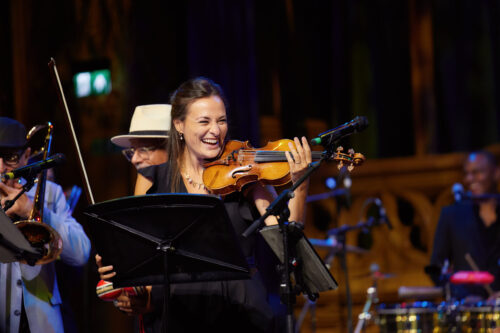
And never once did it feel like the audience was getting second best. The Kleio Quartet played serious music by Webern and Haydn, pianist Makoto Ozone improvised like his life depended on it, and tenor Nicky Spence sang four songs, mostly with his tongue planted firmly in his cheek, accompanied on the piano by his husband, Dylan Perez. It was presented by American violinist Mark O’Connor who, with his wife Maggie, played his own (ferociously difficult) suite that transformed a Scottish reel into some dazzling bebop. Then some Latin American sunshine from trombonist Óscar Dudamel (father of conductor Gustavo) and his 8-piece orchestra who lit the place up with the kind of salsa to which it was impossible to stand still. Gustavo was meant to be there to play violin alongside his father: he had to withdraw due to illness, so none other than festival director Nicola Benedetti stepped in to play her violin with the band instead!
It is that sense of come-as-you-are that makes these evenings pretty special, with some lightning-in-a-bottle moments that you know you only get because everybody there seems to be having an outrageously good time, performers as well as audience.
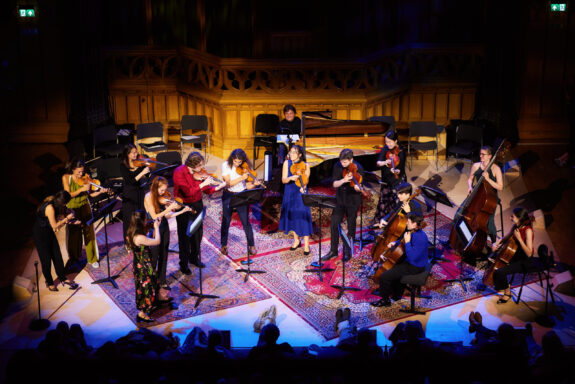
There was an even more seat-of-your-pants feel to the ‘Classical Jam’ concert the following evening, though always in a very refined manner. Classical Jam invites the audience to choose the music and gets up-and-coming musicians to play it. Ticketholders are emailed a shortlist in advance of the concert so that they can vote, and the top four pieces are played, together with a set of things that the musicians choose. Those musicians mostly come from the EIF’s Rising Stars of Strings programme, a scheme which mentors up-and-coming musicians and gives them a high-profile platform at the festival, along with mentorship from Nicola Benedetti. She said from the stage that her ambition with these concerts was to recreate the feeling of the afterparty of a chamber music festival where, apparently, some musicians often bash out a private performance after some food and some drinks, recapturing the sense of wonder at how beautifully something was written and the sheer fun of playing it.
Not everything worked perfectly, but the whole programme had a sense of spontaneity that, for obvious reasons, other classical concerts just don’t have. And with that came a lovely sense of freedom in the risk-taking. Their performance of the opening of Grieg’s Holberg Suite, which began the concert, positively oozed relaxed good humour and affection for one another (aside from their Leroy Anderson encore, this was the only piece in the evening where everyone was taking part), and the first movement of Mendelssohn’s Octet, which followed, was as joyously airborne as any you will hear. Gloriously sunny Dvořák (the last movement of the American quartet) and meditative Tchaikovsky (the slow movement of the Souvenir de Florence) followed along with music from living composers like Philip Glass and Jessie Montgomery, though the serious grandeur of Brahms’s G minor Piano Quartet was a bit of a mood-killer alongside such upbeat good humour.
No matter: this wasn’t so much a concert as an audience being permitted to eavesdrop on some pals having fun and, if you wouldn’t want every classical concert to be like this, it was a real treat to be allowed in on this one. These Hub evenings, in all their forms, are perhaps the most distinctive thing about the EIF under Benedetti’s directorship and, more than that, they feel like they have become an indispensable part of the festival’s culture.
Simon Thompson
The Edinburgh International Festival runs until 30 August in venues across the city. For information click here.
Featured Image: Classical Jam with Nicola Benedetti © Andrew Perry