
 France Oiseau Bleu Festival – Various: Maria Krasnikova (soprano), David Vinitsky (violin), Takahiro Sasaki (positive organ). Saint-François-de-Paule Église, Nice, 15.8.2026. (DS)
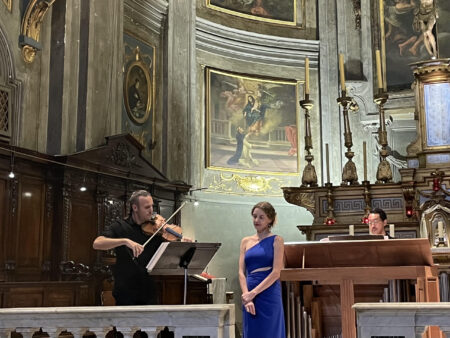
Artistry, inventiveness and preparedness are the hallmarks of a successful recital. At the penultimate concert of the Oiseau Blue Festival in Nice, an unusual but splendid combination of soprano, violin and positive organ (pipe organ) had exactly that.
The inventiveness stemmed from the idea to trace different periods of music through versions of ‘Ave Maria’ (aptly timed for the nationally observed holiday of Mary’s Assumption). After two short Baroque ‘warm-up’ works by André Campra and Andrea Falconieri established the well-versed technical and expressive range of the musicians, they pushed forward into early Romantic bel canto material with soprano Maria Krasnikova performing an operatically superb ‘Ave Maria’ by Donizetti.
She explained that we would recognize some of the ‘Ave Maria’ versions and be surprised by others, which proved to be quite true with a late-20th-century pop-leaning heart jerker version by William Gomez. It verged (with unexpected appeal) on the spectrum of Eurovision Contest Songs, and Krasnikova kept it tasteful with gentle phrasing combined with a sweetness that nevertheless showcased her powerful vocal command.
The trio played striking interpretations of each work. The familiar Bach/Gounod version was both ponderous and sublime, and the Pietro Mascagni – one we should be hearing more often – shadowed Puccini, and the group’s shift to a modern, bittersweet tone was perfectly matched.
Less obvious but equally crucial was the fact that nearly every work on the program required improvisation by violinist David Vinitsky and organist Takahiro Sasaki because none of the works had been arranged formally for this particular grouping of instruments. An interpreter of Early Music and Baroque, Vinitsky responded exquisitely to Krasnikova and blended various timbres of violin tones to meet each moment – arpeggiated sections of the spikier and sardonic ‘Ave Maria’ by Cherubini were levitating in his hands. Sasaki offered excellent transcriptions of large ensemble parts for the organ. Sitting behind the one-pipe organ, he was like a DJ focused on his turntables, keeping up continuo and ostinato or lengthening out harmonies that gave a hypnotizing flow to the concert. For Schubert’s ‘Ave Maria’, he added a fresh, folk-like atmosphere with a toy-like touch he drew from the organ that was reminiscent of 19th-century street fairs. This made for an intriguing contrast that pulled together the earnest tone of the violin and the soprano’s graceful melodic through line.
Covering so many works in the heavy August heat that had infiltrated the church in the old town of Nice proved the group’s dedication and an ability to give a peak performance despite the inevitable setback of steady perspiration. Krasnikova (in a striking blue dress) brought tantalizing facial expressions and aria-like deliveries that animated each song. All three artists adjusted to the demands the acoustics made: during the complex pairing of ‘Laudate Dominum’ and ‘Alleluia’ by Mozart, Krasnikova moved next to Vinitsky after the opening section fell slightly out of alignment so they could better hear each other. The work benefited immediately.
In a well-considered choice – both to keep audience interested and give each other relief during the performance – short works were interspersed. Saint-Saëns’s ‘Le Cygne’ featured just violin and organ and it was terrific, with a bubbly underwater quality produced by the organ and Vinitsky indulging in expressive vibrato instead of the starker Baroque quality of most of his playing. Mozart’s ‘Ave Verum’ was played solo by Sasaki which gave us a moment to relish his lengthy chords that led into dense, layered cadences.
It was ultimately the trio’s charm and personal touch that made the audience come to love rather than just enjoy the concert. Despite being overheated, the listeners voiced their adoration with hearty yelps and a standing ovation.
Daniele Sahr
Campra – ‘Salve Regina’
Falconieri – ‘Suave Melodia’
Donizetti – ‘Ave Maria’
Franck – ‘Panis Angelicus’
Saint-Saëns – ‘Le Cygne’ from Le Carnaval des animaux
Schubert – ‘Ave Maria’
Mozart – ‘Ave Verum’; ‘Laudate Dominum’ from Vesperae solennes de confessore;
‘Alleluia’ from Exsultate, jubilate
Cherubini – ‘Ave Maria’
William Gomez – ‘Ave Maria’
Massenet – ‘Méditation de Thaïs’
Bach/Gounod – ‘Ave Maria’
Mascagni – ‘Ave Maria’