
 United States Stravinsky, Berg, Bartók: Vilde Frang (violin), Juilliard Orchestra and Royal Academy of Music Symphony Orchestra / Esa-Pekka Salonen (conductor). Alice Tully Hall, New York, 7.8.2026. (DS)
Stravinsky – Symphony in Three Movements
Berg – Violin Concerto
Bartók – Concerto for Orchestra
Encores: Ravel – ‘Le jardin féerique’ from Ma mère l’Oye; Stravinsky – ‘Galop’ from Suite No.2 for Small Orchestra
As tenured orchestra jobs become harder to snag, the talent available to fill positions continues to grow. If we are lucky, supply will start to shift demand upwards because classical music very clearly still matters to people, including the young.
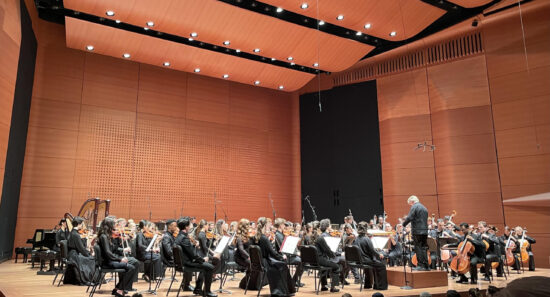
This past weekend members of the Juilliard Orchestra and the Royal Academy of Music Symphony Orchestra merged to perform the first of two transatlantic concerts – the second was held at BBC Proms on 10 August. The collaborative relationship, which began in 2001, has hosted a range of top-tier conductors, and this year Esa-Pekka Salonen led the emerging-artist orchestra. With encouragement and the clear aim of lifting young players to the level of a professional orchestra, he cemented his dedication as a mentor to younger generations.
Despite a thunder-heavy New York City summer storm raging outside, the audience did not thin out – even if they arrived a bit late. (Patiently waiting with a smile, Salonen drew laughter from the audience with his comment ‘No rush’ from the podium.) The program was equally stormy and ambitious. The musicians met the tall order with motivation; they offered impeccably practiced parts that freed up the possibilities of artistry and made for some stellar solos across all sections.
To open, Salonen’s interpretation of Stravinsky’s Symphony in Three Movements brought gravitas to the work. He harnessed the massive sound of this orchestra and pushed themes and melodies around like a hero balancing a boulder as if it were a cotton ball. The ensemble responded to his pushes for changing momentums and gradations in dynamics in an exhilarating rendition of this Rite of Spring meets neo-classicism piece.
Violinist Vilde Frang joined to perform Berg’s Violin Concerto. Her style and unwavering technique were well-suited to the youthful ensemble: welcoming, collaborative and imbued with raucous expressivity. The performance held memorable moments. She drew the viola and cello sections into a magnetic blend of sorrow and irony, and leaned in close to concertmaster Katya Moeller and the first violins which made for a scintillating dialogue with the section.
Salonen led the horns and winds in soaring parts – delineating distinctly between interpretations of grandeur and those of eerie introspection as they met with the stormy violin part. The close of the concerto was mesmerizing: string and wind solos that exchanged with Frang gradually trailed off, leaving the darker questions about life and death hovering.
Bartok’s Concerto for Orchestra was the showcase work for the orchestra – suiting Salonen’s exceptional expertise in 20th-century musical interpretation and underscoring the talent on the stage (a choice like Mussorgsky’s Pictures at an Exhibition would have fallen short in meeting their combined potential). Each movement’s character held individual distinction. The quick tempos Salonen used were fresh and revealed a key ensemble lesson for the young orchestra: how to respond without hesitation to a conductor’s tempi and phrasing. The orchestra’s ability to smoothly shift from playful material to mellower passages in the fourth movement proved the training wheels can come off.
World class technical virtuosity was evident across all the orchestral sections as Bartok’s seminal work tested the musicians with the merciless score. They passed with flying colors.
Daniele Sahr