
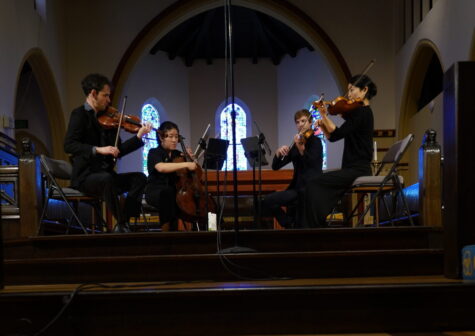
 United States ‘Time and Texture’ – Haydn, Schubert, R. Schumann: Webern Quartet (Benjamin Hoffman, Chiai Tajima [violins], Alex Granger [viola], Stella Cho [cello]). Music Guild, St. Alban’s Episcopal Church, Los Angeles, 2.8.2026. (LV)
Haydn – String Quartet No.4 in B-flat major, Op.76, ‘Sunrise’
Schubert – String Quartet No.13 in A minor, D.804, ‘Rosamunde’
R. Schumann – String Quartet No.3 in A major, Op.41
The revival of the Music Guild of Los Angeles continues to gather momentum. Under new artistic and administrative leadership, what may be the city’s longest-running chamber music presenter is once again attracting distinguished young ensembles, among them the Webern Quartet, whose Sunday afternoon concert culminated in a Robert Schumann Third String Quartet of rare coherence. Rather than treating the score’s abrupt changes of mood as a succession of disconnected episodes, the players allowed one idea to breathe naturally into the next, revealing the work as a continuous emotional narrative.
The program traced a satisfying arc from Classical assurance to Romantic introspection. Haydn’s ‘Sunrise’ Quartet stood securely in its radiant B-flat major, while Schubert’s ‘Rosamunde’ and Schumann’s Third Quartet, in different shades of A, revealed progressively more troubled emotional worlds. Although the Webern Quartet has built much of its reputation on Schoenberg, Berg and Webern, of whom they have recorded four CDs for the Dutch label Etcetera – and the Dutch know their Second Vienna School! – it proved no less persuasive in Haydn, Schubert and Schumann.
Haydn’s ‘Sunrise’ stood apart from the works that followed in its untroubled confidence. The Werbern favored warmth over wit, producing an exceptionally polished performance notable for its remarkably refined ensemble, with impeccably smooth shifts (almost no portamento) and beautifully matched tone.
Yet there were moments when that polish came at the expense of rhetoric. The mysterious stillness after the first movement’s double bar and the long journey back to the recapitulation unfolded as though their destination was never in doubt. Haydn’s element of surprise was muted. The final movement too felt weightier than necessary, its genial stroll becoming something closer to an endurance test. By contrast, the closing pages of the Adagio were quietly sublime and the Trio possessed unaffected grace even if the Menuetto itself went too fast to be truly danceable.
Schubert’s ‘Rosamunde’ Quartet received the afternoon’s most patient performance. The players allowed its long melodic paragraphs to breathe naturally, never forcing the music’s lyricism and never allowing its underlying melancholy to dissipate. The result was a reading of considerable poise and length – more Schubert’s fault than the Webern’s.
It was Robert Schumann’s Quartet No.3 in A major that revealed the ensemble at its most outstanding. Schumann’s episodic structures can easily sound just like that – episodes stitched together rather than organically connected. The Webern Quartet instead treated the transitions as dissolves and not cuts, allowing one emotional state to breathe naturally into the next. Historical accounts of Brahms playing Schumann describe exactly this kind of continuity: phrases separated by breath but never by interruption. The quartet applied that principle instinctively, making Schumann’s sometimes awkward architecture sound inevitable. The result was deeply satisfying. The music’s recurring sighs – often sentimentalized or underplayed – became expressions of genuine passion rather than mere gestures while fleeting reminders of late Beethoven emerged naturally from the musical argument instead of being underlined.
Stella Cho’s cello playing was larger than life, occasionally dominating the texture but entirely consistent with the Webern’s expansive conception. Alex Granger projected effortlessly with his unusually sweet-toned viola while Chiai Tajima’s finely nuanced second violin deserved greater prominence than her stage position sometimes allowed. Benjamin Hoffman led with understated authority, shaping rather than dictating the ensemble’s direction.
The Webern Quartet may have built its growing reputation on the Second Viennese School, but this concert demonstrated that they have equally compelling things to say about the predecessors. More importantly, they reminded listeners that technical refinement matters most when it serves expressive continuity. On this evidence, both the quartet and the revitalized Music Guild are ventures well worth following.
Laurence Vittes