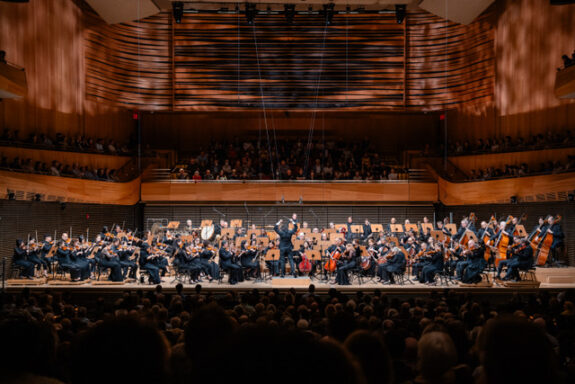
 United States Lanzilotti, Bartók, Ives: Yunchan Lim (piano), New York Philharmonic / Gustavo Dudamel (conductor). David Geffen Hall, 13.9.2025. (RP)

Leilehua Lanzilotti – of light and stone (world premiere)
Bartók – Piano Concerto No.3 in E major
Ives – Symphony No.2
The New York Philharmonic opened the 2025–26 season with an eye towards the future. Gustavo Dudamel will not assume the role of Music and Artistic Director until next year, but he is making his presence felt in six concerts this season. The opening concert indicated what to expect in the future with the world premiere of a newly commissioned work by Leilehua Lanzilotti, the phenomenal playing of Yunchan Lim in Bartók’s Piano Concerto No.3 and a nod to the orchestra’s illustrious past with a performance of Ives’s Symphony No.2.
As the US’s 250th anniversary nears, the NY Phil is exploring the American experience through music, talk and exhibitions culled from its rich archives. The opening work of the concert, Leilehua Lanzilotti’s of light and stone, drew upon the complex history of Hawaii, the fiftieth and final state to enter the Union in 1959. Lanzilotti is a native Hawaiian who grew up on Oahu, which remains her home despite her global career as a composer, performer, multimedia artist and educator. Her 2022 piece for string orchestra, with eyes the color of time, was inspired by artworks in Honolulu’s Contemporary Museum and was a 2022 Pulitzer Prize finalist piece.
Lanzilotti delved into the lives and music composed by ‘the heavenly four’, the siblings of the Royal House of Kalākauaas, as inspiration for of light and stone. They were all composers and worked to preserve native cultural traditions as well as to combine traditional Western musical styles with Hawaiian poetry and chant. The dynasty lost power with the overthrow of Queen Liliuokalani: the coup was led by six Hawaiian nationals, five Americans, one Scotsman and one German with the goal of annexing the island country to the US.
With its four distinct musical sketches, of light and stone is sewn together by Lanzilotti’s evident love of the music composed by Hawaiian royals and her embrace of color and texture. She creates an atmosphere of nostalgia as well as hope in shimmering ripples of sound. Some are realistic, such as the swoosh of wind, while others are meditative, especially in her lovely woodwind writing. As he would with all three pieces on the program, Dudamel found the lightness and allure in the music, even in its most poignant moments such as in the second movement with the tolling of the bells and its mournful clarinet solo.
Bartók composed his Piano Concerto No.3 in 1945 in New York when he was dying, as a birthday gift for his wife, the pianist Ditta Pásztory-Bartók. He lived to finalize all the orchestration except for the last few bars which were completed by his friend Tibor Serly. The concerto was premiered by the Philadelphia Orchestra in 1946 with Eugene Ormandy conducting and György Sándor as piano soloist. Ditta Pásztory-Bartók first performed and then recorded it in 1964 with the Vienna Philharmonic.
The concerto is one of Bartók’s lightest and most lyrical pieces, and these were the qualities that Dudamel and Lim mined in this performance, although never to the expense of the darker emotions that surface in the piece. Dudamel instilled the Allegretto with rhythmic vitality and a sense of joy, qualities that carried over into the second movement with its ebullient chorus of bird songs. In the last movement, the counterpoint emerged crisp and refined with the concluding Presto resounding in boldness and optimism.
Lim, who shot to fame as the youngest person to win gold at the 2022 Van Cliburn Competition at the age of 18, is a disarmingly withdrawn yet intense performer. His virtuosity reveals itself in the most lyrical passages as in the first movement or the intensely dramatic playing in the middle one. In the finale, his pristine playing combined with a fierce intensity to generate raw energy and emotion. For an encore, ever reticent, Lim slid onto the piano bench to perform a brief encore of pure loveliness, ‘This Quiet Summer’ by nineteenth-century Russian composer Feofil Tolstoy.
Ives’s Symphony No.2 was composed around the turn of the twentieth century when he was in his twenties, and the premiere was in 1951 with Leonard Bernstein conducting the NY Philharmonic. Plagued by poor health and involved in a successful insurance career, Ives wrote very little music after 1926. Long estranged from the musical establishment, he did not attend the premiere in person but listened to a rebroadcast of it. His wife, who was in the audience at the concert, was focused on the players and had to be turned to see the audience’s ovation.
Ives combined the sensibilities of European music with his unbounded appetite for Americana, nostalgia and sentimentality. The Symphony No.2 is the first of his major works to exploit that with its quotations of hymns, marches and popular and patriotic songs. Ives weaves tunes from ‘America the Beautiful’, ‘Columbia, Gem of the Ocean’, ‘Camptown Races’, ‘Turkey in the Straw’ and a fragment of ‘Reveille’ into the score. The temptation for a conductor is to indulge in the incongruity of it and go all out for boisterousness, to the detriment of Ives’s goal of intertwining the various elements into a unified whole. Dudamel took the latter, and more rewarding, path.
Rick Perdian
Featured Image: Gustavo Dudamel (conductor) and the NY Phil © Brandon Patoc