
 United Kingdom Schubert, Shostakovich Brahms: Maxim Vengerov (violin) and Polina Osetinskaya (piano). Barbican Hall, London. 28.1.2026. (CSa)
Schubert – Violin Sonata in G minor, D408
Shostakovich – Violin Sonata, Op.134
Brahms – Violin Sonata No.3 in D minor
It was just over 20 years ago at Cadogan Hall London when Daniel Barenboim, concluding the first of his BBC Reith Lectures, was asked by a member of the audience what it was like to be a child prodigy. ‘It’s true’ he said gravely, ‘I was a prodigy, but it’s a dangerous word and creates expectations no child should have to carry’ before adding ‘I have met only a few prodigies…but many mothers’, a quote which can be attributed to the late Arthur Rubinstein.
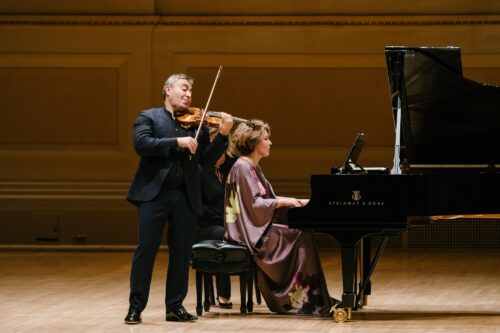
This Barbican Hall recital featured a perfectly matched collaboration between two internationally acclaimed artists and former prodigies: the 51-year-old Soviet-born Israeli violinist Maxim Vengerov and the Russian pianist Polina Osetinskaya, just turned 50, in a richly contrasted programme of works by Schubert, Shostakovich and Brahms.
The young Vengerov began to play the violin when he was 5. He was a grounded child, well protected by loving parents and teachers and was later mentored by Barenboim himself. People who saw little Maxim used to joke that the violin case looked bigger than he was. Yet the moment he played, adults would go quiet. One listener famously said ‘This child does not play at music. He speaks through it.’ While the young Vengerov navigated his genius with comparative ease, Osetinskaya, who gave her first solo recital aged 6, found her prodigious childhood talents more difficult to cope with. In her memoir Farewell Sadness she chronicles the tremendous expectations placed on her by her family, and the violent abuse and humiliation she suffered at the hands of a father intent on ‘raising a superstar’. Music provided her with ‘a kind of emotional transcendence’ and playing the piano ‘offered moments of introspection and self-expression, even in the midst of a…demanding childhood.’
There was no hint of sadness or anxiety as she joined the genial Vengerov in a finely balanced and warmly expressive account of Schubert’s Violin Sonatina in G minor. Written in 1819 when the composer was 19 years old, and intended for private performance by friends, its outward simplicity and clean classical structure owe much to Haydn and Mozart. One imagines that even Schubert and his musical companions would have been somewhat in awe of the seamless techniques and interpretive insights that Vengerov and Osetinskaya – a true chamber partnership – brought to this work. Vengerov, avoiding all superfluous physical gestures, extracted from his famous 1727 ‘ex-Kreutzer’ Stradivarius a deep glowing tone, diamond-sharp articulation and displayed dazzling bow control. Osetinskaya, statuesque and elegantly dressed in black velvet, moved her hands on the keyboard with balletic grace, shaping each sound with concentrated sensitivity. Neither player appeared to exchange a glance, yet they seemed to breathe as one. They infused the opening Allegro giusto with youthful buoyancy but never masked the brooding tensions that lay beneath the notes, while the second movement Andante was subtly shaded and gently reflective. A surging Menuetto pulsed with energy giving way to a wistfully melodious but ultimately festive finale.
After a relatively short pause in the programme the classical boundaries that delineated Schubert’s early musical output – steeped in order and reason – gave way to the starkly dystopian mid-twentieth century sound scape inhabited by Shostakovich: his Violin Sonata, Op.134. Composed in the autumn of 1968 and dedicated to the violinist David Oistrakh, the work alternates between defiance and despair. The opening 12 tone Bach-like Andante, with its ghostly piano introduction and echoes of funeral bells was given an intense and austere reading, suggestive of a lonely walk through a barren landscape. The duo brilliantly highlighted the strident moments of triumph which they alternated in the Allegretto with passages that seemed to tremble on the edge of collapse. In the final, sombre Largo, they brought thrilling virtuosity and raw power to the explosive cadenza-like passacaglia. After this tumultuous emotional struggle, the sonata’s final notes were almost whispered, putting one in mind of dead leaves drifting over a desolate wasteland – a world away in mood and texture from the work which occupied the second half of the published programme – Brahms’s sweetly autumnal Violin Sonata No.3 in D minor.
Written in 1888, the last of his violin sonatas is a masterful example of late Romanticism in four movements. In a ravishing performance Vengerov and Osetinskaya captured the golden lyricism and sweeping intensity of the opening Allegro. The Adagio was expressively shaped, the violin singing with an almost human voice and the piano providing delicate support. The third movement marked Un poco presto e con sentimento was delivered with pinpoint precision and lightness of touch. The final, fiery Presto allowed Vengerov to truly assert his mastery with Osetinskaya matching every shift in momentum and nuance. A perfect melding of talents and meeting of minds.
Generous to a fault, the pair rewarded the audience’s clamour for more with a cornucopia of encores. A lively rendition of the Hungarian Dance No.17 in F by Brahms was quickly followed by Kreisler’s Miniature Viennese March. ‘Restaurants close early in London’ Vengerov warned the insatiable crowd, before embarking on the sprightly March from Prokofiev’s opera The Love for Three Oranges. From a musical standpoint, no-one went home hungry. The evening concluded with a deliciously indulgent account of Tchaikovsky’s Melodie Op.42 No.3, a much-appreciated musical confection.
Chris Sallon
I first heard Maxim Vengerov playing Mendelssohn’s Violin Concerto on ClassicFM many years ago and had to find a lay-by to stop in to listen properly. In 2017 my friend and I went to a concert in Birmingham where he was playing and I forgot to breathe at first and found tears streaming down my face at the sheer loveliness of the sound. This Barbican Hall concert which my sister, violinist nephew and I attended was simply beautiful. It was as though there was just the music directly and no conduit …a privilege to be there.