
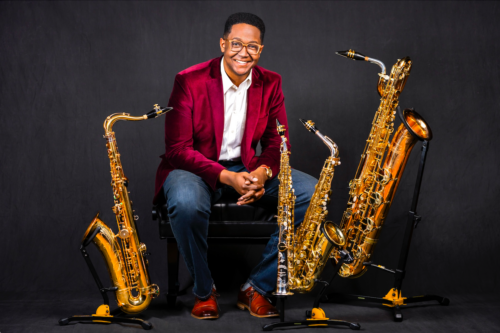
 United States Various – ‘Golden Silhouettes’: Steven Banks (baritone saxophone), Xak Bjerken (piano). Cal Performances, Hertz Hall, University of California Berkeley, 1.2.2026. (HS)
Saint-Saëns – Sonata for Bassoon and Piano
John Musto – ‘Shadow of the Blues’
Carlos Simon – ‘hear them’
Beethoven – Seven Variations on ‘Bei Männern, welche Liebe fühlen’
Barber – Sonata for Cello and Piano
Encore: Jesse Jones – ‘Lulu’
If there is a classical saxophonist who deserves the sobriquet ‘virtuoso’, it is Steven Banks. I was introduced to his magic a couple of years ago when he played a new concerto for saxophone by Billy Childs at the Aspen Music Festival. Wielding soprano and alto saxes, he was mesmerizing for his fluency, clarity and expressiveness without departing from classical structure and rigor.
For an impressively well-attended recital presented by Cal Performances at the University of California Berkeley, he focused entirely on the baritone sax. As a dedicated jazz fan, I am hard put to name a top-tier saxophonist who plays all the saxophone types, including baritone. (Only the late Pepper Adams comes to mind.) The baritone’s range parallels the same territory as bassoons and cellos, and three of the five pieces on the recital’s program were originally composed for those instruments. Transcriptions for instruments other than the composer’s originals are not unknown in the classical music world, of course. Bach’s keyboard works for harpsichord are routinely played today on modern pianos, Mozart adapted flute and oboe sonatas and concertos for other instruments and so on.
But there is a tradeoff. The sonorities are different on other instruments, which casts the music in a different light for listeners, not to mention the challenge for the performer. Banks spoke about that in charming pre-concert remarks and hoped we in the audience would enjoy the different colors. In the end, as good as those transcriptions were – and at times they were gripping – the standouts were two pieces written by contemporary composers.
Carlos Simon’s 2020 ‘hear them’, composed specifically for Banks, makes exotic use of the baritone sax’s sounds to express an encounter with ancestors described in the American poet Nayyirah Waheed’s haunting verse of that title. Waheed, with more than 500,000 followers on Instagram, emphasizes the point in these lines:
‘the ancestors
only whisper
so
as not to frighten you’
They open up the music to the sax’s distinctive sounds – a wide dynamic range, sinuous melodies and occasional squawks and squeaks. It is a tour de force for Banks, who created a memorable, time-stopping moment against soft, jazz-framed chords played by pianist Xak Bjerken.
Simon and Banks worked together remotely on the piece during the first year of the pandemic. Laying the groundwork for the music, Simon first recorded some chord changes on piano to express the feeling of the poem, then Banks recorded his improvisations over them. The composer developed that material into the final piece.
In the other contemporary work, ‘Shadow of the Blues’, four songs on poems by Langston Hughes, Banks played the vocal lines composed by John Musto in 1987 for baritone voice. The piano remained unchanged. Although the full poems appeared in the program, as a useful and often moving prelude to each piece Banks recited each one with a wonderfully natural expression before playing the music they inspired.
Musto’s operas and songs are well known to singers and listeners. He has a flair for fitting music to words, but what counted in this word-free version was the musical fluidity and mood which Banks reflected perfectly. As the title would suggest, the music exudes jazz aromatics, and Banks’s playing suggested that he could, if he wanted, excel at jazz too. He and Bjerken created something resembling a lovely jazz ballad with a gentle swing colored by blue-note accents in ‘Could be’. The ruminations of ‘Silhouette’ (the piece that inspired the ‘Golden Silhouettes’ title of the recital) flowed with a welcome freedom.
Transcriptions of music by Saint-Saëns, Beethoven and Barber showed off both performers’ ability to execute the virtuosic aspects of these composers’ music, even if written for other instruments. Best, for me, was Beethoven’s Seven Variations on ‘Bei Männern, welche Liebe fühlen’, the Pamina-Papageno duet from Act I of Mozart’s Die Zauberflöte. It offered a lyrical stream accented with rhythmic punch, which Beethoven’s variations take charming advantage of. The singing qualities of the slower ones were most appealing.
Saint-Saëns’s Sonata for Bassoon and Piano comes from the composer’s last year and is among a series of pieces he wrote for instruments other than the ‘usual’ violin, cello and piano. The bassoon sonata gave both Banks and Bjerken a chance to flex with music that bounces with rhythms in one phrase and switches to lyric sweetness in the next. A fine opening piece, it demonstrated what the saxophone’s increased volume and rounder sound can do with classical writing.
Barber’s Sonata for Cello and Piano, which closed the program, is one of the 20th-century American composer’s early works. It wanders between angst and purple colors, its gestures natural on a cello but a bit of a struggle for a saxophone. Banks executed them accurately, but they don’t seem to fit the instrument’s language as easily as the bassoon sonata and the variations did.
An encore restored the lovely balance: ‘Lulu’, composer Jesse Jones’s lullaby for his daughter. Written for cello and mandolin, the high-lying sweetness fit beautifully with Banks’s sound, a taste as sweet as a lovely dessert.
Harvey Steiman