
 United Kingdom Kaprálová, Szymanowski, Bartók: Juliana Grigoryan (soprano), Agnieszka Rehlis (mezzo-soprano), Kostas Smoriginas (bass), London Philharmonic Choir (chorus director: Madeleine Venner), London Philharmonic Orchestra / Edward Gardner (conductor). Royal Festival Hall, London, 7.2.2026. (CK)
Vítĕzslava Kaprálová – Rustic Suite; Waving Farewell
Szymanowski – Stabat Mater
Bartók – The Wooden Prince
The second of Edward Gardner and the London Philharmonic Orchestra’s two concerts of music from Central Europe – under the heading Phoenix Lands – proved to be as stimulating and surprising as the first. The gamble (for so some would describe it) paid off: with no familiar, bankable item on the programme, a healthy and enthusiastic audience turned out to explore less familiar musical terrain. In the case of Bartók, many may have felt, as I did, that this was an opportunity to experience music they might otherwise have never encountered in concert. So thank you, Gardner and the LPO: you have evidently won your audience’s trust.
When Jakub Hrůša (now in charge at Covent Garden) and the Czech Philharmonic Orchestra came to the BBC Proms in 2024 for two memorable concerts, they brought Vítĕzslava Kaprálová’s Military Sinfonietta: the work, and the performance, impressed me deeply, so I was eager to hear more of her music. Gardner evidently loves her music too, and in a short introduction paid tribute to her short-lived talent: she died at 25, leaving 25 opus numbers. Born in Brno, Janáček’s town, a protégée of Martinů, an admirer of Stravinsky, she was well on the way – as Gardner noted – to finding her own voice and identity: as we could clearly hear in the bright, tangy sounds of her Rustic Suite.
In the first of the three short movements there was much to catch the ear: a lovely clarinet solo against gently surging cellos, a jolly folk tune with bright trumpets, a rhythmically upbeat ending. The Andante brought a touching lament, beautifully scored, with chirruping woodwind over warm lower strings; the final Allegro was a lively folk dance with stomping strings and trombones and flaring trumpets. Kaprálová more than deserves her foothold in the repertory, and I look forward to hearing more of her music.
Simon Rattle championed the music of Karol Szymanowski during his Birmingham years, but performances since then have been relatively rare: so this outing for the Stabat Mater was most welcome. It was given a fine performance, sensitive to Szymanowski’s incense-laden soundworld and his instinct for drama, fusing raw personal emotion and formal ritual in music that is both mysterious and headily expressive.
The London Philharmonic Choir was on superb form, clean in attack, and the soloists were excellent: Polish Agnieszka Rehlis making beautiful sounds throughout her range, Lithuanian Kostas Smoriginas warm and powerful (though overpowered by the chorus in the dramatic second section), and Armenian Juliana Grigoryan – replacing the indisposed Lucy Crowe – hypnotically pure-toned, emerging beautifully above the chorus in the fourth section and floating her high notes in the sixth with no apparent effort: very much in tune with the composer’s sensibility. The orchestra too were superb: rising memorably, in the penultimate section, from the lower strings through waves of sound to a seismic climax with full organ. The final glowing diminuendo – not unlike, in its effect, Britten’s Let us sleep now at the end of the War Requiem – was beautifully handled.
It was a good idea to promote Kaprálová’s song Waving Farewell to the end of the first half, rather than the beginning of the second as advertised, leaving Bartók in sole possession of the latter. Not that it would have been overwhelmed: this six-minute song is, in Gardner’s words, utterly enchanting, and in its way a masterpiece. Gavin Plumley told us in his programme note that the poem (by Vítĕzslav Nezval) is ‘beautifully guileless…particularly well-known to Czech schoolchildren’; yet its intimate sequence of images of farewell – richly sung by Juliana Grigoryan, the vocal line yielding nothing in beauty to Szymanowski – and its beautiful orchestral dress suggested, in this performance at least, an erotic undertone. Whether or not, we went into the interval enchanted.
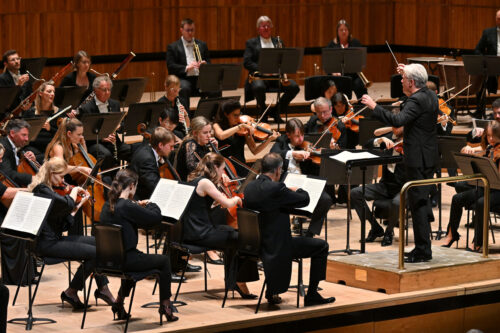
There were over 100 musicians on stage for Bartók’s pantomime ballet The Wooden Prince, including quadruple woodwind, five trumpets and a cornet, two harps, a celeste and a pair of saxophones (required only to play a few bars near the end). What a gorgeous piece! Like a mash-up of Petrushka in its original 1911 version (complete with puppet) and Schoenberg’s Pelleas und Melisande (complete with forest), embracing the grotesquerie and sardonic humour of the former and the saturated sumptuousness of the latter.
I only just restrained myself from laughing out loud at the sheer effrontery of the opening parody of Das Rheingold; and for the next 45 minutes interest never slackened. The orchestra went at it with a will, painting vivid sound-cartoons of the Prince’s pomposity and the Princess’s flightiness (taxing for the violins); rippling harps and soaring strings; a lumbering march, and a grotesque one for bassoons and wood-block as the Princess appears with the broken puppet; a mighty shindig as she shears off her hair (a second timpanist joins the fray). All’s well that ends well, and the whole crazy business evaporates in a shimmering haze.
A wonderful concert. And I must applaud the innovative ‘Tonight in 2 minutes’ page in the free programme: clear, informative, interesting, not at all patronising. If this were my first visit to a classical concert it would be just the job.
Chris Kettle