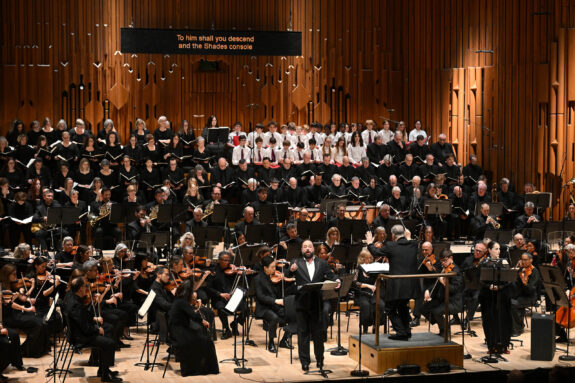
 United Kingdom Lindberg, Stravinsky: Lisa Batiashvili (violin), Amira Casar (narrator), Peter Tantsits (tenor), Boys from the Schola Cantorum of the Cardinal Vaughan Memorial School, Girls from the Chamber Choir of The Grey Coat Hospital School, BBC Symphony Chorus and Orchestra / Sakari Oramo (conductor). Barbican Hall, London, 6.2.2026. (CC)
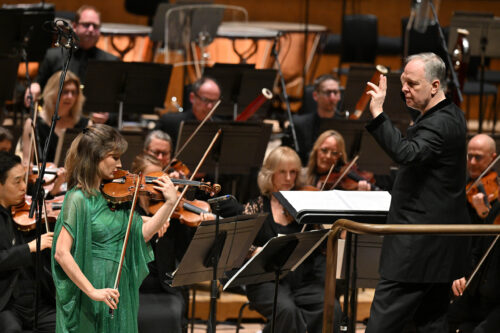
Lindberg – Violin Concerto No.1 (2006)
Stravinsky – Perséphone (1933/4, revised 1939)
A fabulous coupling here (bizarrely presented as ‘Oramo conducts Stravinsky and Lindberg’; not the other way round). Lindberg first: his Violin Concerto No.1 (2006); great to see the composer present, also; and to hear the BBC Symphony Orchestra in such fine fettle throughout.
When Lisa Baiashvili recorded the work, it was of course Lindberg’s Violin Concerto …No.2 was to follow in 2015. The First Violin Concerto was premiered at Avery Fisher Hall, New York, on August 22, 2016; the soloist was, as here, Batiashvili; the Mostly Mozart Festival Orchestra was under the baton of Louis Langrée (Pekka Kuusisto has also recorded it, directing the Tapiola Sinfonietta, on Ondine).
The concerto opens with a long, high solo line against a glassy background of high stings. Parallels with the Sibelius concerto are stark, even thematically (the way the line circles around a central tone). There are Sibelian parallels to the orchestral scoring, too, with woodwind in parallel as a unit. But Lindberg’s space is different: more volatile. And with that volatility comes a different kind of curiosity, agile, angular, one that Lisa Batiashvili has completely embraced. This was a commanding performance from first to last, replete with lyricism and virtuosity. Lindberg takes blocks of sound, too, and at times offers an almost Primitivist aesthetic: from the stratosphere of the opening, the music eventually finds itself chthonically bounded. The orchestra is Lindberg’s home turf, and he scores with a command few contemporary composers can equal, We seem a long way from the Piano Concerto No.3, written for Yuja Wang and, in comparison, lighter and even vacuous. Here, Lindberg moves easily from avian trills to echoes of the Romantic violin concerto tradition to rugged Nordic sound/landscape. He foregrounds a pair of horns, superbly played here, the forest vocations once more Sibelian, but also Richard Straussian (at one point they could be off-stage in the Alpine Symphony). Lindberg plays with expectation structurally, too: the music heads towards a cadenza, even starts as one, but veers off before settling for an orchestrally-bonded rumination.
The brass of the second movement were crystal clear, and when the violin spirals upwards, high and higher, the effect was mesmerising. There was drama here, too, a recitative without words that spirals into a Ligeti-like vortex. The finale offers a dance with a post-Stravinskian flavour (perhaps the determining factor of its inclusion?). But Lindberg offers a darker, glowering aspect, too, the orchestra moving with elemental momentum against the jerky, angular violin. The most obviously ‘approachable’ movement, this is a fine conclusion to a fine work.
Lindberg never fails to impress, be it his Two Episodes (LPO/Jurowski, BBC Proms, 2016), or an unforgettable Southbank performance of Graffiti (where Lindberg sets graffiti from Pompeii). This first half would take some topping; and it came with a rare outing for Stravinsky’s Perséphone.
Perséphone is a near-hour long piece, a melodrama in three scenes, written 1933/4 and revised in 1939; its original version therefore came a decade after Les noces (1923); and yet the opening of the first part, ‘Persephone Ravished’, shows remarkable similarities. The solo tenor initially sounds like a church cantor, here Peter Tantsits. Although nothing was announced, I did wonder if Tantsits was down with some sort of seasonal affliction: the sound lacked body and heft, and he seemed to struggle in the more demanding moments. Amira Casar was the superb narrator (the text in French, with surtitles), her delivery perfect, atmospheric, a born storyteller.
The BBC SO plays superbly under Oramo, strings disciplined and with little loss of tone as the pitch ascends. But the real stars were the choruses: the BBC Symphony Chorus, Boys from the Schola Cantorum of the Cardinal Vaughan Memorial School, and Girls from the Chamber Choir of The Grey Coat Hospital School. The youngsters excelled, losing nothing to their adult colleagues. And those BBC Symphony Chorus contributions were magnificent, from rhythmic buoyancy to ferocious bass to the most magical of textures: the two harps answered by perfectly staccato bassoon at the opening of Part II just one example among many. The oboe song in this part, too, was simply glorious, Alison Teale on top form. Stravinsky’s harmonic mastery is nowhere more apparent than in the slower passages of this part, his harmonies laid bare: especially before the gossamer-light entrance of the upper female voices (here preternaturally together more so than on some studio recordings I have heard).
Tantsits’s air with trumpet brought fine playing from Philip Cobb; the leader’s contributions were excellent late on, too, but the programme gave this position as Stephen Bryant, and unless he has changed both sex and nationality recently, it was not him.
The imposing opening of Part III, ‘Persephone Reborn’, was brilliantly managed by the BBC SO’s brass (and Oramo’s chord balancing). Gloriously bright in an inimitably Stravinskian way, it opened the gates for the most remarkable panoply of timbres, from clomping bassoon to heavenly children’s choirs in their gentle dance. And it was Oramo that created a thread from the opening of the piece to that brilliant, beautiful final chord. In Perséphone, the granitic majesty of Oedipus Rex (1927) meets the balletic grace of the later, diaphanous Orpheus (1947). A curious hybrid of a piece, it nevertheless succeeds brilliantly. Just, why don’t we hear it more often?
For Stravinsky, Perséphone marked the end of a vital portion of his life. The Ballets Russes and Diaghilev, so much a part of his story thus far, were gone; and as we now know, there was plenty left for Stravinsky, not least his own particular take on dodecaphony.
The beautiful sustained final chord of Perséphone also marked the close of a concert that is by far my concert of the 2025/6 season so far. It will be broadcast on BBC Radio 3 on Wednesday, February 18 at 7.30pm. Don’t miss it!
Colin Clarke
Featured Image: Sakari Oramo conducts Stravinsky’s Perséphone © BBC/Mark Allan