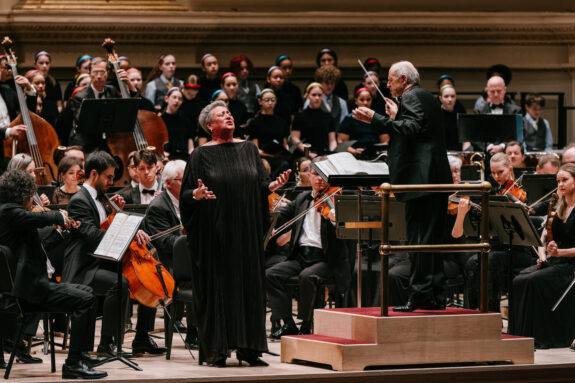
 United States Various: Budapest Festival Orchestra / Iván Fischer (conductor). Carnegie Hall, New York, 6 & 7.2.2026. (ES-S)
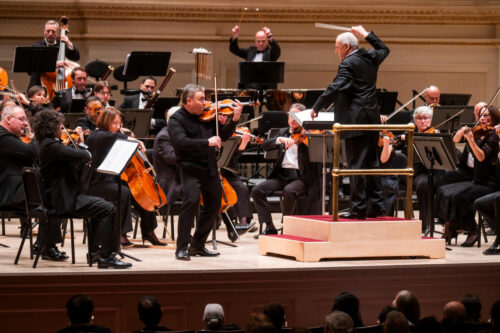
6.2.2026 – Maxim Vengerov (violin)
Pärt – Summa
Tchaikovsky – Violin Concerto in D major, Op.35
Brahms – Symphony No.2 in D major, Op.73
7.2.2026 – Gerhild Romberger (mezzo-soprano), Trebles of Westminster Symphonic Choir / Donald Nally (director), Young People’s Chorus of New York City / Elizabeth Nuñez (director)
Mahler – Symphony No.3 in D minor
Over two successive evenings at Carnegie Hall, Iván Fischer and the Budapest Festival Orchestra traced a rising arc of musical ambition, from the austere clarity of Arvo Pärt to Gustav Mahler’s symphonic vision of the ‘entire world’.
The performances also highlighted Iván Fischer’s instinct for mise-en-scène, recalling his Mozart opera-in-concert projects at the now-defunct Mostly Mozart Festival, where singers performed amid the orchestra, allowing the ensemble to become an active participant in the drama. On Friday, he first asked the instrument-less members of the orchestra to reunite for a heartfelt, beautifully sung rendition of Summa, Arvo Pärt’s original choral setting of the Credo. Later, in Tchaikovsky’s Violin Concerto, he placed just four double basses at the center of the stage behind the winds – a number that would return, somewhat surprisingly, in Mahler as well. For Brahms’s Symphony No.2, he employed a full complement of eight basses but asked the wind players in front of them to stand rather than sit, subtly altering the listener’s perception of balance and projection. The evening closed with an unusually informal encore: a violin–viola–bass trio launched into a sequence of Hungarian folk dances, each more breathless than the last, leaving the audience momentarily unsure whether to remain astonished or to break into rhythmic clapping.
Built on Arvo Pärt’s tintinnabuli technique, Summa seems to change constantly while remaining almost motionless, its serenity emerging from strict discipline rather than atmosphere. Balancing consonance and dissonance with ritual clarity, the music sharpens attention to duration, harmonic weight and silence itself.
That heightened sensitivity proved an intriguing foil for Tchaikovsky’s Violin Concerto, a work born of personal catastrophe yet emphatically directed outward. Written in the wake of the composer’s disastrous marriage, the concerto refuses confession in favor of melodic abundance. Its emotional directness is projected not through structural argument but through lyric overflow: themes that sing, soar and accumulate with seemingly inexhaustible invention. What may sound excessive on the surface revealed itself, in Maxim Vengerov’s interpretation, as natural, unforced spontaneity.
In the first movement, the solo line was shaped with a strong sense of continuity, while the Canzonetta was sustained with inward, vocal poise. There were nevertheless moments when his focus on maintaining the long arc left limited space for dialogue with individual wind solos, even as the overall trajectory remained secure and purposeful. In the Finale, restraint gave way to release, the music’s kinetic energy emerging as the natural culmination of the concerto’s momentum. As if to preempt any perception of unbridled display, he followed with the Adagio from J.S. Bach’s Sonata No.1 for Solo Violin, played with utmost calm and concentration.
The first program concluded with Brahms’s Symphony No.2, often described as pastoral or sunlit yet marked by a more complex balance of lyric ease and underlying tension. Iván Fischer favored transparency and rhythmic fluency over weight, drawing from the Budapest Festival Orchestra a sound that suggested Brahms’s preference for smaller forces: pliant strings, characterful winds and textures that encouraged attentive listening across the ensemble.
The opening movement unfolded in broad lyrical spans, its gently rocking pulse kept light and flowing, yet darker inflections were allowed to surface in a more unsettled development, marked by tighter harmonic pressure. The Adagio non troppo deepened that tension, its long spans repeatedly interrupted by darker gestures from lower strings and brass, leaving even its closing pages tinged with unresolved unease.
In the third movement, Fischer kept the contrasts clearly profiled. The ländler-inflected, oboe-introduced opening began with dance-like ease, while the more robust episodes asserted a grounded rusticity, the dialogue between grace and earthiness never pressing either quality too far.
In the finale, exuberance was carefully accumulated over time. Brightness grew gradually, darker material surfacing only briefly before being absorbed into the forward motion. When the jubilant coda finally arrived, it still acknowledged the shadows encountered along the way.
The second evening stood apart in scale and ambition, devoted entirely to Mahler’s Symphony No.3, one of the most radical attempts to redefine the symphony as an all-encompassing form. In Fischer’s interpretation, Mahler’s cosmic ambition was less about monumentality and prophetic emphasis. It acquired instead a more practical dimension: how a profusion of forces – natural, human and metaphysical – might be held together without being fused into premature unity. The immense first movement proceeded as a succession of collisions: marches that curdle into dirges, fanfares that turn grotesque and moments of stasis that felt hard-won. Each transition functioned less as a bridge or connective tissue than as a point of exposure, with the music’s rough edges left intact. The tuba line, firmly grounded and unsentimental, anchored the movement’s weight, reinforcing its sense of mass without tipping it toward heaviness.
The inner movements did not offer contrast in the traditional sense but reset scale and perspective. The minuet’s lyricism was kept exposed and lightly weighted, its grace never allowed to settle into comfort. In the Comodo, Scherzando, ohne Hast, rustic humor avoided any hint of caricature; its playfulness carried an undertow of unease, the dialogue between surface animation and disruption held in tension. The solo violin, deliberately thinned in tone, hovered uneasily above the texture, sharpening the movement’s sense of distance and dislocation. The distant posthorn episode was projected without sentimental emphasis, its distance integral to its effect. Exquisitely played, it did not sound like something merely overheard but as music genuinely imbued with nostalgia.
With the vocal movements, the symphony’s focus shifted inward. Gerhild Romberger shaped the setting of Friedrich Nietzsche’s nocturnal stanzas with restraint, her mezzo-soprano avoiding operatic emphasis in favor of a veiled, almost withdrawn intensity that aligned closely with Fischer’s refusal of rhetorical expansion. At its close, the music hovered on the edge of dissolution.
The following choral movement, with its bells and children’s voices, can easily tip toward reassurance, but here the Nietzschean doubt persisted. The Westminster Symphonic Choir and the Young People’s Chorus of New York City sang with clarity and discipline, brightness present but edged, the angels sounding like fragile intermediaries. Their message was offered without insistence, its gentleness reinforced by Iván Fischer’s refusal to press the music toward affirmation.
The final Adagio didn’t bring an abrupt, undoubtable triumph over darkness. Intermediary climaxes were perceived as accumulated tension, their impact arising from persistence and continuity. At the end of an exhausting yet remarkably rewarding musical journey, there was indeed a sense of victory, but a precarious one.
Edward Sava-Segal
Featured Image: Budapest Festival Orchestra with Ivan Fischer, Gerhild Romberger and Young People’s Chorus of NYC © Fadi Kheir