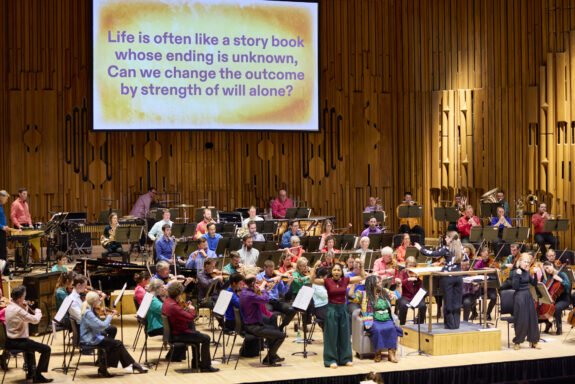
 United Kingdom Various – The King Who Tried To Change His Fate: London Symphony Orchestra / Karen Ní Bhroin (conductor), Jan Blake (storyteller), Belinda McFarlane (presenter), Angie Newman (BSL interpreter). Barbican Hall, London, 8.3.2026. (CSa)#
Verdi – Overture from The Force of Destiny
Coleridge-Taylor – Dance and Military March from Othello Suite
Louise Farrenc – Excerpts from Symphony No.3
Tchaikovsky – Excerpts from Symphony No.4
Ayanna Witter – Johnson – FAIYA!
Paul Rissmann – Forest Prelude: What is Fate?
Almost a year ago, when Sir Antonio Pappano was about to start his tenure of the London Symphony Orchestra, he lamented the decline of publicly funded music education and argued that orchestras were now being required to compensate. ‘People being exposed at a young age to music is a known enhancer of brain development. But it is not the LSO’s – or the responsibility of any orchestra – to educate children. It’s the government’s job to create not only the talent of the future but also audiences of the future.’ Deaf to such entreaties, successive governments have failed to prioritise musical education in schools and continue to leave it to orchestral ‘outreach’ programmes such as the LSO’s laudable Discovery series to fill the gap.
This modestly priced Family Concert in London’s Barbican Hall was the culmination of an afternoon of free musical workshops and events for children aged between 7 and 10. It centred on a story, much in the style of the Brothers Grimm, compellingly narrated by ‘magical storyteller’ Jan Blake about a king who tried to change his fate, and interpolated with orchestral extracts from works by a diverse range of composers from Verdi, Tchaikovsky, Bernstein and Coleridge-Taylor to Louise Farrenc, Ayanna Witter-Johnson and Paul Rissman.
What better way to introduce my curious 8-year-old grandson to the joys of classical music I thought, recalling my own childhood experiences in the late 1950s when my rambunctious classmates and I were ferried from school in Roehampton to those famous Robert Mayer Children’s Concerts at the Royal Festival Hall. Mayer was a German-born banker and philanthropist who settled in London and became passionate about musical education. He was amongst the first to devise programmes in which full orchestras (frequently the LSO) would perform short extracts from serious classical music with a well-known presenter on hand to explain it clearly. I recall the urbane and unflappable pianist and broadcaster Sidney Harrrison introducing us to the players and their instruments, his perfectly enunciated BBC voice gently leading us into the mysterious worlds of Mozart, Beethoven, Prokofiev and Britten.
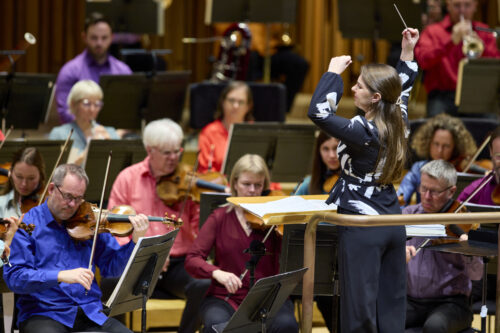
70 years on, although the essential format of this LSO Discovery Concert is little changed, its programme and presentation are decidedly more innovative. On the podium stood a woman – the dynamic Irish conductor Karen Ní Bhroin – a striking contrast to the dapper Sir Malcolm Sargent of those earlier concerts. The orchestra, casually dressed rather than in constricting white tie and tails, seemed to signal that classical music had become more open and alive than I had ever known, and the audience was far more racially diverse than the crowds I remember from my childhood.
Compering the event was LSO violinist Bindi McFarlane who, once the musical introductions were made, resumed her place in the string section. The story, which predictably began in a dark, eerie forest, centred on a proud and resolute king who despite his regal authority could not escape the shadow of fate, but who strove desperately to bend destiny to his will. Verdi’s overture from his opera The Force of Destiny – splendidly played – captured the narrative as it unfolded. Galloping horses, a journey to the South, a serving girl ‘heavy with child’, were followed by a dramatic execution. This was perfectly evoked by an extract from Tchaikovsky’s Symphony No.4; its turbulent first movement contained for the composer ‘the fatal power which prevents one from attaining the goal of happiness.’ The Dance and Military March from Coleridge-Taylor’s Othello Suite and excerpts from Louise Farrenc’s Symphony No.3 propelled the tale forward, its lighter and celebratory moments neatly paired with Leonard Bernstein’s infectious Cha Cha from West Side Story.
The great achievement of the afternoon was not merely to be found in the fine playing, nor the fact that the music perfectly embodied every twist and turn in Jan Blake’s imaginatively written saga. It lay in the reaction of the many children in the audience for whom the LSO continue to provide a priceless musical education. If there was a litmus test of success, it was to be measured in my young grandson’s obvious pleasure throughout the performance and his response at the end of the concert. ‘Grandpa, what’s the difference between fate and destiny?’ he asked. I’m still working on the answer.
Chris Sallon
Featured Image: LSO Family Concert: The King Who Tried To Change His Fate © Kevin Leighton