
 United Kingdom Britten, Tower, Weber, Hindemith: Steven Banks (saxophone), BBC National Orchestra of Wales / Tomas Djupsjöbacka (conductor). Hoddinott Hall, Cardiff, 12.3.2026. (LJ)
Britten – An American Overture (1941)
Joan Tower – Love Returns (2024, UK premiere)
Weber – Symphony No.2 (1807)
Hindemith – Symphonic Metamorphosis of Themes by Carl Maria von Weber (1943)
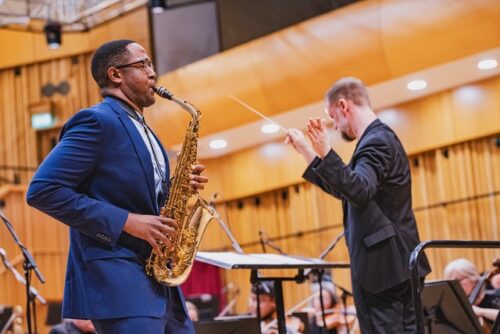
Steven Banks flew from North Carolina to give his debut performance in the UK with the BBC National Orchestra of Wales at Cardiff’s Hoddinott Hall. He is fresh, exciting, and exceptionally talented, playing each note and phrase with intention and lyricism. In his UK premiere performance of Joan Tower’s Love Returns, he demonstrated his mastery of the alto saxophone. His sound was warm and mellow in places, then reedy and bold in others. There was texture to his playing, and he was in control of his phrasing too. Banks is certainly a soloist, but he also situated himself within the orchestra. His performance rose out of the ‘lush textures’ of the BBC NOW, as he put it when interviewed by BBC Radio 3’s Alex Humphreys.
Tower composed Love Returns in 2024 for Banks. Its structure follows a theme (taken from Tower’s earlier work Love Letter, a solo piano piece dedicated to her late husband Jeff Litfin, who passed away in 2022) and variations in six sections. Each variation, built on a series of raising-fifth intervals, is faster than the previous one, with the exception of the fifth, which is a solo cadenza for the saxophone. Banks’s performance was tender and electric with Tower’s melodic phrase providing a moment of calm between dazzling jazz-inspired runs.
One of the clearest indications of Tower’s personality and, therefore, her compositional style, comes in the form of her answer to the question: ‘is it true that you don’t like Mozart?’ Her response is full of her characteristic charm, wit, and depth of musical understanding: ‘That is true. Although the more I admit that, the more enemies I gain! Because, especially with string players – they love Mozart – I never tell string players that I’m not a big fan of Mozart. Mozart to me is way too perfect and you’re walking on eggshells with him. When I played the piano and I had to play Mozart’s sonatas, I really hated it because it was a little too perfect and a little too precious for me, for me. I know he’s a great composer, but I like the more earthy [composers like] Haydn.’
Tower’s comments are from an interview with the Milwaukee Symphony Orchestra in 2018. In the same interview, she describes herself as ‘more of a novelist’ when talking about her compositional method. In Love Returns, the story ricochets between ‘comfort and argument’ (as Banks told the audience). It requires a performer to have a keen understanding of the piece’s intimate character.
Banks certainly demonstrated his understanding of Tower’s music. Although he is a young saxophonist (32 years old), he has a clear idea of his musical identity. His website contains an ‘Artistic Statement’ where he outlines his approach towards and belief in music-making. Banks states: ‘the feeling of vulnerability and connection to your collaborators and audience while performing is something that becomes more sacred to me with each passing day.’ This directness and confidence certainly came across during Banks’s performance.
His encore – Debussy’s Syrinx (1913) – was sublime. It was originally composed for flute and contained no breath marks. As such, it has an inherent improvisational quality and requires the instrumentalist to play each note with intentionality, which Banks did throughout his performance.
Whilst Tower’s Love Returns was the evening’s most compelling performance, the concert began with Benjamin Britten’s An American Overture (Op.27), which he composed in 1941 when he was living in the US with his partner, Peter Pears. It was written for the conductor Artur Rodziński but left unperformed and forgotten until the score, which had been deposited in the New York Public Library, was rediscovered by an archivist named Joe Bailey Cole in 1972. When asked about the score, Britten confessed that he ‘had absolutely no recollection whatsoever of writing the work’ and confessed to Cole that he ‘should love to have the work destroyed’. This, however, did not happen as after Britten’s death, Simon Rattle premiered the piece with the City of Birmingham Symphony Orchestra in 1983.
An American Overture typically lasts ten minutes and is structured in three sections. It begins with a slow march played by pizzicato double basses and harp. The piece then shifts to a faster folk- and jazz-influenced passage. Its conclusion sees the full orchestra return to the opening march and chorale. The BBC NOW played well, particularly in the final section where percussion and brass bring the piece to its emphatic conclusion.
After the interval, the BBC NOW performed two Weber pieces, of sorts. One was by Carl Maria von Weber himself, and the other was by Paul Hindemith who referenced works by Weber. Born in 1786, Weber bridged the Classical and Romantic eras. Despite suffering from several illnesses and dying at the age of just 39, he was a prolific composer. He is best known for his opera Der Freischütz (1821) and his two clarinet concertos of 1811. He is not, however, known for his two symphonies.
Weber’s Second Symphony in C major (1807) is a bright but rather uneven work. Weber took one week to compose this symphony, and he would never again return to the form. The piece opens vivaciously, but the first movement is overly long, and the last movement is very short (as is the third movement) with an extremely abrupt end. Perhaps this is a musical joke à la Haydn. The second movement contains echoes of Beethoven’s Pastoral and opens with beautiful violin and oboe solos, played very nicely by Lesley Hatfield and Steven Hudson. The horns then play a more elaborate repeat of the theme, which develops as an operatic aria – fitting for Weber, who is best known for his operas. Overall, however, the piece did not hang together due to some phrasing inconsistencies.
Hindemith’s Symphonic Metamorphosis of Themes by Weber (1943) brought this concert full circle as this work was first conducted by Artur Rodziński on 20 January 1944. But this is a much more involving and showstopping piece than Britten’s American Overture. In Hindemith’s borrowings from Weber, it is not simply a neo-classical piece, rather, it fizzes with excitement, drama, and a sense of adventure.
Hindemith took themes from incidental music that Weber wrote for a play by Carlo Gozzi (based on the same Turandot legend that later inspired Puccini). Hindemith also quoted from Weber’s music for piano four-hands, which he would play with his wife, Gertrud Rottenberg. There is, therefore, a distinctly European quality to the music but it also has an American sense of scale. Indeed, Hindemith composed the work when living in the US (he fled Europe due to the rise of Nazism and unpopularity of his music amongst the likes of Josef Goebbels who called him the ‘atonal noisemaker’). It is written for a large symphony orchestra and contains a percussive charge, especially in the second movement (Scherzo) which borrows from jazz rhythms and in the fourth movement with its strident military beat.
This concert marked Finnish conductor Tomas Djupsjöbacka’s debut performance with the BBC NOW. He focused intently on each section of the orchestra, and this led to some moments of intense expression (such as the flute solos in Hindemith’s Symphonic Metamorphosis by Matthew Featherstone and the violin and oboe solos in the second movement of Weber’s symphony). Djupsjöbacka’s movements were elaborate and, in places, ornate. Whilst this worked well for the individual instrumentalists on whom he focused, the pieces lacked momentum. Indeed, there was an issue with pacing, especially in the Weber symphony where pauses were too exaggerated. This made the symphony heavy and laboured, despite considerable effort from the double basses to keep things moving during Weber’s symphony and Hindemith’s Symphonic Metamorphosis.
Overall, therefore, this concert provided moments of beauty, a brilliant premiere of Joan Tower’s new composition, and pleasant, if not entirely captivating, performances of work by Britten, Weber, and Hindemith.
Lucy Jeffery