
 Ireland Adams, Rachmaninov, Stravinsky: Jaeden Izik-Dzurko (piano), National Symphony Orchestra Ireland / Alexander Shelley (conductor). National Concert Hall, Dublin, 13.3.2026. (RB)
John Adams – Short Ride in a Fast Machine
Rachmaninov – Piano Concerto No.3 in D minor, Op.30
Stravinsky – The Firebird
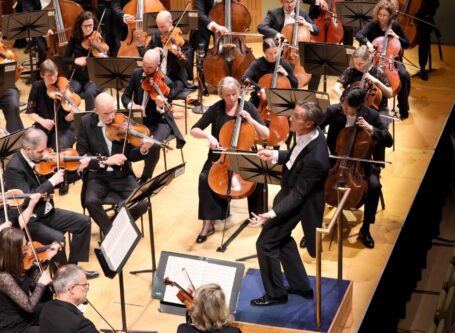
The National Symphony Orchestra Ireland (NSOI) were joined by their new Principal Conductor Designate, Alexander Shelley, for this programme of highly virtuosic 20th-century works. The soloist in Rachmaninov’s D minor Concerto was the Gold Medal Winner of 2024’s Leeds International Piano Competition, Jaeden Izik-Dzurko.
John Adams’s Short Ride in a Fast Machine served as a fast-paced high-octane curtain raiser for the concert. The insistent rhythm was maintained as layers of sound accumulated to produce rich bright sonorities. This was a highly exhilarating performance from Shelley and the NSOI with impressive interjections from brass and percussion.
The main work in the first half was Rachmaninov’s Third Piano Concerto which has often been described as the ‘Everest of the keyboard’. Rachmaninov wrote the work in 1909 for his first American tour to showcase his prowess as a composer and virtuoso pianist. He dedicated the work to Josef Hofmann, but sadly the latter never performed it. Unlike Rachmaninov, Hofmann had very small hands and the large stretches and thick textures would no doubt have created problems for him. This concerto is one of the most technically demanding works in the repertoire and has proved a vehicle for great pianists. There have been several superb exponents of the work, including Horowitz and Argerich. The younger generation of pianists are also putting their stamp on the piece and there have been exceptional performances from Yuja Wang and, more recently, Yunchan Lim, in the final of the 2022 Van Cliburn Competition.
I last heard Jaeden Izik-Dzurko in a recital at the Stoller Hall in Manchester where I was particularly impressed with his Scriabin playing; he clearly has an affinity for Russian music. In the opening movement of the Rachmaninov, he adopted a very measured tempo which allowed the sombre sweeping Russian melody space to breathe. Shelley kept the orchestra reined in and there were some deftly handled exchanges between piano and orchestra. Izik-Dzurko’s handling of the high voltage, virtuoso passagework was exemplary. I was just as impressed with the musicality of this performance, the sheer beauty of the melodies and the mining of Rachmaninov’s dark poetry. Izik-Dzurko opted to play the more technically demanding of the two cadenzas and it was at this point that the performance really caught fire. The climax to the cadenza was an incendiary piece of playing as chords and octaves were dispatched at speed in a rapid descent down the keyboard and followed up with massive powerful chords. It was a stunning piece of piano playing.
The second movement opened with lush Romantic textures in the orchestra before Izik-Dzurko made his entrance with thick chordal textures. He did a wonderful job in capturing the grand Romantic sweep of the music while bringing out some of the inner melodies. The playful waltz section with its rapid repeated notes was played with enormous polish and tonal refinement. As we moved into the finale, Izik-Dzurko displayed his full technical arsenal. The music was taken at a cracking pace and at various climax points was whipped up into a cauldron of white heat. At one or two points, pianist and orchestra did not seem completely together although Shelley succeeded in bringing things back on track. Izik-Dzurko’s characterised the scherzando material beautifully and his fingerwork was dazzling. He maintained the momentum right to the end of the movement before rapid descending octaves drove the work to an electrifying conclusion. The young pianist was greeted with ecstatic applause and a standing ovation from the Dublin audience. He performed Rachmaninov’s Prelude in E-flat as an encore.
Superb virtuosic playing from both soloist and orchestra. In his remarks to the audience, Shelley mentioned that Izik-Dzurko has just recorded the Rachmaninov Third Piano Concerto with another conductor. I have not heard the recording but, given the standard of playing at this concert, it promises to be something special.
The final work on the programme was a performance of the full ballet score of Stravinsky’s The Firebird. Stravinsky wrote the work in 1910 for Diaghilev’s Ballets Russes, and it was an immediate success catapulting the composer to international fame. The ballet is set in the castle of the evil Kaschei and describes the efforts of Prince Ivan to rescue thirteen princesses from the control of this evil sorcerer with the help of the magical firebird. Stravinsky uses a series of leitmotifs to distinguish people or places in the ballet and specialist and highly original orchestral techniques. The Firebird remains an extraordinary, seismic work which in many ways set the future direction of Classical music in the 20th century.
We moved from virtuoso piano playing in the first half of the concert to virtuoso orchestral playing in the second. There were surtitles above the main stage which allowed the audience to follow the action as the music progressed. Shelley and the NSOI were brilliant in bringing the various scenes in the ballet to life. In the opening section, the lower strings conjured up the dark supernatural world of Kaschei. The NSOI’s strings and woodwind with their fluttering textures and glissandos characterised the fantastical firebird to perfection. Shelley was highly attuned to the dramatic twists and turns of the work as the main characters came into view. The dance of the thirteen princesses was performed beautifully with the orchestra conveying the sense of carefree abandon.
Kaschei’s Infernal Dance is perhaps the most famous part of the ballet, and it received a scintillating performance. The rhythmic drive and violence of the dance was very much to the fore and Shelley ensured the rapid exchanges were tightly managed. Conductor and orchestra expertly characterised the increasing instability in the music before they careered into the frantic coda. This was a virtuoso tour de force from the NSOI. The Lullaby provided a soothing balm after the frenzy of the Infernal dance. Tim Jones’s horn solo ushered in the finale as bright colours dispelled the dark shadows, and Prince Ivan was united with his princess.
Robert Beattie