
 United States Various: Víkingur Ólafsson (piano), Music Room of the Rosen House, Caramoor Center for Music and the Arts, Katonah, 22.3.2026 and Stern Auditorium, Carnegie Hall, New York, 24.3.2026. (ES-S)
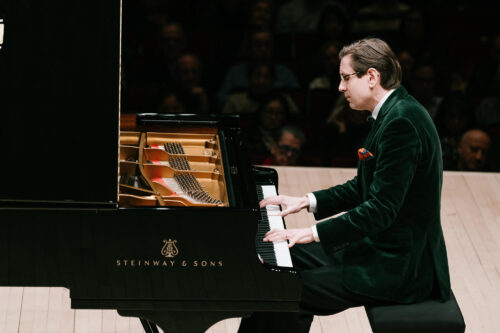
Bach – The Well-Tempered Clavier, Book I: Prelude in E major, BWV 854; Partita No.6 in E minor, BWV 830W
Beethoven – Piano Sonata No.27 in E minor, Op.90; Piano Sonata No.30 in E major, Op.109
Schubert – Piano Sonata in E minor, D.566
When Víkingur Ólafsson’s Carnegie Hall recital was first announced, it was to be devoted to Beethoven’s last three piano sonatas. In his program notes, he suggests that hearing them in succession is not necessarily ‘the most illuminating’ approach. Instead, he places a single work – the Sonata No.30, Op.109 – at the ‘gravitational center’ of the recital, ‘traveling freely in its orbit’ as he explores related works.
The resulting design unfolded within a single tonal space, organized around the interplay between E major and E minor. Instead of contrasting styles or periods, it moved through proximity, with each work emerging not as a departure but as a transformation of what preceded it. The result was not a linear progression but a recursive structure in which musical ideas returned in altered form, shared textures and colors reappearing in different guises, each work functioning as a variation on a common foundation. Heard without intermission and often attacca, the recital reinforced this continuity, the boundaries between works deliberately softened.
The overall conception was shaped by Ólafsson’s yearlong immersion in Bach’s Goldberg Variations, whose influence was evident in its construction. The Prelude in E major from Book I of The Well-Tempered Clavier, brief but poised, was not simply a point of departure but established a language of clarity and balance that resonated throughout the performance.
Bach’s Partita No.6 in E minor, placed at the heart of the sequence, expanded this framework into a more complex and exploratory terrain. Rather than presenting a succession of stylized dances, Ólafsson treated the work as a continuous unfolding of contrapuntal thought, each movement testing the limits of its nominal form. The opening Toccata, with its imitative writing and dense chromatic inflections, established a more unsettled expressive space, its tensions not easily resolved. In the Sarabande, that unease turned inward, its chromatic lines unfolding with a sense of isolation that avoided overt pathos, while the Gigue was shaped with a lightness and rhythmic precision that never compromised its structural clarity. With gestures reduced to a minimum, each note retained its independence within the texture, making the interplay of voices unusually transparent.
Beethoven’s Sonata No.27 in E minor introduced a more explicit duality, its contrasting characters held in close proximity, not sharply opposed. The first movement unfolded as a series of shifting impulses, with changes absorbed into a continuous line. The second, in E major, provided a point of release, its cantabile shaped with a quiet steadiness that avoided sentimentality. A similar introspective quality, at times almost dreamy in its suspension of momentum, also permeated Schubert’s Sonata in E minor, positioned on the opposite side of the Partita. Treated not as an unfinished fragment but as a self-contained, two-movement work, it emerged as a natural counterpart to Beethoven’s Op.90. The Moderato took on an introspective character, while the Allegretto expanded into a lyrical breadth, its recurring theme acquiring a gentle persistence.
Beethoven’s Sonata No.30 in E major concluded the program. Its opening movement moved between contrasting ideas without breaking the flow, while the Prestissimo avoided sheer force in favor of a more contained intensity. It was in the final movement, however, that the recital’s underlying idea became fully palpable. The theme and its variations took shape with a quiet inevitability, recalling Bach’s Goldberg Variations, whose presence had been felt from the outset. When the theme, with its sarabande-like character, returned at the end in disarming simplicity, echoing the reappearance of the opening Aria in Bach’s Goldberg Variations, it carried with it the memory of what had come before, not only within the sonata but across the entire structure.
Heard first in the Music Room at Caramoor and then, days later, at Carnegie Hall, the performance revealed a conception that held across very different acoustic environments. In Caramoor’s intimate space, the sense of inwardness was heightened, allowing details of articulation and voicing to register with particular immediacy. At Carnegie Hall, the same definition projected outward with greater breadth, the lines more widely spaced yet no less distinct, without altering the underlying balance. If anything, the shift in scale confirmed the coherence of Ólafsson’s approach.
Edward Sava-Segal