
 United Kingdom Schubert, Janáček, Skryabin, Beethoven: Pavel Kolesnikov and Samson Tsoy (piano). Wigmore Hall, London, 23.3.2026. (CSa)
Schubert – Fantasie in F minor, D940
Janáček – Piano Sonata 1.X. 1905 (‘From the Street’)
Skryabin – Vers la flamme, Op.72
Beethoven – Grosse Fuge, Op.134
The pianists and frequent partners Pavel Kolesnikov and Samson Tsoy made a welcome return to Wigmore Hall in an emotionally challenging lunchtime recital lasting just under 90 minutes but spanning almost 90 years. Playing together and individually, they explored works strikingly different in style and structure but unified by an accumulated emotional intensity in which harmonies, rhythms and form were driven to a point perilously close to collapse.
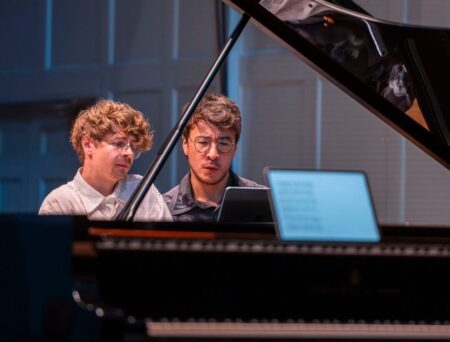
The programme opened with Schubert’s Fantasie in F minor, D.940, written in 1828, the year of his untimely death. The work’s apparent lyricism masks a far more unsettled core. The two players sat cheek by jowl at the same keyboard, Tsoy poised at the upper end to play the primo line and Kolesnikov at the lower end to explore the piece’s darker sonorities. Distinguished only by their brightly coloured shirts -Tsoy in orange and Kolesnikov in purple – they performed as if joined at the hip, breathing and phrasing as one. Importantly they resisted any temptation to smooth over the tensions or sugarcoat the pressing sense of urgency which pervades Schubert’s fatalistic score. The opening first movement marked Allegro molto moderato unfolded slowly and somewhat tentatively, sighing, rocking and surging with suppressed emotion, while the Largo evoked Schubert’s essential sense of loneliness and profound introspection. In a dramatic contrast the duo conveyed the febrile energy of the Scherzo with complete conviction and propelled the ever-tightening counterpoint of the Finale to a thrilling climax before returning to the fragile opening melody.
Next came Piano Sonata 1.X. 1905 ‘From the Street’ composed by Leoš Janàček to commemorate a young worker killed during a political demonstration in Brno in 1905 and played here with total assurance by Tsoy. The shifting, fractured harmonies and anguished outbursts of the opening Foreboding were given a vivid reading, and the raw grief which permeates the second movement entitled Death was skilfully sustained.
It was then Kolesnikov’s turn to return to the stage to give what proved to be an incandescent account of Aleksandr Skryabin’s mystical Vers ls Flamme. Some might experience the piece, written in 1914, as a single vision of a world moving towards annihilation by fire; others, such as Peter Reed in his illuminating programme note as a ‘cleansing by fire, from which creation is re-born.’ Whether he intended to convey mystical transformation or a sense of total destruction Kolesnikov, in a masterful study of controlled combustion, let the music generate its own heat.
The last item on the published programme was Beethoven’s Grosse Fuge, written originally as the finale of his String Quartet Op.130, but re-worked by him and published separately in 1828 to help listeners grasp its complex musical architecture more easily and make the piece more popular. In many ways, its inclusion in this recital was the culmination of the emotional and structural threads of the previous musical offerings. Stark, confrontational, technically daunting and uncompromising in its contrapuntal rigour, the piece rose up like a vast monument to modernity. On this occasion Kolesnikov assumed the primo role and Tsoy the secondo, in a close collaboration notable for its clarity, precision and balance. In an extraordinary display of unity, they crossed arms over the keys, and took turns to share the pedals, ensuring that the jagged rhythms of the Fuge and biting articulation remained coherent and tightly controlled.
An anecdote from Kolesnikov preceded a surprise encore. Stravinsky, we were told, famously admired Beethoven’s Grosse Fuge. He called it ‘a contemporary piece of music that will remain contemporary for ever.’ ‘I wonder what Beethoven would have made of Stravinsky’s Rite of Spring?’ mused Kolesnikov before he and Tsoy unleashed a raw and energetic rendition of the Sacrificial Dance. Stravinsky’s volatile piano score was executed with steely precision, its wild unpredictability meticulously prepared. This was an incendiary performance by two artists who are fast becoming legends in their own lunchtime.
Chris Sallon