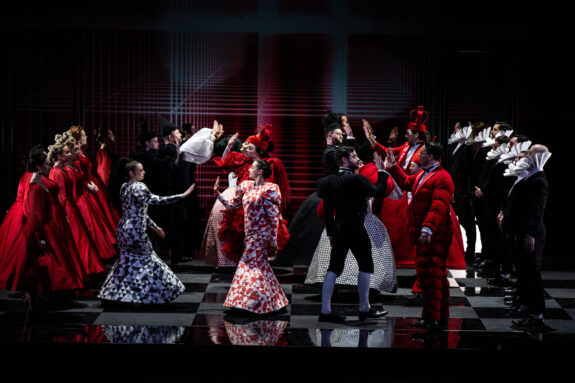
 Ireland Dvořák, Rusalka: Soloists, Chorus and Orchestra of Irish National Opera / Fergus Sheil (conductor). Board Gáis Energy Theatre, Dublin, 22.3.2026. (RB)
Dvořák’s Rusalka is the last of three Czech operas Irish National Opera (INO) have staged this season (following Smetana’s The Bartered Bride and Janáček’s Cunning Little Vixen). It is the first time INO have staged Dvořák’s ‘lyric fairy tale’ and it is also the first time rising star soprano, Jennifer Davis, has sung the title role. It is a co-production with Royal Swedish Opera and Nouvel Opera Fribourg; the former company has already staged this production to critical acclaim.
Director Netia Jones’s last production for INO was the harrowing, Ivor Novello award-winning opera about Rosemary Kennedy, Least Like the Other. This new high concept production of Rusalka uses multi-media stagings, including digital projections and flickering screens. Jones uses the fairy tale setting to explore ideas around environmental pollution, societal pressure on women to change their appearance and body shape and the objectification and abuse of women.
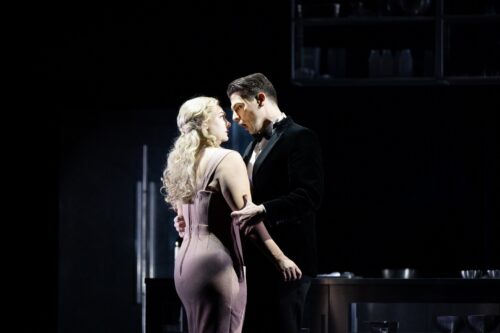
Jones transformed the idyllic meadow by the lake setting in the first act into a huge underwater network of industrial pipes. A group of aerialist water sprites performed elaborate gymnastics on the pipes. The water goblin entered wearing a plumber’s outfit and clearly had a role sorting out leaks and maintaining the system (given the current state of the UK’s rivers there is clearly a need for this!). Ježibaba was portrayed as a plastic surgeon and arrived smoking a cigarette on a hospital bed. Rusalka’s physical transformation took place against a backdrop of projections depicting the making of a new Bride of Frankenstein. Rusalka emerged Barbie doll-like with long blonde hair and a tight-fitting dress. Jones was clearly critiquing the societal pressure placed on women to improve their appearance and body shape and the toxicity of the modern cosmetics industry. In the ballroom scene in Act II, the chorus were dressed in stylised Lewis Carroll-type outfits and were lined up like chess pieces. There was a marked contrast between the shimmering beauty of the underwater world and the mechanised coldness of the human world.
Jones’s digital projections continually flickered and transformed during the production. During the Overture she projected on to the screen an image of a figure swimming under the waves, and in the third act this was transformed in a startlingly beautiful way into a more indistinct shadowy figure. There were constantly evolving shapes and colours, images of an ECG in the hospital scene, and shadowy pictures of the moon. There is always a risk that this kind of approach will detract from the main narrative thrust of the opera. However, I found the images compelling, and they helped to illuminate the opera in new and original ways. The underwater pipes served to illustrate how our rivers and lakes have changed since Dvořák’s time to everyone’s detriment. The hard-hitting cosmetic surgery scene was perhaps the most radical idea and made the subsequent relationship between Rusalka and the Prince more abusive than is usually the case in this work. However, it was again an insightful provocation highlighting the gender power imbalance at the heart of the opera.
This was an auspicious role debut for Irish soprano, Jennifer Davis as Rusalka. She captured the sweetness and vulnerability of the character in the first act and Rusalka’s increasing sense of social alienation in the second as she experienced rejection from the Prince and his courtiers. Davis brought a rich lyricism to the vocal line and her voice blazed at the climaxes to Act I, filling the Bord Gáis Energy Theatre. In the famous ‘Song to the Moon’ she maintained a seamless legato and did a brilliant job projecting the soft vocal line above Dvořák’s lush orchestration. Davis’s voice soared with longing at the climax points to the song. In the final act Davis showed her dramatic credentials as her voice surged above large orchestral forces with thrilling top notes.
Ryan Capozzo was impressive in the role of the Prince. He was suitably dashing in the first act and tormented in the third. In the second act his character was unusually abusive to Rusalka, although this was in keeping with the director’s vision of the work. He did a superb job negotiating Dvořák’s high vocal line and his tone was bright and brilliant. He struggled at some points to project above the large orchestral forces in the second act. In the final one he mustered more vocal power and captured the sense of heartbreak and desolation before succumbing to Rusalka’s poison. Some of the most impressive singing of the evening came from Croatian bass, Ante Jerkunica as the Water Sprite. His powerful voice effortlessly filled the theatre as he signalled evil omens ahead, and he lamented the loss of his daughter to the mortal world. His Act II aria was particularly affecting and infused with lyricism while his interactions with the chorus were beautifully handled.
Veteran mezzo-soprano Michelle DeYoung brought a detached cynicism and a whiff of danger to the role of Ježibaba. Her diction was excellent although the vocal line was a little uneven in the lower vocal register. Giselle Allen’s Princess was a sophisticated socialite with an edge to her. Allen brought dramatic power to the performance projecting above large orchestral forces, and her set piece numbers were tinged with aggression. The rest of the cast and the chorus all acquitted themselves well.
Fergus Sheil did a marvellous job ensuring the cast, chorus and orchestra stayed on track and his pacing of the material was first-rate. In Act I the woodwind beautifully depicted Rusalka’s shimmering underwater world and there was some glorious playing from Dianne Marshall on the harp. The brass were impressive signalling the Prince’s initial entries and in the Act II Polonaise. Sheil expertly synthesized Dvořák’s web of leitmotifs. There were a few balance issues in Act II where the singers had to cut through the composer’s heavy Wagnerian orchestration, although the balance was for the most part well managed.
Overall, this was a provocative and insightful production from Netia Jones featuring first class singing and playing from the performers.
Robert Beattie
Featured Image: Irish National Opera’s Rusalka © Ruth Medjber
Production:
Director, Set and Costume designer – Netia Jones
Lighting design – Lotta Hammarstrand
Video design – Netia Jones/Lightmap
Video associate – Amelia Scott
Choreography – Jessica Kennedy
Chorus director – Richard McGrath
Cast:
First Wood Nymph – Rachel Croash
Second Wood Nymph – Sarah Richmond
Third Wood Nymph – Alexandra Urquiola
Water Sprite (Vodník) – Ante Jerkunica
Rusalka – Jennifer Davis
Ježibaba – Michelle DeYoung
Huntsman – Andrew Masterson
Prince – Ryan Capozzo
Gamekeeper – Benjamin Russell
Kitchen Boy – Sarah Richmond
Foreign Princess – Giselle Allen