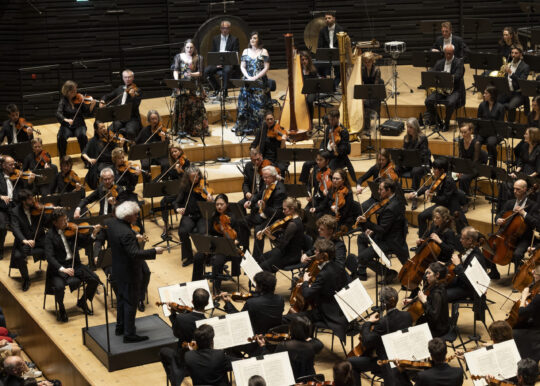
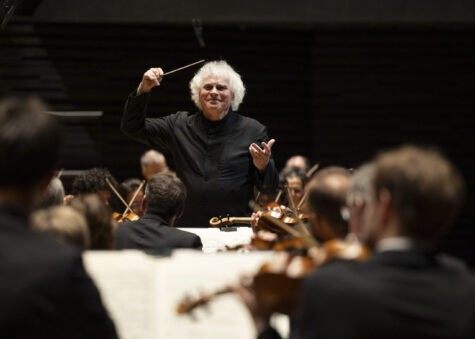
 Germany Purcell, R. Schumann, Mahler: Louise Alder (soprano), Beth Taylor (mezzo-soprano), Bavarian Radio Chorus, Bavarian Radio Symphony Orchestra / Sir Simon Rattle (conductor). Isarphilharmonie, Munich, 20.3.2026. (AL-L)
Purcell — Remember not, Lord, our offences, Motet, Z.50
Robert Schumann — Nachtlied for choir and orchestra, Op.108
Mahler — Symphony No.2 in C minor (‘Resurrection’ Symphony)
There are works in the symphonic repertoire that seem to guarantee, by their very nature, a collective triumph. Mahler’s Second Symphony is perhaps the supreme example: a piece that draws on the deepest reserves of every performer and, when it goes well, transforms a concert hall into something closer to a place of worship. This Munich account — the second of two performances — under Sir Simon Rattle went considerably beyond going well. It was one of those rare evenings that deepens understanding of a work one thought one already knew.
The concert opened with two brief pieces that served, in retrospect, as a meditation on mortality — the very subject at the heart of the Mahler. Purcell’s motet Remember not, Lord, our offences (Z.50), performed a cappella, showed the Bavarian Radio Chorus in austere, luminous form. Robert Schumann’s Nachtlied, Op.108, followed: restless music shot through with dark, interior glow, the orchestra adding textural richness to the already impressive range of colour of the chorus. Both were beautifully done yet functioned primarily as preparation — an antechamber to the great questions of the symphony.
Rattle’s relationship with the ‘Resurrection’ Symphony spans decades. He recorded it with the City of Birmingham Symphony Orchestra at the close of his long and transformative tenure there and has since returned to it with the Vienna Philharmonic at Salzburg and on European tour with the Berlin Philharmonic. What distinguishes this Munich account is the combination of that accumulated intimacy with the particular chemistry he has built with the Bavarian Radio Symphony Orchestra — and with the Isarphilharmonie itself, which has proved, not for the first time, a natural acoustic home for music of very large forces. Schoenberg’s Gurrelieder, Richard Strauss’s Alpine Symphony, and Wagner’s Siegfried have all found their ideal setting in this hall. Some musicians and listeners may prefer the warmer reverberation of the Herkulessaal, but the Isarphilharmonie offers something rarer: the ability to hear every strand of polyphony, to experience a balance that feels genuinely organic. More than in any hall this reviewer has visited, musicians appear to hear themselves and each other with exceptional clarity — and that quality of mutual listening was palpable throughout the evening.
It was evident from the opening bars. The entry of cellos and double basses in the first movement had a bite and edge that a certain celebrated Berlin recording — beautiful as it is — never quite conjures up. Mahler’s writing here is almost Ivesian in its layering of simultaneous fanfare figures, and the hall’s transparency allowed each strand to register with full weight. The woodwind/string balance, often a source of frustration in this work, was consistently ideal: inner voices that habitually disappear into the general mass were fully audible throughout. In the scherzo, Beckmesser would certainly have noted a few rough edges — Rattle pushed tempi to the limit and not every ensemble precision was maintained. But the risk-taking was entirely in the spirit of the music, and Rattle rightly declined to pull back.
The brass were outstanding — not merely secure in the demanding exposed passages but alive to every dynamic gradation, from the hushed questioning of the inner movements to the blazing proclamations of the finale. Individual contributions deserving particular mention include Ramón Ortega Quero’s consistently beautiful oboe playing, and the equally fine work of Lucas Spagnolo (flute), Magdalena Hoffmann (harp), and Carsten Duffy (horn). Concertmaster Anton Barakhovsky held the string body together with quiet, unfailing authority.
The final movement’s choral entry — emerging from near-silence in barely audible, hushed tones, with cellos and double basses sustaining a transparent and discreet accompaniment beneath — was perhaps the most extraordinary passage of the evening. I have praised the Bavarian Radio Chorus already, but their performance now raised the bar further still. The unanimity of ensemble, the clarity of diction, the extraordinary range of colour and dynamic: this was choral singing of the highest order, a body that sings as a single instrument. The two soloists were ideally matched: Louise Alder bringing a luminous soprano of easy command and radiant high notes, Beth Taylor’s mezzo-soprano — heard to particular effect in ‘Urlicht’ — was powerful, deeply felt and richly coloured throughout.
The audience listened with great concentration. One could have heard a pin drop, and in that condition of shared, collective attentiveness, the performance became something approaching a religious experience — precisely the transformation that Mahler had in mind. That Munich’s concertgoers are exceptional was confirmed once more on this occasion. The standing ovation was not a formality but a genuine expression of appreciation for a unique mutual experience.
Antoine Lévy-Leboyer
Featured Image: Sir Simon Rattle conducts the BRSO in Mahler’s ‘Resurrection’ Symphony © BR/Astrid Ackermann