 Germany Wagner, Lohengrin: Soloists, Chorus of Badisches Staatstheater, Badische Staatskapelle / Georg Fritzsch (conductor). Badisches Staatstheater. Karlsruhe, 22.3.2026. (DM-D)
This was a refreshingly straightforward rendering of Wagner’s opera. Director Manuel Schmitt focused on a central theme, the dangers inherent in allocating power over millions to one individual. Based on this and together with the design team, he has developed a cogent narrative for the opera.
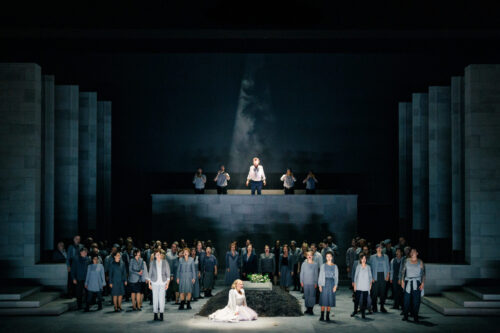
The opera was set in a courtroom or meeting room, with a wooden podium for the judge or chairman and colleagues at the back, and several rows of seats behind simpler desks to the right and left. To this modern, wooden feel, an archaic dimension was added, with tree structures serving both as frames and additional elements, including an entire barren tree trunk, a reference to the concept of the court linden or oak tree. A large burial mound with a flat marble sheet on top took up a prominent position centre stage. The courtiers were busy sifting through and shuffling sheets of paper. The Herald, comically deafened by the trumpets played as part of the proceedings, used a typewriter to take instant minutes. The King wore a modern suit under a more ancient-looking (courtly) cloak. Elsa wore a modern costume, she commanded attention, was used to her (former) position of power – both Telramund and the King rose when she walked past them.
When initially nobody appeared to speak for Elsa, the guards prepared her execution by lethal injection. The swan then appeared on the stage, a frightened boy, with wings he was not able to use, shaking and stumbling. He held a silver shield, onto which the light was directed in such a way that it reflected into the fifth row of the stalls, where Mirko Roschkoswki (Lohengrin) had taken his seat a few moments before the lights went down. He sang his opening ‘Mein lieber Schwan’ from there before making his way onto the stage, where he comforted the boy/swan. For his encounter with Elsa in that first act, the lights were dimmed for all but them.
The scene between Ortrud and Telramund at the beginning of Act II took place in a dimly lit area full of remnants of their dissolved household. Thugs roughly shaved Telramund’s head, an act of both humiliation and torture. Elsa appeared at the side of the stage from a balcony from which she descended to engage with Ortrud. When Telramund launched his renewed accusations, the swan/boy reappeared towards the front of the stage from the left, while a large projection of his troubled face appeared on the back wall. For much of the scene Elsa resisted the onslaught from Ortrud and Telramund bravely, and this was indicated her upright posture. At the end of the act, however, she crumbled on the final temptation motif.
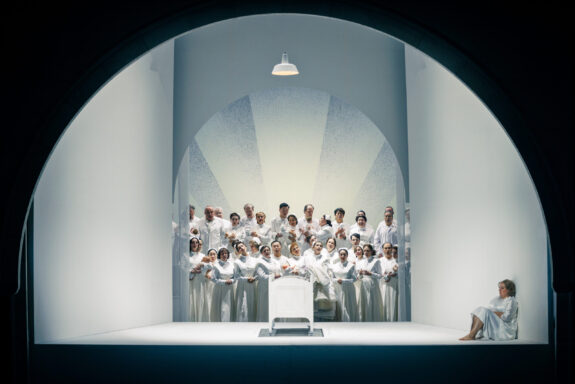
The bridal chamber was a cold, bare, white space, functional, with a crib in it (from which the swan/boy emerged when Elsa had the hallucination of seeing the swan). The bridesmaids were placed behind a white gauze curtain. They wore identical uniforms, held babies in their arms and went about their business of helping Elsa change from wedding dress to night gown with cold, professional efficiency.
On the intrusion of Telramund and his men, following immediately after Elsa had asked the forbidden question, the swan/boy gave Lohengrin the sword, and while he killed Telramund, all parts of the set were briskly moved from where they were, allowing the burial place to be revealed again at the centre of the stage. Lohengrin rested here for his Grail Narration, with the others initially at a distance, in awe, later drawing closer and touching the mound as if it were a holy relic. At the very end, Lohengrin freed the boy of his swan wings; a restored Gottfried stood atop the burial mound and broke Lohengrin’s sword in two over his knee.
Mirko Rosckkowski’s Lohengrin – who had begun his performance seated in the stalls – ended it standing in the aisle. His performance matched attention to detail both in terms of acting and singing. His voice was steady and even across volume and registers. He was able to remain audible as a separate voice in the large orchestral and choral passages; comfortably heroic where needed, and demonstrating particular beauty of tone in the lyrical passages. Rosckkowski used his voice very well technically: he did not need to hold back at any time before allowing his voice to shine for the Grail Narration at the end of the performance. The piano on ‘Taube’ was particularly subtle and delicate, as was the farewell to the swan. Sitting only a few feet away during the initial farewell to the swan and the forte finale ‘Seht da…’, this reviewer was treated to a close- up visual and auditory experience.
Pauliina Linnosaari was a wonderful Elsa. Her voice sounded crystal clear throughout, with precise diction. Kihun Yoon as Telramund allowed the beauty of the music Wagner created for this role to sustain and form the apparent basis for outbursts of evil. Barbara Dobrzanska as Ortrud was very convincing, particularly thanks to her excellent breath control, which allowed her to maintain the role’s long arcs rather than having to resort to sudden shrieks. Konstantin Gorny brought his musical and elegantly lean – rather than black and booming – bass to his interpretation of King Henry. Tomohiro Takada used his strong voice to give the Herald the required authority. Georg Fritzsch’s reading of the score was above all transparent, balancing orchestral voices cogently throughout.
Daniel Meyer-Dinkgräfe
Featured Image: Badisches Staatstheater’s Lohengrin: Pauliina Linnosaari (Elsa, far right) © Felix Grünschloss
Production:
Director – Manuel Schmitt
Stage design – Julius Theodor Semmelmann
Costume design – Carola VollesLighting design – Stefan Woinke
Fight choreography – Atef Vogel
Chorus director – Ulrich Wagner
Dramaturgy – Natalie Widmer
Cast:
Heinrich der Vogler – Konstantin Gorny
Lohengrin – Mirko Roschkowski
Elsa von Brabant – Pauliina Linnosaari
Friedrich von Telramund – Kihun Yoon
Ortrud – Barbara Dobrzanska
The King’s Herald – Tomohiro Takada
Four Brabantine Nobles – Ks Klaus Schneider, Alejandro Aparicio, Lorenzo de Cunzo, Don Lee
Four boys – Alexandra Klenia, Annika Buchner, Tara Priemer, Klara Traub (members of Cantus Juvenum Karlsruhe e.V., trained by Lorenzo de Cunzo and Anette Schneider)
Duke Gottfried / Swan – Philipp Hohner