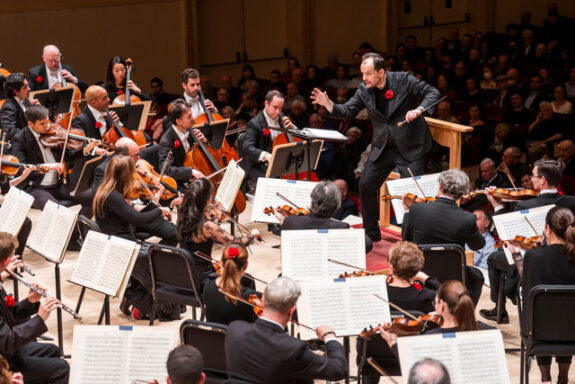
 United States ‘United in Sound: America at 250’ [4] – Adams, Dvořák: Renée Fleming (soprano), Thomas Hampson (baritone), Tanglewood Festival Chorus (director: Lisa Wong), Boston Symphony Orchestra / Andris Nelsons (conductor). Carnegie Hall, New York, 9.4.2026. (RP)
Adams – Three selections from Nixon in China
Dvořák – Symphony No.9 in E minor, Op.95, ‘From the New World’
The Boston Symphony Orchestra has performed at Carnegie Hall over 950 times — the most by any visiting orchestra. It returned for two concerts led by Andris Nelsons, the first of which was part of Carnegie Hall’s United in Sound: America at 250. This was an emotionally charged event, as much for the musical performances as for the recent events that have rocked the orchestra.
John Adams broke new ground with his first opera, Nixon in China. He not only proved that opera could examine the modern world, he also established minimalism as a powerful operatic style. The satirical yet serious and thought-provoking plot centers on President Richard Nixon’s 1972 visit to China, which led to diplomatic relations between the two countries.
Nelsons programmed a selection of the opera’s most powerful arias and scenes, beginning with extensive excerpts from the first act: a Chinese military chorus sings before the arrival of the presidential party at Beijing Airport; an orchestral bombast greets the arrival of the Spirit of ’76, as Air Force One was then called in honor of the upcoming Bicentennial; and then Nixon’s aria, ‘News has a kind of mystery’. In the aria, Nixon muses on the historical significance of his visit to China and the power of media, an evergreen topic since at least the invention of the printing press.
The scene then shifts to the First Lady’s Act II aria, ‘This is prophetic’. She envisions a world at peace after a tour of Beijing that included a factory, a commune and a school where she watched children play games, all perfectly staged by Communist Party officials to present an idealized China. The concluding excerpt was the final scene from Act I in which Nixon responds to the toasts by commenting that he has attended many feasts but never enjoyed a dinner so much as this one, reflecting with awe and self-satisfaction on the scene.
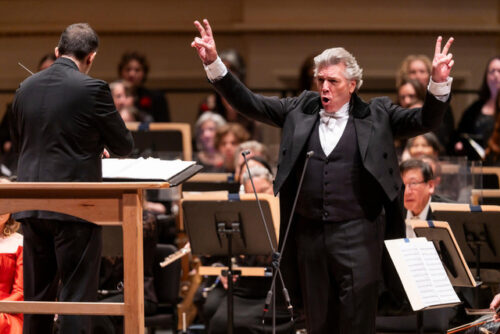
Renée Fleming and Thomas Hampson have just completed a run as the presidential couple in Nixon in China at Paris’s Opéra Bastille. Adams requires amplification of voices to compete with his dense orchestra textures. At this stage in their careers, neither Fleming nor Hampson has the advantages of youth in their artistic arsenal. They do have charisma and sufficient vocal allure to make an impact in the right circumstances, and this was one of them.
Hampson’s imposing Nixon was a combination of pomposity and insecurity. His command of the text was riveting, and his voice retains its authority, even if the upper notes thin. He conjured an era with both arms raised in Nixon’s ‘V for Victory’ sign. Fleming, a vision in a burnt orange gown, was a wistful, airy Pat Nixon, expressing wonder and joy in her still lovely soprano. She floated high notes with impressive ease, but her soprano is heard to the best advantage in its still plush middle range.
Even with Fleming and Hampson’s megawatt star power, the Tanglewood Festival Chorus and the BSO stole the show. The chorus’s articulation of the text in ‘Three Rules of Discipline and Eight Points for Attention’ was exemplary, as was their precision. Adams’s repetitive melodic and rhythmic cells were played with a transparent, often shimmering sound. Two BSO hallmarks, the sheen of the sound it produces and its blazing brass section, were on full display. They would be even more so in Dvořák’s ‘New World’ Symphony.
In the Nixon in China excerpts, Nelsons paced the musical flow with deliberation, and he did likewise in Dvořák’s Symphony No.9. This exposed the work’s structure and set instrumental solos like jewels. To some extent, flow was impeded but never the beauty and power of the music. After the slow, melancholy opening, the first movement sizzled in the subsequent fast-paced section, driven by principal hornist Richard Sebring’s superb playing. In the Largo, English hornist Robert Sheena instilled the solos with mellow tone and exquisite sensitivity, but thankfully, scant sentimentality.
The Scherzo was ignited by muscular playing from the BSO’s tremendous brass section. Equally impressive was the silken sound of the strings, especially the violins. In the Finale, Nelsons wove the themes from the previous movements into a fascinating, unified whole, with timpanist Timothy Genis propelling the slow, tension-filled buildup to the symphony’s triumphant end.
Recently the BSO’s board of directors fired Nelsons, terminating his contract in 2027. The action was taken without the knowledge of the players, many of whom have protested his dismissal, and they wore red roses here to signal their support for Nelsons. He received a prolonged ovation when he appeared to conduct the Dvořák, but that paled in comparison to the one he received at the concert’s end, with many orchestra members joining in either with applause or by stomping their feet.
Rick Perdian
Featured Image: Andris Nelsons leading the Boston Symphony Orchestra © Chris Lee
Thank you for your review! An important correction needs to be made: Lisa Wong, Cleveland Orchestra Chorus director, prepared the TFC as guest chorus conductor for these performances. Her superb work led to the precision and effectiveness you heard. (I’m a long-time member of the TFC.)
Jim for S&H: Thank you too! That important correction has now been made in the header.