
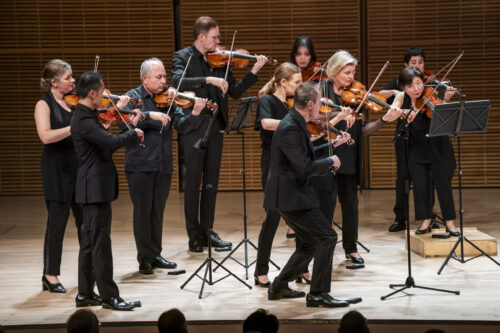
 United States Purcell, Adams, Schubert: Australian Chamber Orchestra / Richard Tognetti (director and violin). Zankel Hall, Carnegie Hall, New York, 22.4.2026. (DS)
Purcell – Fantazia upon One Note, Z.745
John Luther Adams – Horizon (world premiere)
Schubert (arr. Richard Tognetti) – String Quartet No.14 in D minor, D.810, ‘Death and the Maiden’
On its 50th anniversary, the self-conducted Australian Chamber Orchestra is touted for having been transformed into a group of extraordinary artistic prowess under the direction of music director and violinist Richard Tognetti. I heard them for the first time at their tour stop in Carnegie Hall’s Zankel Hall, and the deft command and hypnotic passion with which they delivered typically standard works left me believing it.
The stunner of the evening was Tognetti’s arrangement of Schubert’s ‘Death and the Maiden’, which he transformed from a string quartet into a 16-person string ensemble including, quite adventurously, a bass. If an arrangement is a musician’s homage to a great piece, this was a prime example. Tognetti’s evident in-depth understanding of Schubert’s masterwork proved to be a personal love letter to the piece. His parsing of the parts to harness the strength of the group’s players while carefully crafting a balance between full ensemble and occasional solo parts brought forth a fresh glimpse of the shadings and moods that are possible in this audience favorite. From the outset, there was Baroque styling written into the phrasing that lent itself surprisingly well to this otherwise staunchly Romantic work, perhaps as a way to keep the intimacy of a string quartet alive with four times the number of players.
The crystalline perfection of the ensemble work and responses in tonal phrasing between players was mesmerizing as they followed Tognetti’s physically visceral direction from his first violin spot (his lunges and back arches were not only great fun to watch from the audience but clearly did the trick in communicating with the players). As the musicians progressed to the final movement, every musical decision fell delightfully into place. And by holding the reins of the Presto movement to suit this larger ensemble, both ‘death’ and ‘maiden’ were suddenly of less significance in face of the palpable intensity of the Australian Chamber Orchestra’s gripping gallop to the end.
The concert had opened with a 3-minute Fantazia by Purcell that the orchestra presented as a sparkling warm-up. They opted to connect Purcell’s drone note C, without pause, directly into John Luther Adams’s Horizons – the evening’s world premiere – which also required that drone note. The theater went dark, leaving musicians and audience with only the light emanating from the players’ iPads for illumination. Much like the way the group upended all expectations for ‘Death and the Maiden’, they captured a unique tension in Adams’s work, which is nearly always described as meditative. While Horizons undoubtedly still offered that ponderous quality, the ensemble’s approach to the first movement, ‘Visible Horizon’, demonstrated the pressure and power of a dark, mellow atmosphere. Each player had a distinct part which blended together in a complex tapestry of speedy passages that coexisted with neighboring players’ slower tempi. The second movement, ‘True Horizon’, had a broader, planar quality and, gradually, lighting was reintroduced overhead. The players stood far apart, covering the whole stage, and their matching of sound and space with expert timing in relation to the incrementally brighter lighting was as sublime as experiencing nature’s sunrise across the horizon. Considering that they maintained these intricately intertwined parts for over 40 minutes, technical endurance and profound attention to performance preparation are clear non-negotiables in their ensemble toolkit.
An encore was most welcome. With gentle charm, they played an excerpt from Haydn’s Symphony No.4. The evening demonstrated that leadership may be required for transformation but, as the members of Australian Chamber Orchestra proved, the contribution by each individual to a new vision is how an average group turns into a great one.
Daniele Sahr