
 United States Wagner, Die Walküre: Soloists, Los Angeles Philharmonic / Gustavo Dudamel / (conductor). Walt Disney Concert Hall, Los Angeles, 19-21.5.2026. (HS)
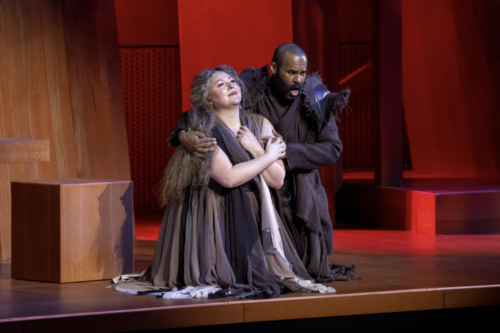
Los Angeles Philharmonic’s approach to semi-staged opera pays big dividends with thrilling moments in Wagner’s Die Walküre. A combination of gold-plate casting and energetic conducting by Gustavo Dudamel overcame the puzzling set design, originated by architect Frank Gehry who also designed Disney Hall. These performances of the most popular opera in the Ring cycle highlighted the final weeks of Dudamel’s 17-year tenure as LAPhil’s music director before he steps into his new role later this year at the New York Philharmonic.
Rather than presenting the four-hour-plus opera in one evening, the three acts were spaced over three evenings, making for bite-sized (for Wagner) doses of relatively short duration. LAPhil did the same in the Tristan Project (another Dudamel-inspired Wagner revived in 2022), spreading the even-longer acts of Wagner’s Tristan und Isolde over three nights. In this Walküre, whatever might have been lost in continuity allowed musicians to delve into each act and gave audiences more time to absorb what they had experienced before moving on.
It is hard to beat such assets as soprano Christine Goerke as Brünnhilde (the Valkyrie of the title) and bass-baritone Ryan Speedo Green as Wotan, the Valhalla god who sets the complicated plot in motion. They both provided glorious singing and insightful dramatic touches while Dudamel and the orchestra rendered Wagner’s soundworld with impressive presence.
At times the staging got as close to opera-house quality as any concert version I can imagine, but often the concept missed the mark.
Gehry’s first foray into opera with the LAPhil and Dudamel dates from 2012 when he designed the sets for all three Mozart-Da Ponte operas presented over three years. The orchestra reprised the trilogy over 2019-2022. Gehry also designed the 2024 Das Rheingold. For Walküre, Gehry’s best innovation created a sort of shallow orchestra pit about half a metre below the audience’s front row rather than placing the orchestra in its usual position on a raised stage. He also wrapped an apron walkway around the front of the orchestra, a set-up common on Broadway, which allows the action to surround the music.
Instead of being hidden from view as happens in most opera houses, the orchestra became an essential part of what the audience sees. That is perfect for Wagner – his music is often described as another character. We literally see what we hear and what we hear is not muffled. Those advantages cannot be overstated, whether it is seeing all six harps that Wagner’s score calls for or all the unusual brass instruments. Most of all, the conductor-orchestra-singer connections were something to be relished. Unfortunately, to get to the apron performers had to exit backstage which made basic blocking complex and awkward.
Gehry’s abstract set design filled the space above the stage with gigantic clouds of crumpled paper. Shifting colors were projected on it for subtle effects, but the wooden shapes on the stage only hinted at an actual hut in Act I, a forest clearing in Act II and a mountaintop in Act III. If the point was to focus our imagination on the human aspects of the story, the cast found ways to illuminate them more vividly with their singing and interactions than the set did.
In Act I, tenor Jamez McCorkle’s Siegmund and Jessica Faselt’s Sieglinde caught the aura of long-lost siblings rediscovering their love for each other. As Siegmund, McCorkle’s velvet-textured heldentenor rang the perfect overtones in a voice that had enough heft to make big climaxes thrilling. ‘Winterstürme’ was as seductive as could be, and the repeated cries of ‘Wälse!’ were especially arresting. In their long scenes together, Faselt’s Sieglinde seemed totally connected with him. Bass Soloman Howard’s rough-hewn Hunding wielded a vocal character of richness without softening any blunt edges.
As Act II began, Green’s muscular, plangent bass-baritone and Goerke’s athletic ‘Hojotoho’ vocalizations created a jolly mood as they greeted each other on the apron. Scolding Wotan for allowing the twins to copulate, his wife Fricka, voiced by Sarah Saturnino, focused her mezzo-soprano sharply as she systematically knocked down Wotan’s plans. As Green’s voice took on a worried edge, he lost none of his ability to spin out long phrases with deep vocal allure. In the extended monologue spelling out his dilemma to an attentive Brünnhilde, Green built up an extraordinary rendering with waves of kaleidoscoping colors and pointed attention to the words.
Goerke’s scene with McCorkle’s Siegmund was another treasure, the beauty of both voices reflecting a quiet outpouring of love as they confront his pending death at the hands of Hunding. In these quieter scenes, Dudamel got the orchestra’s sound to float with the voices, almost miraculously. Less effectively, the revved-up orchestra occasionally overshadowed the singers’ climactic high notes.
In the fight that ends Act II, the staging side-stepped elements specified in the libretto. In this telling Wotan interfered not with magical gestures but by physically taking away Siegmund’s sword and breaking it over his knee (which, awkwardly, required him to duck offstage to trade it with the prop sword set to be broken). Wotan then forces Hunding to kneel and slashes his throat with Hunding’s own sword. Perhaps the intent was to underline human traits, but it was an awkward way to do it.
Awkwardness also intruded on the ‘Ride of the Valkyries’ scene that opens Act III. Eight three-dimensional, internally-lit white horses occupied the stage, meant to symbolize the steeds that the Valkyries fly in on. But these artfully fashioned horses were stationary, and the eight singers had to carefully wend their way onto the stage.
Distractingly, the horses remained for the duration of the opera, still there in the magnificent and intimate final scene in which Brünnhilde convinces Wotan to alter the punishment for disobeying him. A circle of light suggested the rock on which Brünnhilde is stranded, requiring her to sink to the floor of the stage on her own. The horses glowed red during the Magic Fire, but flames were nowhere to be seen.
Fortunately, the singing through all this was sensational. Goerke’s long legato enriched her a cappella pleas and her musicality made the emotional points. Green’s umber voice answered with a tone that reflected the character’s conflicting emotions. Wotan’s long farewell further raised things to a glorious height as Dudamel savored the quiet, sonorous chords for a touching finish.
These musical aspects were what made this three-part, three-evening version special.
Harvey Steiman
Featured Image: Ryan Speedo Green (Wotan) and Christine Goerke (Brünnhilde) in Act II of Die Walküre © Elizabeth Asher
Creatives:
Scenic designer – Frank Gehry
Director – Alberto Arvelo
Costumes – Cindy Figueroa
Original Oil paintings, Sequential photography – Omar Cerrada
Video – Gabriela Camejo
Dramaturg – Cori Ellison
Cast:
Wotan – Ryan Speedo Green
Brünnhilde – Christine Goerke
Sieglinde –Jessica Faselt
Siegmund – Jamez McCorkle
Hunding – Soloman Howard
Fricka – Sarah Saturnino
Valkyries – Alexandria Shiner, Teresa Perrotta, Lindsay Amman, Ronnita Miller, Laura Wilde, Zole Reams, Taylor Raven, Siphokazi Molteno
I thought this was a spectacular event. Well worth the three visits. Remember the orchestra opened Coachella last year with the Ride of the Valkyries so to see it staged and played so beautifully is a gift that we will never forget. Thank you Gustavo and LA Phil. Best, Michael Kamiel MD
Slight correction – the Tristan Project initiated in LA (semi-staged version, 2004) and Paris (staged production, 2005) was a vision and partnership between Esa-Pekka Salonen, Dudamel’s predecessor, Peter Sellars (direction) and Bill Viola (video). Both versions were widely toured, both by Salonen and others, I assume Dudamel conducted a revival of it in LA.