
 United States Anuj Bhutani, Harriet Steinke – BMP: NextGen3: Soloists, Instrumentalists. Beth Morrison Projects, National Sawdust, Brooklyn, 16.5.2026. (RP)
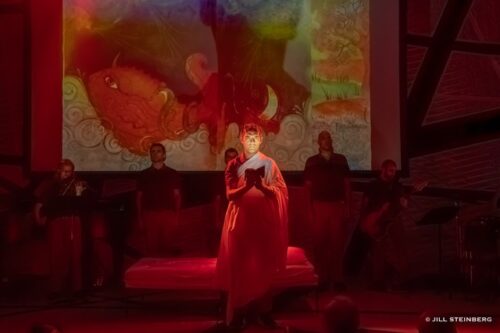
Beth Morrison Projects has announced Anuj Bhutani’s autobiographical vocal-theater piece, Manu, as the winner of the 2026 BMP: NextGen project. Founded in 2006, Beth Morrison Projects commissions, develops and tours groundbreaking works by living composers, redefining modern opera-theater. BMP: NextGen is its multi-year program for music-theater composers. The process yielded two finalists, Bhutani for Manu and Harriet Steinke for Monna Innominata, whose works were previewed in semi-staged performances at National Sawdust in Brooklyn. As the winner, Manu will be developed into a full-length work in conjunction with BMP.
Bhutani is a first-generation Indian-American composer whose interdisciplinary works focus on liminal spaces. His musical palette spans classical, emo/screamo, ambient and electronic music, yielding genre- and culturally-fluid pieces that place the listener between multiple musical worlds. His most important works include the chamber piece and all the lives we lived, an award-winning cello concerto and flightpath (commissioned by the Metropolis Ensemble and the Brooklyn Botanic Garden). His choral work ‘your little voice’ reached the finals of the VOCES8 Composer Competition.
Manu was Bhutani’s childhood nickname. In Hindu texts, it is the name of the progenitor and first king of humanity, comparable to the concept of Noah. Manu saves a little fish who warns him that a flood will destroy all of humanity. As with Noah and the ark, Manu builds a boat and survives the flood. From the catastrophe comes rebirth and hope, which is also Bhutani’s story
He describes his music-theater piece as ‘the container that holds all the parts of his life’, in which the myth of Manu and the little fish intertwines with his experience at a troubled-teen institute. As a child, Bhutani grappled with the tension between his conservative Indian-born parents’ expectations and the realities of contemporary American society. To straighten him out, his parents enrolled him in the Red River Academy.
The school was part of a multi-billion-dollar network of therapeutic boarding schools, wilderness programs, boot camps and religious academies. The industry has faced intense scrutiny over allegations of widespread physical, emotional and psychological abuse. One of its fiercest critics is Paris Hilton, who spent 11 months at four youth residential facilities. Hilton’s efforts to expose institutional child abuse resulted in her testifying before the US Congress in support of a federal bill of rights to protect children in such settings.
Bhutani, who wrote the libretto and music for Manu, performs the lead role. It opens with Bhutani introducing his story to a montage of childhood photos. This culminates in Manu being kidnapped and placed in a spartan room at Red River Academy with Zoltan as his roommate and mentor. It’s a Christian academy where world history is taught as Bible study. Looking out the window is forbidden, and music is banned. As a coping mechanism, Manu writes the lyrics of his favorite songs in a notebook.
Zoltan, performed with disarming sincerity, innocence and openness by Dylan Frederick, was a foster child. He didn’t fit in at school and had no friends, and he ended up at Red River Academy because his foster parents did not know what to do with him. He struggles with his lessons because English is not his first language, something that Manu helps him with. The chemistry between Bhutani and Frederick was palpable, and their scenes together were incredibly moving.
Bhutani doesn’t do a hatchet job on his parents. There were videos of parents explaining they only wanted the best for their child but were unable to help. If their actions result in the child hating them, it is a trade-off they are willing to accept. These contrasted with videos of survivors of the system who summed up the experience as ‘they will do anything to break you’. Manu emerges from the Red River Academy whole and unbroken. Upon his release, he gives Zoltan his book of song lyrics, telling him to remember the little fish in the story of Manu who saved the world.
Manu is a visceral experience. The music, heavy with electronics and percussion, can be as terrifying as the scenes where guards manhandle Manu after an attempted escape. Bhutani’s performance is electrifying in the scenes where Manu’s desperation and frustration peak. Projections depicting the tale of Manu and the fish add calm, cohesion and hope to the story, as do the heartrending scenes between Manu and Zoltan. Bhutani has a longer, richer story to tell, and one can only imagine its emotional power.
Steinke’s Monna Innominata, a song cycle for a quartet of female singers, could not have been more different aesthetically and emotionally than Bhutani’s Manu. Steinke has received commissions from chamber ensembles, orchestras, soloists, festivals and presenters across the U.S. Her work is often inspired by poetry and other word-based art forms, and much of her music explores the big capabilities of small ideas.
In Monna Innominata, Steinke reimagined the Victorian poet Christina Rossetti’s sonnet cycle of the same name. The title translates to ‘Unnamed Lady’, summoning the muses of Renaissance poets such as Dante’s Beatrice and Petrarch’s Laura, who were idealized but never permitted to speak. Rossetti’s poems give voice to such an unknown lady who struggles with longing and denial to cope with the reality of unfulfilled or perhaps renounced love
Steinke set Rossetti’s words in flowing ballads sung to transparent, delicately colored instrumental sounds. The four singers, Danielle Wartz, Alex Koi, Emily Geller and Molly Yuko McGuire, strolled about the stage singing to the accompaniment of bell-like sounds and the strumming of strings. Steinke’s vocal and instrumental style, which ranged from the Renaissance to contemporary minimalism, provided an escape into a mystical place where beauty and mystery reigned. We have not heard or seen the last of Monna Innominata.
Rick Perdian
Featured Image: Anuj Bhutani (Manu) & Dylan Frederick (Zoltan) © Jill Steinberg
Manu
Creative and Design Team:
Composer, Librettist and Performer – Anuj Bhutani
Director – Rory Pelsue
Movement director – Allison Jones
Lighting – Paige Seber
Dramaturg – Dahlak Brathwaite
Cast:
Manu – Anuj Bhutani
Zoltan / The Fish – Dylan Frederick
Staff 1 – Jonathan Christopher
Staff 2 – Alex Syiek
Orchestra:
Music Director – Kazem Abdullah
Erika Dohi (piano/synthesizer), Drew Sensu-Weinstein (electronics), Brendon Randall-Myers (guitar), Madeline Hocking (violin), Avirodh Sharma (tabla), Jeff Gretz (percussion)
Monna Innominata
Creative and Design team:
Composer – Harriet Steinke
Director – Nina Goodheart
Lighting – Paige Seber
Costumes – Olivia Vaugh Hern
Projections – Camilla Tassi
Performers: Danielle Wertz, Alex Koi, Emily Geller, Molly Yuko McGuire
Orchestra:
Music Director – Kazem Abdullah
Max Hammond (piano), Makana Medeiros (percussion)
Katrina String Quartet – Jeanel Liang (violin), Jérôme Chiasson (violin), Celia Morin (viola), Maya Enstad (cello)