
 United Kingdom Mendelssohn, Bach, Grieg: Vilde Frang (violin), Baptiste Lopez (violin and director), Sebastian Wienand (harpsichord), Basel Chamber Orchestra. Wigmore Hall, London. 20.5.2026. (CSa)
Mendelssohn – String Symphony No.4 in C minor; String Symphony No.10 in B minor
JS Bach – Concerto in A minor for violin, strings and continuo BWV 1041; Concerto in E for violin, strings and continuo BWV 1042
Grieg – Holberg Suite
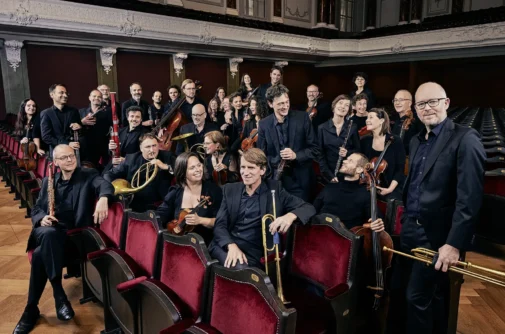
‘It’s something miraculous!’ declared Goethe, amazed by the extraordinary talent of the child prodigy Felix Mendelssohn. The young Felix was an occasional visitor to Goethe’s Weimar home and performed his own compositions there on numerous occasions between 1822 and 1823. It is doubtful however, that the great writer ever heard String Symphony No.4 in C minor, written in 1821 when Mendelssohn was 12 years old or his Symphony No.10, composed two years later. Nor is it likely that it was ever performed in Basel during Mendelssohn’s extensive European tours. These two astonishingly precocious works were almost certainly first aired by a private orchestra assembled in Mendelssohn’s wealthy family home and were chosen to bookend the first half of the concert given by the 19-strong strings of the Basel Chamber Orchestra under the directorship of violinist Baptiste Lopez.
Originally descended from Paul Sacher’s Basler Kammerorchester which was founded in 1926, the present chamber ensemble emerged in 1984. It is famed for its light articulation, transparent textures and precision, qualities much in evidence in the confines of the acoustically intimate Wigmore Hall.
There is little recognisably Mendelssohnian in the Fourth Symphony – the boy genius had yet to define his unique style – but the influence of the great German masters who inspired him strongly echoed throughout. The opening Grave suggested Handel at his most stately, while the ensuing Allegro development had the intensity and urgency of early Beethoven. The lyrical slow movement – shades of Mozart here – was played with exceptional balance between the different string sections, while the structurally complex Finale was executed with clarity and energy.
Mendelssohn’s early Romantic voice began noticeably to emerge in his String Symphony No.10 in B minor. A short single movement piece marked Adagio-Allegro, its restless rhythms and sudden contrasting harmonies were finely articulated in an emotionally charged performance.
Mendelssohn’s unbounding admiration for (and single-handed 19th-century revival of) JS Bach was appropriately reflected in the inclusion in the programme of two of the latter’s violin concertos: A minor BWV 1041 in the first half and in E, BVW 1042 after the interval. Joined by the famed Norwegian violinist Vilde Frang as soloist, each was given a subtle and gloriously expressive reading. Frang’s spare, unshowy high-precision playing and minimal vibrato, gave her performance of BVW 1041 a deep humanity and an almost time-suspended authenticity. The opening Allegro unfolded in an effortless conversation with the players, followed by a soul-searchingly tender Andante and a propulsively dancing Finale. The concerto’s companion – BWV 1042 – continued the seamless dialogue. Frang’s violon darted in and out of the orchestral texture with buoyancy and brilliance in the first movement and sang soulfully in the Adagio. After an exuberant foot-tapping Finale, the audience craved more and were rewarded with an encore: the slow movement of Bach’s Double Violin Concerto in which Frang, joined by Lopez played with heavenly serenity.
The concert ended with a work which was built on the Baroque dance forms employed by Bach but also nodded to the rich string sonorities of Mendelssohn: Grieg’s familiar five-movement Holberg Suite blew gently like a fresh Nordic breeze through the Wigmore Hall. Bright, lyrical, melancholy and joyful in turn, Lopez and his players gave us a life-enhancing performance, hovering between eras and ageless in spirit.
Chris Sallon