 Italy Verdi, Nabucodonosor (Nabucco): Soloists, Teatro alla Scala Chorus and Orchestra / Riccardo Chailly (conductor). Livestreamed (directed by Ella Gallieni) from Teatro alla Scala, Milan, 29.5.2026. (JPr)

Verdi was in despair in the winter of 1840-41 after the failure at Milan’s La Scala of Un giorno di regno which was withdrawn after just one performance, and this followed the recent terribly sad deaths of his young wife and two children. It is no wonder Verdi vowed never to compose again. In a chance meeting with impresario Bartolomeo Merelli, Verdi was given a copy of Temistocle Solera’s libretto about Nebuchadnezzar II, the ruthless Babylonian king who oppressed the Israelites. It had been rejected by the composer Otto Nicolai and Verdi described how he took it home, and having thrown ‘it on the table with an almost violent gesture. … In falling, it had opened of itself; without my realising it, my eyes clung to the open page and to one special line: “Va pensiero, sull’ ali dorate”’.
Of course, these are now the opening words (‘Go, thought, on golden wings’) of the opera’s extraordinarily famous Act III chorus – sung by the Hebrews in captivity – that would seal the success of Verdi’s third opera, Nabucco, in 1842, originally titled, as at La Scala, Nabucodonosor. The chorus became an anthem for the Italians who were a divided nation under foreign rule and seeking unification and independence. ‘Va, pensiero’ is often encored and certainly the applause for a deeply moving performance by the magnificent La Scala Chorus went on and on, but the audience’s wish was not granted by Riccardo Chailly conducting his last new La Scala production as its music director.
What La Scala presented on this occasion was in the context of strike action with apparently approximately 60% of the scenic realisation unavailable, scene changes severely restricted, only five stage technicians available to operate a production that would normally require around twenty, and a number of chorus costume changes also could not be executed. So South Africa born Alessandro Talevi’s production cannot be evaluated as if it was a complete performance of his and designer Gary McCann’s vision. What we were left with was fairly respectful – i.e. traditional – and was approached as a series of tableaux which anyway possibly befits an opera which is not especially a masterpiece consisting, as it does, of several rather static choruses, forthright and rather repetitive arias, as well as some uninspired oompah-pah passages typical of Verdi. What we heard was the critical edition of the score edited by Roger Parker and published by Ricordi and University of Chicago Press and it included the ballet divertissements Verdi wrote for Brussels in 1848 which – while receiving their first modern-day outing – extended an already over-long opera. In Act III on a stage-within-a stage we had Anna Netrebko ‘dancing’ as Semiramide, donning a gold crown, breastplate and holding a spectre and surrounded at one point by figures costumed as horses or doves. Netrebko even essays a ‘Dance of the One Veil’ at one point. Netrebko was more committed to this nonsense than it deserved just as Chailly conducted his chorus and orchestra with a commendable energy and impetus totally worthy of the epic breath of the religious and political plotlines of Nabucco, making the intense music sound much better than it probably is.
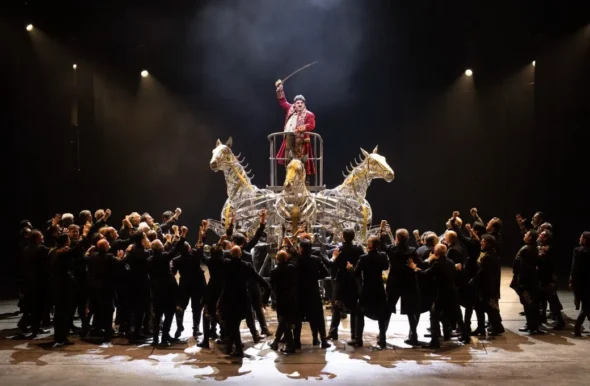
For the first act there was a pile of rubble in a smoky blue haze which suggested the Temple of Solomon had already been destroyed and the Israelites often clutched a chunk of masonry. The opera opened with a suggestion of bombing which resonated with modern-day events which are best not dwelt on here. The stage – possibly for reasons explained above – remained rather bare from then on with just a hint of pillars or columns and intriguingly ‘Nabucco’ is later shown walking a tightrope at the start of Act IV and being haunted by nightmarish figures. Quite effective was the image of Nabucco atop a huge chariot drawn by three skeletal (War Horse-type) horses. Abigaille’s appeal to God for mercy at the end during what amounts to a ‘mad scene’ is for naught as after she dies her corpse is consumed by flames.
McCann’s raggedy costumes for the downtrodden Hebrews were mainly sombre greys, blues or black. For the Babylonians the costumes were militaristic and often had gold-braided frockcoats such as Netrebko’s Abigaille wore – initially blue/black then crimson – with breeches and boots though she was later in a bejewelled turquoise or dark green gown; while a bald-pated Fenena had a sci-fi look straight from a Milan catwalk as did the members of the court in the Act III festivities.
One of the reasons Nabucco is not performed that often anywhere is because of its punishing soprano role of Abigaille. She is a Babylonian slave who is accepted as Nabucco’s eldest daughter yet schemes to win the crown for herself. Abigaille prowls the stage angrily for most of the opera until she takes poison and dies at the end begging for forgiveness. I have never seen and heard Anna Netrebko sing (and possibly act) better and if anyone doubts she is the leading dramatic soprano of her generation they needed to have experienced her fearless and tireless singing as Abigaille. Netrebko’s voice was even throughout its registers from velvety chest sounds to effortless and glorious no-holds-barred top notes which could also be refined to the merest whisper and allied to flawless coloratura when necessary. Netrebko’s was a mightily impressive and exciting vocal performance.
Veronica Simeoni was Nabucco’s biological daughter Fenena, and she loves Ismaele, the king of Jerusalem’s nephew. Simeoni gets little to sing, but portrayed a severe, wide-eyed Fenena somewhat railing against her lot with her compelling dark mezzo-soprano. Both Abigaille and Fenena are attracted by Francesco Meli’s Ismaele – another woefully underwritten part – who sang with ardent lyricism. Michele Pertusi brought great dignity to the role of the High Priest Zaccaria and elicited great sympathy for his plight whilst Simon Lim was suitably declamatory as the authoritarian High Priest of Baal.
Luca Salsi gave a typically assured performance in the vocally demanding title role. With his wide-ranging, burly, burnished baritone Salsi vividly traced his character’s arc: from ruthless despot, to showing a pitifully disarrayed mind after Nabucco declares himself not just a king but also his subjects’ god, through to his regaining his senses after converting to Judaism just in time to free the Hebrews and save Fenena from death.
With even the smallest roles performed with the commitment of the leading ones this new La Scala Nabucco was a feast for the ears and ultimately it was a big disappointing that viewers of the livestream missed seeing the full-staging of the opera.
Jim Pritchard
Featured Image: Luca Salsi (rear, Nabucco) © Bresia e Amisano/Teatro alla Scala
Creatives:
Staging – Alessandro Talevi
Sets and Costumes – Gary McCann
Lighting and Video designer – Marco Giusti
Choreography – Danilo Rubeca
Acrobatic Movements and Special Effects – Ran Arthur Braun
Illusionist/Magic Effects – Masters Of Magic
Chorus master – Alberto Malazzi
Cast:
Nabucco (Nabucodonosor) – Luca Salsi
Ismaele – Francesco Meli
Abigaille – Anna Netrebko
Zaccaria – Michele Pertusi
Fenena – Veronica Simeoni
High Priest of Baal – Simon Lim
Abdallo – Haiyang Guo
Anna – Laura Lolita Perešivana