
 United Kingdom Bach, Kodály: Rainer Crosett (cello). Netley Abbey, 25.5.2026. (CK)
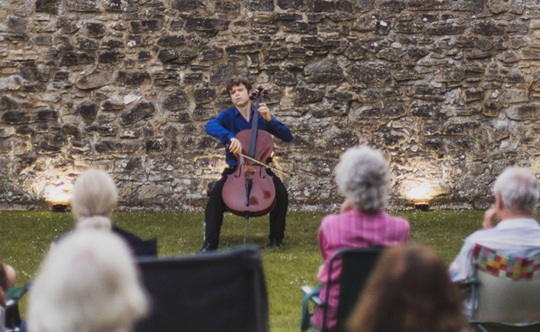
Bach – Suite No.2 in D minor for Solo Cello
Kodály – Sonata in B minor for Solo Cello
Two years ago, Rainer Crosett provided one of the highlights of the 2024 Festival with a cello recital, in growing light, at 6am on Midsummer Morning on the bank of the River Test: here, at 9pm, as the light faded, he played in front of the romantic ruins of Netley Abbey. In 2024 he began with Bach’s First Cello Suite; here he began with the Second. I hope he will continue the series, playing Bach in marvellous locations: though we will all – including Rainer – be a little older by the time he reaches No.6.
Rainer cannot avoid being poetic when he plays: he is one of those musicians with so fine a sensibility, so attuned to the music, that his extraordinary virtuosity is always an expression of this sensibility, never indulged for its own sake. In his hands the Prélude to Bach’s Second Suite was pensive, almost bare; as he made his way through the succeeding, predominantly minor-key dances – he characterised them vividly in his programme note – his playing reminded me of water flowing at changing speeds, making its way into crannies, gathering itself and flowing on again. The final Gigue – restless, as Rainer describes it – was athletic, gymnastic even, in its leaps and twirls; the abiding impression, though, was the sheer naturalness and expressivity of his playing.
Kodály’s Cello Sonata was unknown to me. Its half-hour length is a formidable challenge: in his note Rainer alludes to Luke Hsu’s stunning performance of Bartók’s Violin Sonata at the 2023 Festival, and it must surely rival that as a solo tour de force. As Rainer explained, Kodály’s is the earlier of the two, directly inspired by Hungarian folk music, whereas Bartók later transformed them into a new and personal musical language.
In its working out of sonata form the opening Allegro maestoso features a dramatic contrast between growling bass and plaintive treble: the lyrical second theme’s intervals make it sound more like a cry than a song, and the angularity of the music, the gap between treble and bass, suggests pain. It is almost as if there are two voices, two musics, that cannot meet each other: there is a sense of dislocation. This sense of fractured lyricism persists through the central Adagio: the music climbs slowly and wearily from deep bass to treble, and despite its attractiveness – there is a folk tune like birdsong – the sense of disconnection never disappears. Towards the end, the music sounds as if it is trapped in the bass and cannot get out: the movement expires on a high note, and three pizzicatos in the bass.
The finale was astounding. Varied, virtuosic, dazzling: so many techniques on display! Even here, in Rainer’s hands, there was a sense of unease: even the liveliest folk dances had a brittle quality. It was a phenomenal performance, recognised and celebrated by an audience that had listened to it spellbound as the light faded on the ruins above, behind and around our lone and much-admired solo cellist.
Janáček, Haydn, Brahms: Emma Roijackers, Laura Rickard, Ruslan Talas (violins), Anuschka Cidlinsky (viola), William Harris, Lydia Hillerudh (cellos), Emme Hensel (flute), Ziteng Fan (piano). Romsey Abbey, 26.5.2026.
Janáček – from On an Overgrown Path, arr. for string quartet
Haydn – Trio in G major, London Trio No.4
Brahms – Violin Sonata No.1 in G major, ‘Regenlied’
Romsey Abbey was again well populated for this concert, doing double duty as a Festival event and part of the Abbey’s regular series of Tuesday lunchtime recitals.
Seasoned RCMF players Emma and Laura were joined by violist Anuschka Cidlinsky and cellist William Harris for four short pieces arranged by Jarmil Burghauser for string quartet from Book I of Janáček’s sequence for piano, On an Overgrown Path. The sometimes-fragile essence of Janáček’s music was eloquently preserved in these arrangements: repeated phrases tug gently at the heartstrings; more animated passages achieve a raw intensity that seems to border on articulate speech. In the sympathetic hands of these four players the last piece, In Tears, achieved an ineffable tenderness.
Emma was joined by Emme Hensel and Lydia Hillerudh for what was, for me, a novelty – a Trio for flute, violin and cello written by Haydn during his time in London: delicious music on a domestic scale, reflecting Haydn’s enjoyment of London’s musical and social life.
The concert culminated in a performance of the first of Brahms’s three violin sonatas, in which his use of his earlier song Regenlied hints at nostalgia for a lost past – a past that includes suffering and bereavement – rather as Janáček’s piano pieces do: but the sonata as a whole is suffused with the warmth and pastoral character of the Violin Concerto and the Second Symphony, also composed at his idyllic retreat on the Wörthersee in Austria.
This warmth was very clear in violinist Ruslan Talas’s playing – sweet-toned, almost reticent at first, with a gentle lift to the rhythm – but with no loss of depth: in his hands the Adagio, launched expressively by Ziteng Fan’s piano, became a sombre journey, balancing bleakness and fervour, towards the distant goal of a major-key ending. The finale, too, had a very Brahmsian beauty, poised between serenity and something like grief.
Ravel, Takemitsu, Haydn, Grainger, Debussy: Joanna Lam, Sofia Sacco, Ziten Fang (piano), Luke Hsu, Laura Rickard, Ruslan Talas, Emma Roijackers (violins), Kyungsik Shin (viola), William Harris, Rainer Crosett, Lydia Hillerudh (cellos). URC Church, Romsey, 28.5.2026.
Ravel – Jeux d’eau
Tōru Takemitsu – Between Tides
Haydn – String Quartet in D, Op.64 No.5: ‘The Lark’ (finale)
Grainger – Molly on the Shore (arr. for string quartet)
Debussy – La mer (arr. Sally Beamish for piano trio)
This imaginatively devised concert took its title from Takemitsu’s Between Tides: and the performances were as bracing, refreshing and invigorating as if we were by the sea itself. Joanna Lam’s performance of Ravel’s Jeux d’eau was the perfect opener: her fingerwork rippling almost to the point of liquidity, delicacy, and a superb sense of drama as she built to the central climax. Ravishing playing from a participant in the Festival’s Young Artists Programme.
Takemitsu’s Between Tides could not have had a better advocate than cellist William Harris (also a participant in the Young Artists Programme), who explained that the music concerns not the sea’s movement in time but ‘the charged stillness between ebb and flow…image, not story’. Water was a constant source of inspiration for Takemitsu, as many of his pieces’ titles suggest; and so were dreams. I remember a critic suggesting that the Japanese composer had music going on in his head the whole time; now and then, when he felt like it, he cut a length of it for performance (which may be a way of saying that you never know when his music is going to stop).
William was joined by Luke Hsu on violin and Sofia Sacco – also a participant in the Young Artists Programme – on piano. Their playing was acutely responsive to the music’s atmosphere, like an extended meditation, or a dream; sometimes with an almost Webernian spareness, hovering on the edge of silence, sometimes as if they were stretching the music out as far as it would go. For an audience – well, for me (it might just be me being cloth-eared) – there is no discernible shape: and towards the end of its 20 minutes or so some of RCMF’s famously loyal and receptive audience may have been wondering where it was going. It seemed, though, that the sea came in strongly just before the close. The performance, an impressive feat of concentration, was very warmly received.
With consummate artistic sense, Laura then offered us two ‘lollipops’ (as Beecham would have called them) before the interval: the buoyant finale of Haydn’s ‘Lark’ Quartet, and Percy Grainger’s brilliant arrangement of Molly on the Shore for string quartet (the Haydn shoehorned ingeniously into the marine theme by virtue of the fact that it resembles a Hornpipe). Lovely playing of both pieces – light, agile, rhythms infectiously pointed – by Laura, Ruslan Talas, Kyungsik Shin and Rainer Crosett.
When Sally Beamish was asked to arrange Debussy’s La mer for piano trio (on the face of it, almost as unlikely as the arrangement a musical friend found in a second-hand shop of the 1812 Overture for solo viola) she wisely chose not to transcribe it – which would have kept the texture continuously dense and all three players unrelievedly busy – but to distil it, using all the tricks the players are capable of. Inevitably, the piano is entrusted with the lion’s share of the music’s colours and harmonic movement, but the violin and cello are called upon to perform astonishing feats of virtuosity and ingenuity.
Beamish’s arrangement was played a few years ago in the Turner Sims by the Fidelio Trio: all I can say is that I found this performance by Emma Roijackers, Lydia Hillerudh and Ziteng Fan much more convincing – immersive, even: the acoustic certainly helped, but as so often in RCMF we in the audience found ourselves engulfed by intense, totally committed music-making. For me, as I expect for others, the performance left shockwaves that had Debussy (and Beamish) echoing in my head long after the music’s physical tide had ebbed.
Chris Kettle