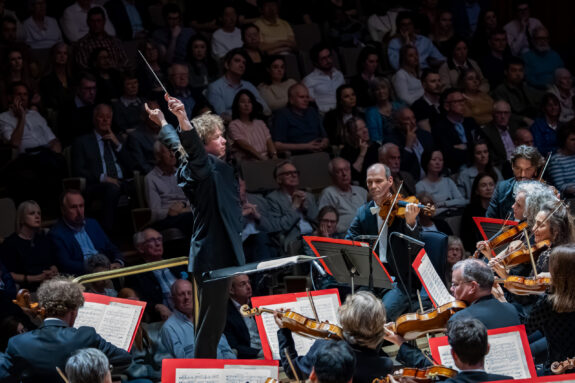
 United Kingdom Richard Strauss: Benjamin Grosvenor (piano), Philharmonia Orchestra / Santtu-Matias Rouvali (conductor). Royal Festival Hall, London, 4.6.2026. (AV-E)
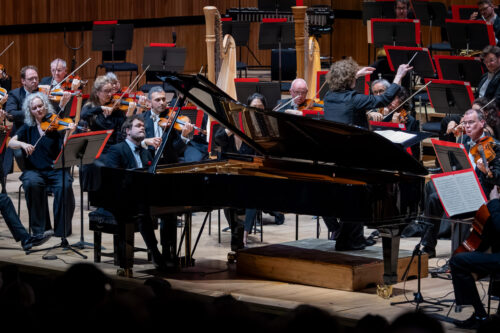
Richard Strauss – Don Juan, Op.20; Burleske in D minor for piano and orchestra; Symphonia domestica, Op.53; Rosenkavalier Waltzes – First Sequence 1909-1910
On 19 October 1947, the 83-year-old Richard Strauss conducted the Philharmonia Orchestra at the Royal Albert Hall in a concert which was recreated this evening to mark the final concert of their 80th Birthday Season, under the header: Santtu conducts a Strauss extravaganza. In introductory remarks, Thorben Dittes, the Philharmonia’s Chief Executive, and James Buckle, Principal Bass Trombone and President of the Orchestra, revealed that Strauss’s Symphonia domestica was the first work the suave Santtu-Matias Rouvali ever conducted; thus accounting for the authority and affection with which such a scrupulous serving of the score was shaped.
In Don Juan, rather unusually, Rouvali set the music in a state of poised restraint, of tightly coiled energy, maintaining majestic control over its shifting tempi and lyrical spans, moving between ardent surges and more reflective unfolding without ever losing structural poise.
In the more reflective passages, Rouvali’s Celibidache-inflected approach brought a sense of distillation rather than sluggishness, the music retaining its lingering line and taut tension even in more spaciously paced passages. The Philharmonia responded with clarity and brilliance, charged with a palpable sense of heightened energy and expressive momentum.
In the boisterous Burleske, Benjamin Grosvenor met Strauss’s formidable demands with fire and force, playing with a rhythmic retribution against the snappy timpani interjections. The timpani function as a central thematic framing device — a conversational counterpart to the piano across the entire composition, acting as a quasi-soloist. The timpanist was spot-on tonight.
I found the orchestration to be crude, brash and boorish (to put it mildly) and it remains decidedly substandard Strauss — though I will likely be castigated for saying so.
Following the bombastic Burleske, Grosvenor offered us Strauss’s Morgen! Op.27, No.4, as a cooling-off encore, originally for voice and piano, in a solo piano transcription. Played with such serene sensitivity and melting melancholia, its studied stillness was an oasis of calm after the storm.
The still underrated Symphonia domestica unfolded as a continuous symphonic span, its three principal musical strands emerging with striking clarity: the father’s material firm and directional, the mother’s writing more lyrical and pliant, and the child’s music bright, immediate and disarmingly simple.
From the outset, Rouvali revealed the luxuriant richness of Strauss’s orchestration in all its sumptuous abundance. Intricate detail remained clearly audible even in the loudest passages, with the conductor carefully balancing the vast orchestral forces. The Philharmonia responded with precision and panache, exquisitely evoking the domestic bliss of the bourgeois household.
The Scherzo burst into life with rhythmic buoyancy and sharply etched articulation, animated by contrast and impulse. Sudden dynamic shifts and flickering exchanges were projected with clarity within a seamless continuity, the orchestral textures remaining light and transparent even at their busiest.
In the cradle-song episode, Rouvali’s control of atmospheric nuance was finely judged. Hushed lyricism shaped the phrases, unfolding with poise and restraint, while clock chimes rang through the texture with quite crystalline precision. An almost chamber-like delicacy permeated the scoring, lending the passage eloquent stillness without becoming stilted.
The Adagio broadened into a more contemplative space, moving from introspection into richer orchestral writing. Long lines were shaped with patience and inevitability, harmonic shifts and instrumental colour fully exposed, while the nocturnal atmosphere deepened without blurring the orchestral detail.
Rouvali maintained total control across the work, balancing the vast orchestral forces with remarkable clarity and preserving a continuous sense of narrative flow. Even in the densest writing, the Philharmonia’s detail remained lucid, reduced scoring revealing an almost chamber-like intimacy within the larger orchestral fabric.
The Finale unfolded with impressive architectural foresight, its contrapuntal web articulated with crisp, linear purpose. Rouvali navigated the hazardous terrain of the double-fugue with organic ease, sustaining momentum without sacrificing inner voice detail or structural symmetry. He calibrated the shifting planes of harmonic tension with meticulous care, ensuring the dense brass and percussive thematic materials did not obscure the intricacy of the woodwinds, allowing the disparate musical threads to coalesce into a unified whole.
The incisive timpanist played with such commanding fury that one of his sticks took flight, but he recovered seamlessly, seizing a backup for his next attack. As the music drove headlong towards its blazing conclusion, the closing brass erupted with ferocious intensity.
The final orchestral flourish brought tears to my eyes as the engulfing concluding chords cascaded through the hall to a well-earned standing ovation.
For this restorative reviewer, the Symphonia domestica stands alongside Elektra as Strauss’s supreme achievement in orchestration — a preposterous proposition for steadfast Straussians, but one that this revelatory performance made seem entirely self-evident. Sadly, the Symphonia domestica is rarely heard in concert and needs to be performed much more often, which would no doubt enhance its status within the Richard Strauss canon.
On CD, I strongly recommend Charles Munch’s Symphonia domestica recently unearthed 1959 live stereo broadcast with the Boston Symphony Orchestra, available on Pristine Classical (PASC568). Andrew Rose’s XR remastering from my tape originating from The Nate Brown Western Sound Archive Collection 1930-1981.
Alexander Verney-Elliott
Featured Image: Santtu-Matias Rouvali conducts the Philharmonia Orchestra © Marc Gascoigne