 Germany Nino Rota, Il cappello di paglia di Firenze (Der Florentiner Hut / The Italian Straw Hat): Soloists, Saxon State Opera Chorus and Orchestra / Daniele Squeo (conductor). Semperoper Dresden, 31.5.2026. (MC)
Prolific Milanese composer Nino Rota (1911-1979) was renowned for writing over 170 film scores. Successful by some distance were his collaborations with renowned directors such as Federico Fellini, Luchino Visconti, Franco Zeffirelli, and notably his multi-award-winning scores for Francis Ford Coppola’s The Godfather films. Rota’s success with film music overshadows his output in other genres such as his ten operas with Il cappello di paglia di Firenze as the third. Rota’s Il cappello di paglia di Firenze is translated into German as Der Florentiner Hut and into English as The Florentine Straw Hat or more usually as The Italian Straw Hat.
This wasn’t an opera I knew. When it first came to my attention, I had to admit the title The Italian Straw Hat was rather off-putting as it seemed trifling and reminded me of children’s opera such as The Adventures of Pinocchio, Hansel and Gretel and Alice’s Adventures in Wonderland. What Rota had written was a top quality Farsa musicale or musical comedy. In the original Italian the libretto was a family affair a collaboration between Nino Rota and his mother Ernesta Rota Rinaldi, an adaptation of the successful farce Un chapeau de paille d’Italie (1851) by playwright Eugène Labiche and Marc Michel.
To my ears Rota’s The Italian Straw Hat is a parody with nods to both Rossini and Donizetti and I also hear Puccini and others. Tenor Piotr Buszewski (who played the leading role Fadinard at this production’s premieres both in Graz and here at Dresden) has described the comic opera as ‘a nice combination between bel canto and movie’ describing how for singers Rota ‘used the tradition of Italian opera to write for the voice’. Set in 1850s Paris, although the libretto might appear light, it is clever, delightful and amusing. Basically, Fadinard and Elena are to marry. On their wedding day his horse has eaten a Florentine straw hat belonging to Anaide a lady out with her officer lover Emilio as they frolicked in the bushes. Without her precious hat Anaide won’t risk returning home to her jealous husband Beaupertuis. She will not rest until Fadinard replaces the hat. The shenanigans continue at a breathless pace as Fadinard rushes across Paris in search of a replacement Florentine straw hat. Not an easy task as a Florentine straw hat is distinctively manufactured using high quality materials and according to renowned milliner Beate Pawolka at that time the hat was an expensive ‘status symbol’.
Although completed by Rota in 1945 at the end of WW2 it was a decade before The Italian Straw Hat received its premiere, given at the Teatro Massimo, Palermo. I notice that in 2021 with Opera Graz that Daniele Squeo conducted a studio recording of The Italian Straw Hat with Piotr Buszewski as Fadinard for the Capriccio label. For his first Semperoper production this was Bernd Mottl’s staging of The Italian Straw Hat, a co-production with Opera Graz first given in May 2023, and I was at its Dresden premiere.
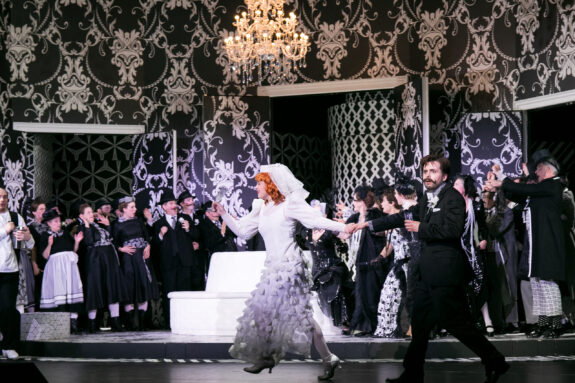
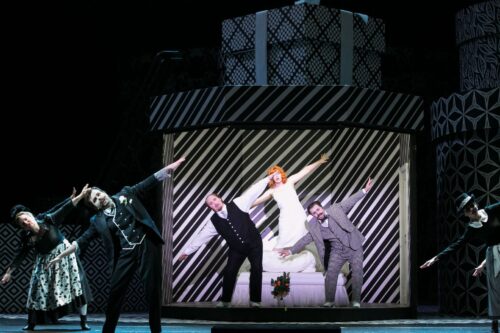
Explained in a directorial note Mottl and his design team decided to employ ‘a nostalgic black-and-white aesthetic’ believing that ‘focusing on patterns and silhouettes allows us to highlight the distinct personalities of the characters even more effectively’. Given at a breathless pace clearly a lot of endeavour has gone into this madcap comedy romp, and everything worked extremely well.
Set and lighting designer Friedrich Eggert created a striking scene on a revolving stage filled with oversized hat and gift boxes, some topped with bows and all decorated in black-and-white art deco-style fabrics. At times I did find the various designs rather dizzying, but likely that’s just me. Several boxes had lids that opened partially or fully. Among the most memorable images was a half-open box containing a group of seamstresses sewing a giant straw hat and also the antics inside a square box which held a toilet and wash basin.
Alfred Mayerhofer was the costume designer who kept to the black and white comedy theme of the hat boxes, such as piano key designs on the front of women’s black tunics, black suits with white piping and vice versa, white night shirts and bed caps, black and white gendarmerie uniforms with flat round hats (kepis), Elena’s white wedding dress with its bobbled skirt while the Baroness de Champigny looked like a version of the villainous Cruella de Vil from the Disney films. Bucking the black and white trend was the copper/red hair colour of both Elena and Anaide.
Congratulations to the Semperoper for assembling such an outstanding cast. It would be an understatement to say Polish tenor Piotr Buszewski excelled in the leading role of bridegroom Fadinard, he was terrific. As the confident man about town his splendid voice, acting prowess and reserves of energy were a potent combination. Buszewski with his attractive voice, clarity of enunciation and well achieved high notes was perfect for the role of Fadinard. Spanish soprano Rosalia Cid stood out as the put-upon bride Elena with her copper-coloured hair she almost permanently wore her comedy wedding dress. This was an assured performance by Cid whose singing and acting were displayed to a high standard.
I thought Austrian bass-baritone Alexander Grassauer was marvellous in the role of Nonancourt, Elena’s father. He is the man the audience will remember for wearing new, ill-fitting shoes before swapping them for a pair that fitted. Such a splendid comedy actor with a big personality he made much of the role and his sonorous voice was ideal.
Valerie Eickhoff took the role of Anaide, the pain in the neck lady, who was having a fling with her lover officer Emilio. A first-class performer the German mezzo-soprano was straight into Anaide’s character without any noticeable difficulty. The amorous Police officer Emilio was taken by the Ukrainian baritone Danylo Matviienko who revealed his smooth and secure voice combined with splendid comedy ability. American mezzo-soprano Maire Therese Carmack clearly relished the madcap role of Baroness de Champigny, that Cruella de Vil look-a-like. A highly committed performer with an unforced stage presence Carmack’s strong, dark and weighty voice suited the role to a tee.
Undoubtedly well-drilled by Jonathan Becker the Saxon State Opera Chorus added to the success of the production. The Saxon State Opera Orchestra, more usually known in the UK as the Staatskapelle Dresden, was in sterling form and under conductor Daniele Squeo didn’t put a foot wrong.
At Dresden a first class cast and performance together with its witty libretto and Bernd Mottl’s creative team produced an uplifting and glorious production.
Michael Cookson
Featured Image: Piotr Buszewski (Fadinard) and Rosalia Cid (Elena) © Mark Schulze Steinen
Production:
Stage director – Bernd Mottl
Set and Lighting design – Friedrich Eggert
Costume design – Alfred Mayerhofer
Choral rehearsal – Jonathan Becker
Dramaturgy – Marlene Hahn, Dorothee Harpain
Cast:
Fadinard – Piotr Buszewski
Nonancourt – Alexander Grassauer
Baroness de Champigny – Maire Therese Carmack
Elena – Rosalia Cid
Beaupertuis – Neven Crnić
Anaide – Valerie Eickhoff
Emilio – Danylo Matviienko
Uncle Vézinet – Florian Stern
Milliner – Dalia Medovnikov
Corporal – Martin-Jan Nijhof
Servant– Jongwoo Hong
Achille di Rosalba – Gerald Hupach
Minardi (violin virtuoso) – Florian Mayer